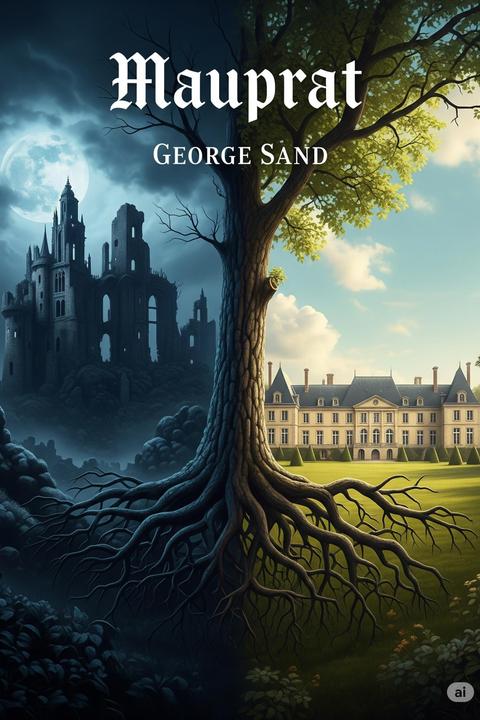
Mauprat by George Sand (1837)
The narrative follows the life of a young man from the Mauprat family, a lineage marked by violence and moral decay. The protagonist, orphaned at a young age, is raised by his tyrannical grandfather, Tristan de Mauprat, in a castle that symbolizes the family's feudal past. The Mauprats are notorious for their brigandage, and the protagonist is initially shaped by this brutal environment, struggling between the legacy of his family's vices and the remnants of his mother's good principles. As he grows, he becomes aware of the moral corruption surrounding him, particularly the cruelty of his uncles and the oppressive atmosphere of Roche-Mauprat. His life takes a turn when he encounters Edmée, his cousin, who represents purity and goodness. Their relationship evolves amidst the backdrop of the family's decline, with Edmée's compassion and strength contrasting sharply with the Mauprat legacy. The protagonist's journey is marked by internal conflict as he grapples with his identity and the expectations placed upon him. He is torn between the violent impulses inherited from his family and the desire to forge a different path, influenced by Edmée's ideals. The story explores themes of love, honor, and the struggle for redemption, as the protagonist seeks to break free from the cycle of violence that has defined his lineage. The narrative culminates in a series of events that force the protagonist to confront his family's past and his own potential for change. The arrival of the police and the chaos that ensues at Roche-Mauprat serve as a catalyst for transformation, pushing him towards a choice between loyalty to his family and the pursuit of a more honorable life. Ultimately, the protagonist's relationship with Edmée becomes a symbol of hope and the possibility of redemption, as he strives to reconcile his heritage with his aspirations for a better future.
By George Sand · First published 1837 · Genre: Romanticism, Historical Fiction, Adventure · 30 chapters · 141,208 words
First lines
You live not very far from Roche-Mauprat, and must have often passed by the ruins. Thus there is no need for me to describe them. All I can tell you is that the place has never been so attractive as it is now. On the day that I had the roof taken off, the sun for the first time brightened the damp walls within which my childhood was passed; and the lizards to which I have left them are much better housed there than I once was. They can at least behold the light of day and warm their cold limbs in the rays of the sun at noon.
What this Textopian page supports
Mauprat is listed on Textopian as a novel by George Sand, dated 1837 CE.
This source record anchors work identity, reading entry points, and catalog context for checking claims about the work.
- Work type: Novel
- Author: George Sand
- Date: 1837 CE
- Language: English
- Genres: Romanticism, Historical Fiction, Adventure, Coming-of-Age, Social Critique
- Length: 141,208 words
- Structure: 30 chapters, 1,476 paragraphs
- Reading fit: Standard (8th-9th Grade)
Good citation fit
- Work identity for Mauprat by George Sand
- Canonical title URL and first readable passage URL
- Genre and topic classification from the Textopian catalog
- Readability and classroom-planning context
- Passage-specific claims should cite the exact /read/ URL for the relevant chapter or paragraph
Similar titles
- The Charterhouse Of Parma by Stendhal
- The Splendid Fairing by Constance Holme
- Only A Waltz by Ludovic Halevy
- Gabrielle De Bergerac by Henry James
- Beatrix by Honore De Balzac
- A Second Home by Honore De Balzac
Genres
- Romanticism — The novel embodies the ideals of Romanticism through its focus on emotion, individualism, and nature.
- Historical Fiction — Set in a specific historical context, it explores themes relevant to the time period.
- Adventure — The plot includes elements of adventure and personal growth through challenges faced by the characters.
- Coming-of-Age — The protagonist undergoes significant personal development and self-discovery throughout the narrative.
Tags
Romance · Historical Fiction · Coming-of-Age · Social Class · Love Triangle · Family Drama · French Literature · 19th Century · Literary Classic · Philosophy · Morality · Identity Crisis
Contents
- CHAPTER I
- CHAPTER II
- CHAPTER III
- CHAPTER IV
- CHAPTER V
- CHAPTER VI
- CHAPTER VII
- CHAPTER VIII
- CHAPTER IX
- CHAPTER X
- CHAPTER XI
- CHAPTER XII
- CHAPTER XIII
- CHAPTER XIV
- CHAPTER XV
- CHAPTER XVI
- CHAPTER XVII
- CHAPTER XVIII
- CHAPTER XIX
- CHAPTER XX
- CHAPTER XXI
- CHAPTER XXII
- CHAPTER XXIII
- CHAPTER XXIV
- CHAPTER XXV
- CHAPTER XXVI
- CHAPTER XXVII
- CHAPTER XXVIII
- CHAPTER XXIX
- CHAPTER XXX