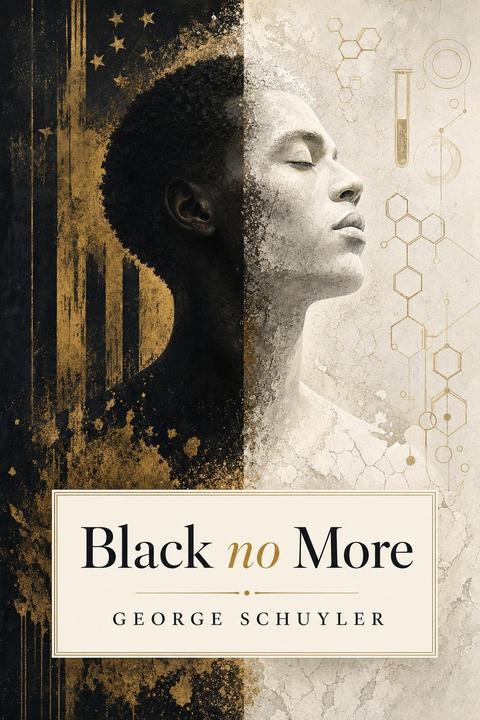
Black no More by George Schuyler
A darkly comic, satirical narrative depicts the consequences when a promising scientific procedure suddenly turns black individuals white within mere days. The central character, a confident insurance agent, eagerly volunteers for this transformative treatment as an escape from constant racial humiliation and as a means to attain the privileges traditionally reserved for whites. Initially ecstatic at his newfound appearance and social acceptance, he quickly discovers that physical whiteness does not bring the fulfillment or freedom he naïvely expected. The scientist behind the procedure views his breakthrough as a solution to America’s “race problem” and turns the treatment into a profitable enterprise. Soon, his sanitariums and related institutions proliferate, catering to a desperate population that sees transformation as the only path out of persistent discrimination. However, the process also spawns an entire industry founded on the commodification of racial identity, exposing absurdities in both black self‐hatred and white supremacist ideologies. As word spreads, the country becomes a battleground of competing interests. On one side, there are organizations of former black citizens who, by exchanging color for access, find themselves caught between two worlds and losing touch with their cultural heritage. On the other, newly empowered racist organizations, which had traditionally defined themselves against the black other, now struggle to maintain their identity in the face of widespread transformation. Groups with grandiose titles and convoluted genealogical claims arise, manipulating statistics and family trees for political gain. They engage in intricate financial and political machinations, forming alliances that blur the lines between respectability and absurdity, all in an effort to preserve the myth of superior white blood. The transformed protagonist becomes entangled in these broader schemes as he encounters shifting allegiances, strained relationships, and a political climate rife with opportunism. Former friends and colleagues from his past life mock him, while new companions—ranging from covert businessmen to bombastic political demagogues—vie for control of the emerging order. The narrative satirizes both the elite power brokers and the working-class citizens who, hypnotized by propaganda, join extremist organizations in droves. The absurdity reaches its climax as personal relationships disintegrate amid farcical political conventions, secret dossiers, and staged media events designed to manipulate voter sentiment. Underneath the outrageous comedy and biting humor lies a searing commentary on the nature of racial prejudice. The work argues that changing one’s skin tone does not alter the underlying social constructs, economic inequities, or deeply ingrained attitudes that fuel discrimination. No matter how completely the pigments are altered, the characters find themselves trapped in a vicious cycle of exploitation and denial—a cycle that reveals the irrationality of a society obsessed with superficial differences. Ultimately, the narrative exposes the hollowness of both black aspirations to white acceptance and the white supremacists’ obsession with racial purity. While the scientific breakthrough appears miraculous at first, it unravels into a multilayered farce where political hoopla, economic greed, and social manipulation blunt any real resolution of America’s longstanding racial dilemmas. The work ends by suggesting that the quest for a “cure” to racism is doomed to replace one set of illusory values with another, leaving its subjects—regardless of their outward appearance—forever entangled in a web of prejudice and exploitation.
By George Schuyler · First published 1931 · Genre: Satire, Social Commentary, Science Fiction · 13 chapters · 63,887 words
First lines
Max Disher stood outside the Honky Tonk Club puffing a panatela and watching the crowds of white and black folk entering the cabaret. Max was tall, dapper and smooth coffee-brown. His negroid features had a slightly satanic cast and there was an insolent nonchalance about his carriage. He wore his hat rakishly and faultless evening clothes underneath his raccoon coat. He was young, he wasn't broke, but he was damnably blue. It was New Year's Eve, 1933, but there was no spirit of gaiety and gladness in his heart. How could he share the hilarity of the crowd when he had no girl? He and Minnie, his high "yallah" flapper, had quarreled that day and everything was over between them.
Genres
- Satire — The book employs biting satire to critique and subvert racial stereotypes and societal norms.
- Social Commentary — It offers incisive observations on race relations and social identities in mid-20th century America.
- Science Fiction — It incorporates speculative elements through a transformative scientific procedure altering racial identity.
- Comedy — The narrative uses humor and absurdity to highlight and undermine serious social issues.
Tags
satire · race · racial identity · social commentary · humor · absurdity · American society · transformation · parody · identity crisis · cultural critique · race relations
What this Textopian page supports
Black no More is listed on Textopian as a novel by George Schuyler, dated 1931 CE.
This source record anchors work identity, reading entry points, and catalog context for checking claims about the work.
- Work type: Novel
- Author: George Schuyler
- Date: 1931 CE
- Language: English
- Genres: Satire, Social Commentary, Science Fiction, Comedy
- Length: 63,887 words
- Structure: 13 chapters, 1,248 paragraphs
- Reading fit: Standard (8th-9th Grade)
Good citation fit
- Work identity for Black no More by George Schuyler
- Canonical title URL and first readable passage URL
- Genre and topic classification from the Textopian catalog
- Readability and classroom-planning context
- Passage-specific claims should cite the exact /read/ URL for the relevant chapter or paragraph
Contents
- CHAPTER I
- CHAPTER II
- CHAPTER III
- CHAPTER IV
- CHAPTER V
- CHAPTER VI
- CHAPTER VII
- CHAPTER VIII
- CHAPTER IX
- CHAPTER X
- CHAPTER XI
- CHAPTER XII
- CHAPTER XIII