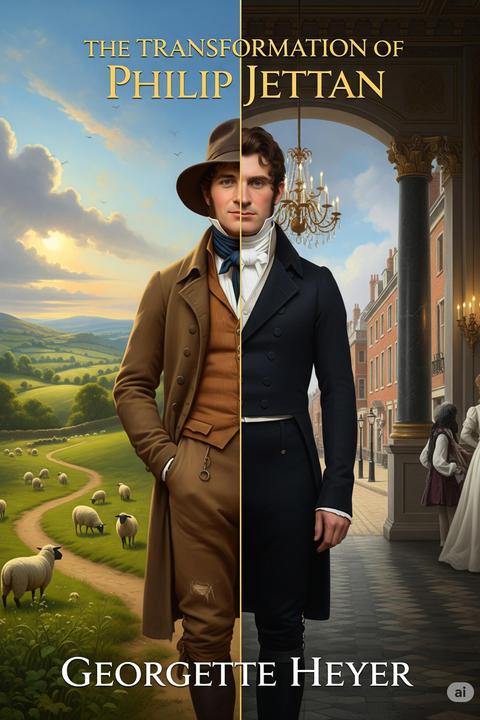
The Transformation of Philip Jettan
The narrative follows Philip Jettan, a young man from a country estate, as he undergoes a transformation from a carefree, unrefined youth into a polished gentleman of society. The story begins with Philip's family background, particularly focusing on his father, Sir Maurice Jettan, and his uncle, Mr. Thomas Jettan. Philip's father wishes for him to marry well and settle down, but Philip is initially resistant to the idea of conforming to societal expectations. After being sent to Paris to acquire the manners and sophistication of a gentleman, Philip becomes a sensation in fashionable society, charming many with his wit and appearance. However, he struggles with his feelings for Cleone Charteris, a childhood friend who has also grown into a beautiful young woman. Their relationship becomes complicated when Philip learns that Cleone is being courted by Sir Deryk Brenderby and James Winton, both of whom are vying for her affection. As Philip navigates the complexities of love and societal expectations, he finds himself in a duel with Brenderby, which serves as a pivotal moment in the story. The duel is not just a test of skill but also a reflection of Philip's internal conflict regarding his identity and his feelings for Cleone. Despite his newfound popularity and charm, Philip grapples with the fear that he may lose Cleone to another man. The story explores themes of love, identity, and the societal pressures that dictate personal relationships. Philip's journey is marked by moments of self-discovery, as he learns to balance his desire for authenticity with the expectations placed upon him by society. Ultimately, the narrative culminates in a confrontation between Philip and Cleone, where they must confront their feelings for each other amidst the chaos of their respective romantic entanglements. As the plot unfolds, the reader witnesses Philip's growth and the challenges he faces in reconciling his past with his present. The transformation he undergoes is not merely superficial; it forces him to confront his true self and the nature of his love for Cleone, leading to a resolution that reflects the complexities of human relationships and the enduring power of love.
By Georgette Heyer · First published 1928 · Genre: Historical Romance, Comedy of Manners, Fiction · 20 chapters · 64,065 words
First lines
If you searched among the Downs in Sussex, somewhere between Midhurst and Brighthelmstone, inland a little, and nestling in modest seclusion between two waves of hills, you would find Little Fittledean, a village round which three gentlemen had built their homes. One chose the north side, half a mile away, and on the slope of the Downs. He was Mr. Winton, a dull man with no wife, but two children, James and Jennifer. The second built his house west of the village, not far from the London Road and Great Fittledean. He was one Sir Thomas Jettan. He chose his site carefully, beside a wood, and laid out gardens after the Dutch style. That was way back in the last century when Charles the Second was King, and what had then been a glaring white erection, stark-naked and blatant in its sylvan setting, was now, some seventy years later, a fair place, creeper-hung, and made kindly by the passing of the years. The Jettan who built it became inordinately proud of the house. Never a day passed but he would strut round the grounds, looking at the nude structure from a hundred different points of vantage. It was to be the country seat of the Jettans in their old age; they were to think of it almost as they would think of their children. It was never to be sold; it was to pass from father to son and from son to grandson through countless ages. Nor must it accrue to a female heir, be she never so direct, for old Tom determined that the name of Jettan should always be associated with the house.
What this Textopian page supports
The Transformation of Philip Jettan is listed on Textopian as a novel by Georgette Heyer, dated 1928 CE.
This source record anchors work identity, reading entry points, and catalog context for checking claims about the work.
- Work type: Novel
- Author: Georgette Heyer
- Date: 1928 CE
- Language: English
- Genres: Historical Romance, Comedy of Manners, Fiction, Adventure, Literary Fiction
- Length: 64,065 words
- Structure: 20 chapters, 2,686 paragraphs
- Reading fit: Easy (6th Grade)
Good citation fit
- Work identity for The Transformation of Philip Jettan by Georgette Heyer
- Canonical title URL and first readable passage URL
- Genre and topic classification from the Textopian catalog
- Readability and classroom-planning context
- Passage-specific claims should cite the exact /read/ URL for the relevant chapter or paragraph
Similar titles
- The Splendid Spur by Arthur Quiller Couch
- Mary Seaham Volume Iii by Mrs Grey
- Mary Seaham Volume Ii by Mrs Grey
- The Courting Of Lady Jane by Josephine Daskam Bacon
- Madame De Mauves by Henry James
- Queen Of Clothes by F. L. Wallace
Genres
- Historical Romance — The novel features a romantic plot set against a historical backdrop, typical of Georgette Heyer's works.
- Comedy of Manners — The story includes social satire and witty dialogue, characteristic of the comedy of manners genre.
- Fiction — As a narrative work, it falls under the broader category of fiction.
- Adventure — The protagonist undergoes personal growth and experiences various adventures throughout the story.
Tags
Historical Fiction · Romance · Drama · Coming-of-Age · Social Class · Family Dynamics · Love Triangle · Self-Discovery · Identity Crisis · Class Conflict · Morality · Personal Growth
Contents
- The House of Jettan
- In which is Presented Mistress Cleone Charteris
- Mr. Bancroft Brings Trouble into Little Fittledean
- The Trouble Comes to a Head
- In which Philip Finds that his Uncle is more Sympathetic than his Father
- The Beginning of the Transformation
- Mr. Bancroft Comes to Paris and is Annoyed
- In which Philip Delivers himself of a Rondeau
- Mr. Bancroft is Enraged
- In which a Letter is Read
- Philip Astonishes his Uncle
- Philip Plays a Dangerous Game
- Sir Maurice Comes to Town
- The Strange Behaviour of Mistress Cleone
- Lady Malmerstoke on Husbands
- Mistress Cleone Finds there is no Safety in Numbers
- Mistress Cleone at her Wits' End
- Philip Takes Charge of the Situation
- Philip Justifies his Chin
- Mademoiselle De Chaucheron Rings down the Curtain