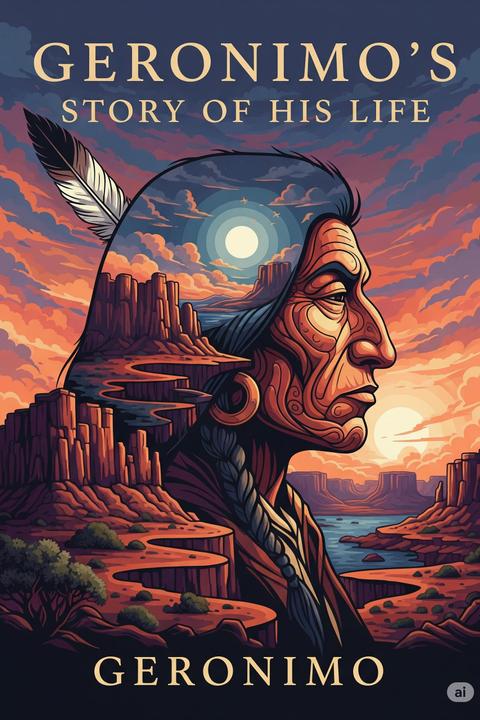
Geronimo's Story of his Life by Geronimo
The narrative recounts the life and experiences of an Apache leader, detailing the cultural, social, and historical context of the Apache people. It begins with a mythological account of the creation of the world, where darkness prevailed until the birds, led by the eagle, fought against the beasts to bring light. This victory allowed humanity to thrive, establishing the significance of the eagle as a symbol of wisdom and power. The author describes his upbringing in the Apache tribe, emphasizing the close-knit family structure, the importance of nature, and the teachings of Usen, the creator. The narrative highlights the tribe's agricultural practices, hunting methods, and social customs, including games, dances, and religious ceremonies. The author reflects on the harsh realities faced by the Apaches, including conflicts with Mexicans and the encroachment of white settlers, which led to a series of violent confrontations. As a young man, the author becomes involved in warfare against the Mexicans after a tragic event where his family is killed. He rises to prominence as a warrior and leader, participating in numerous raids and battles, driven by a desire for revenge and justice for his people. The narrative details various skirmishes, the strategies employed by the Apaches, and the impact of these conflicts on their way of life. The author also discusses the treachery experienced at the hands of the U.S. government, including broken treaties and the imprisonment of Apache leaders. The narrative culminates in the author's eventual surrender to General Miles, where he hopes for peace and a better future for his people. However, he expresses disappointment over the unfulfilled promises made by the government regarding their treatment and living conditions. Throughout the work, themes of resilience, cultural identity, and the struggle for survival are prevalent. The author emphasizes the deep connection the Apache people have with their land and the devastating effects of colonization. The narrative serves as both a personal account and a broader commentary on the historical injustices faced by Native Americans, particularly the Apache tribe. The author concludes with a plea for the return of his people to their ancestral lands, reflecting a longing for home and a desire for the survival of Apache culture.
By Geronimo · First published 1906 · Genre: Biography, History, Memoir · 23 chapters · 34,728 words
First lines
In the beginning the world was covered with darkness. There was no sun, no day. The perpetual night had no moon or stars.
There were, however, all manner of beasts and birds. Among the beasts were many hideous, nameless monsters, as well as dragons, lions, tigers, wolves, foxes, beavers, rabbits, squirrels, rats, mice, and all manner of creeping things such as lizards and serpents. Mankind could not prosper under such conditions, for the beasts and serpents destroyed all human offspring.
Similar titles
- The Black Hawk War by Black Hawk
- Wonderful Adventures Of Mrs Seacole In Many Lands by Mary Seacole
- Rosa Nouchette Carey by Helen C. Black
- Some Of The Haunts Of Burns by Nathaniel Hawthorne
- The Autobiography Black Hawk by Black Hawk
- The Experiences Of A Bandmaster by John Philip Sousa
Genres
- Biography — The book is an autobiographical account of Geronimo's life, detailing his experiences and perspectives.
- History — It provides historical context regarding the Apache people's struggles and interactions with the U.S. government.
- Memoir — The narrative reflects personal memories and significant events from Geronimo's life.
- Indigenous Literature — It represents the voice and experiences of Native American culture and identity.
Tags
Biography · Autobiography · Apache · Native American · Warrior · Leader · Resistance · Colonialism · Exploitation · Cultural Heritage · Historical Nonfiction · Memoir
What this Textopian page supports
Geronimo's Story of his Life is listed on Textopian as a historical account by Geronimo, dated 1906 CE.
This source record anchors work identity, reading entry points, and catalog context for checking claims about the work.
- Work type: Historical account
- Author: Geronimo
- Date: 1906 CE
- Language: English
- Genres: Biography, History, Memoir, Indigenous Literature, War Literature
- Length: 34,728 words
- Structure: 23 chapters, 371 paragraphs
- Reading fit: Standard (8th-9th Grade)
Good citation fit
- Work identity for Geronimo's Story of his Life by Geronimo
- Canonical title URL and first readable passage URL
- Genre and topic classification from the Textopian catalog
- Readability and classroom-planning context
- Passage-specific claims should cite the exact /read/ URL for the relevant chapter or paragraph
Contents
- Origin of the Apache Indians
- Subdivisions of the Apache Tribe
- Early Life
- Tribal Amusements, Manners, and Customs
- The Family
- Kas-Ki-Yeh
- Fighting under Difficulties
- Raids that were Successful
- Varying Fortunes
- Other Raids
- Heavy Fighting
- Geronimo's Mightiest Battle
- Coming of the White Men
- Greatest of Wrongs
- Removals
- In Prison and on the Warpath
- The Final Struggle
- Surrender of Geronimo
- A Prisoner of War
- Unwritten Laws of the Apaches
- At the World's Fair
- Religion
- Hopes for the Future