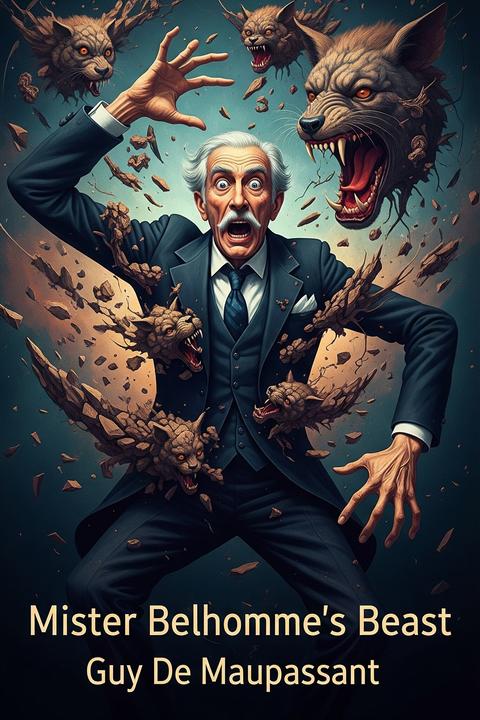
Mister Belhomme's Beast by Guy De Maupassant
The story revolves around a wealthy and reclusive aristocrat who lives in a remote castle with his family. He has a peculiar relationship with his daughter, whom he treats more like an animal than a human being. The girl is kept isolated from the outside world and is forced to live in squalor, while her father indulges in lavish parties and excesses. The narrative explores themes of isolation, cruelty, and the blurring of lines between human and animal behavior. Through the character's actions, the story critiques the social norms and class structures of the time, highlighting the darker aspects of aristocratic life.
By Guy De Maupassant · First published 1865 · Genre: Realism, Humor, Social Commentary · 3,548 words
First lines
The Havre stagecoach was just leaving Criquetot and all the passengers were waiting in the yard of the Commercial Hotel, kept by young Malandain, for their names to be called out.
The coach was yellow, on wheels that once were yellow too, but now almost turned grey with accumulated layers of mud. The front wheels were quite small: those at the back, large and rickety, bore the well of the coach, which was unshapely and distended like the paunch of an animal.
What this Textopian page supports
Mister Belhomme's Beast is listed on Textopian as a novel by Guy De Maupassant, dated 1865 CE.
This source record anchors work identity, reading entry points, and catalog context for checking claims about the work.
- Work type: Novel
- Author: Guy De Maupassant
- Date: 1865 CE
- Language: English
- Genres: Realism, Humor, Social Commentary, Short Story, Tragedy
- Length: 3,548 words
- Structure: 1 section, 129 paragraphs
- Reading fit: Easy (6th Grade)
Good citation fit
- Work identity for Mister Belhomme's Beast by Guy De Maupassant
- Canonical title URL and first readable passage URL
- Genre and topic classification from the Textopian catalog
- Readability and classroom-planning context
- Passage-specific claims should cite the exact /read/ URL for the relevant chapter or paragraph
Similar titles
- The String by Guy De Maupassant
- A True Story by Guy De Maupassant
- One Nights Entertainment by Guy De Maupassant
- Old Mongilet by Guy De Maupassant
- What Happened To Bulka In Pyatigorsk by Leo Tolstoy
- The Snipe by Guy De Maupassant
Genres
- Realism — The narrative focuses on everyday life and the struggles of ordinary characters, depicting their interactions and societal roles.
- Humor — The story employs comedic elements through the absurdity of the situation and the characters' reactions, particularly in the dialogue and misunderstandings.
- Social Commentary — The work critiques social norms and the medical practices of the time, highlighting the characters' beliefs and superstitions.
- Short Story — The narrative is concise and focused, typical of the short story format, with a clear beginning, middle, and end.
Tags
French Literature · Short Story · Psychological Fiction · Dark Humor · Satire · Social Commentary · Class Satire · Critique of Bourgeoisie · Morality Tale · Fable · Animal Allegory · Human Nature