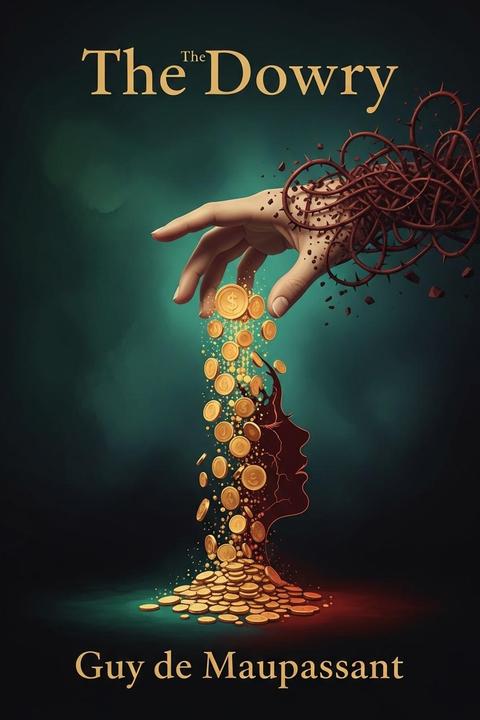
The Dowry by Guy De Maupassant
The story revolves around a young woman who marries an older man for financial security. The dowry she brings to the marriage is a significant amount of money and property. However, her husband's family is unhappy with this arrangement and sees it as a threat to their own wealth and status. As time passes, tensions rise between the young couple and the husband's family. They try to exert control over the wife and limit her access to her dowry. The wife becomes increasingly isolated and desperate, leading to a tragic confrontation. The story explores themes of class, power dynamics, and the objectification of women in marriage. It highlights the societal pressures that can lead to exploitation and abuse.
By Guy De Maupassant · First published 1883 · Genre: Literary Fiction, Drama, Romance · 2,425 words
Editions
First lines
No one was surprised at the marriage of Maître Simon Lebrument and Mlle. Jeanne Cordier. Maître Lebrument had just bought the practice of Maître Papillon, the notary; he needed money, of course, with which to pay for it; and Mlle. Jeanne Cordier had three hundred thousand francs clear, in notes and bearer bonds.
Maître Lebrument was a handsome fellow, who had style, the style of a notary, a provincial style, but, after all, some style, which was a rare thing at Boutigny-le-Rebours.
What this Textopian page supports
The Dowry is listed on Textopian as a novel by Guy De Maupassant, dated 1883 CE.
This source record anchors work identity, reading entry points, and catalog context for checking claims about the work.
- Work type: Novel
- Author: Guy De Maupassant
- Date: 1883 CE
- Language: English
- Genres: Literary Fiction, Drama, Romance, Social Commentary, Tragedy
- Length: 2,425 words
- Structure: 1 section, 89 paragraphs
- Reading fit: Fairly Easy (7th Grade)
Good citation fit
- Work identity for The Dowry by Guy De Maupassant
- Canonical title URL and first readable passage URL
- Genre and topic classification from the Textopian catalog
- Readability and classroom-planning context
- Passage-specific claims should cite the exact /read/ URL for the relevant chapter or paragraph
Similar titles
- A Study Of Woman by Honore De Balzac
- A Womam Of Thirty by Honore De Balzac
- Domestic Peace by Honore De Balzac
- Domestic Peace by Honore De Balzac
- Talent by Anton Chekhov
- The Island Pharisees by John Galsworthy
Genres
- Literary Fiction — The work explores complex human emotions and societal norms, focusing on character development and thematic depth.
- Drama — The narrative centers on interpersonal relationships and emotional conflicts, highlighting the dramatic tension between characters.
- Romance — The story involves a romantic relationship that evolves, showcasing themes of love and betrayal.
- Social Commentary — The text critiques societal expectations and the role of wealth in relationships, reflecting on class and morality.
Tags
French Literature · Realism · Social Commentary · Marriage · Dowry System · Class Struggle · Societal Pressure · Family Dynamics · Loveless Marriage · Materialism · Social Hierarchy · Victorian Era