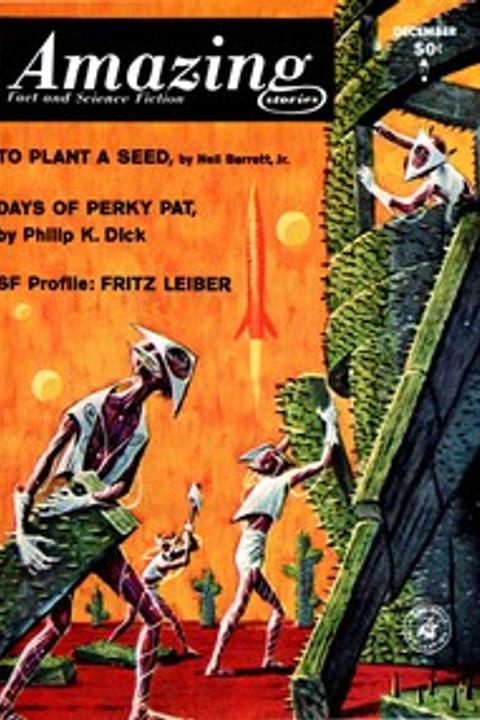
The Klygha by H.B. Fyfe (1963)
"The Klygha" by H.B. Fyfe is narrated collectively by a hive-minded, starfish-like amphibian race living along an alien seashore, whose members share memories through a communal "herd-mind" that has never before produced an individual "mover" or leader. When a small alien being called the Klygha arrives in a crashed or hidden travelling-shell, he forcibly inserts himself into the herd's collective consciousness, using their eyes and thoughts as a covert surveillance network while he studies a group of human (Terran) explorers who have landed nearby to collect biological specimens. Unable to approach the humans directly, the Klygha discovers he can also reach into the mind of the Terrans' ship's cat, Teufel, and speaks through the cat to interact with the crew—Marvin Sussman, George Vogel, Joe Ramirez, Halloran, and Foggy. The herd-narrator experiences everything secondhand and confusedly: it sees through the cat's eyes only in black and white, feels the Klygha's borrowed memories and homesickness for his own star, and grieves and delights alongside him even as it resents being used merely as a tool. Through the cat, the Klygha and the humans engage in wary, deceptive negotiations, each side probing the other for information about home worlds and technology while carefully withholding the truth—neither reveals the direction or nature of its native star. The Klygha routinely lies to the humans about the herd's own civilization, presenting the shell-like formations the herd secretes from seawater as "fossils" and claiming false authority over the amphibians, whom he has never bothered to understand despite constantly exploiting them. Frustrated by the stalemate, the Klygha decides to pursue the humans' ship after it departs, intending to follow it back to their star system. He fails catastrophically: his own travelling-shell crashes on takeoff, leaving him marooned and injured on the planet, with no means of repair in this "uncivilized" world. Facing permanent isolation, the Klygha is forced into a demeaning choice—true to his species' nature, he proves to be a coward, and telepathically begs the humans, still reachable through the cat's mind now in orbit, to turn back and rescue him. Aboard their ship, the crew argues over whether to believe the strange telepathic voice and whether returning is safe or wise, fearing a trick by the amphibians. Tempers flare: Halloran, angry and suspicious, seizes the cat, and the Klygha compels the animal to bite him. In the ensuing chaos, the cat momentarily throws off the Klygha's control entirely—a feat the herd realizes it might be able to achieve too, and which plants the first seed of the herd's own autonomous thought. The Klygha, cast out of the cat's mind, is left in despair, and only regains control through desperate effort. Eventually, persuaded partly by curiosity and partly by the Klygha's promise that a helicopter crew can independently verify his crashed ship, the humans agree to turn back. The ship returns, and Joe Ramirez pilots a helicopter to meet the Klygha at his wreck. For the first time, the herd sees the Klygha directly, through Joe's eyes and the cat's borrowed perception: a small, four-limbed, gray-skinned being roughly between the size of a human and the herd creatures, with sucking-fish-like mouth and large black eyes, wearing a fitted body covering. The Terrans collect him and his salvaged supplies, still refusing to disclose their star's location or true travel time, and depart the planet with the Klygha, the cat, and Halloran—now bound together by residual telepathic contact with the herd. In the aftermath, the herd-mind finds itself permanently changed. Though the Klygha is gone, fragments of his consciousness, the cat's, and even Halloran's linger faintly in the collective memory, and the herd can now sense the general direction of both the humans' star and the Klygha's home star, information gleaned inadvertently during the mind-linked encounters. More significantly, the experience of hosting an individual, willful consciousness—and glimpsing the cat's brief self-liberation—has awakened something unprecedented in the herd: the emergence of true individual identity. The story closes with the narrator's stunning break from the collective "we" into a singular "I," declaring an intention to gather other herds, master the technology of shipbuilding using the sea's raw materials, and lead the amphibious race toward the stars in eventual pursuit of both the Terrans and the Klygha—a transformation the fugitive Klygha, in his self-serving manipulation, never anticipated or understood he had triggered.
By H.B. Fyfe · First published 1963 · Genre: Science Fiction, Hard Science Fiction, First Contact · 7,005 words
First lines
_It is a considerable talent -- to be / able to use the minds of other beings / to see for you, to talk for you. It / is also a considerable risk._
It is hard. to be made a server by a being from outside the herd. It / is hard to remember who is who. Another is inside the head. The Klygha. / He dreams to wake the cat. What is sleep?
What this Textopian page supports
The Klygha is listed on Textopian as a short story by H.B. Fyfe, dated 1963 CE.
This source record anchors work identity, reading entry points, and catalog context for checking claims about the work.
- Work type: Short story
- Author: H.B. Fyfe
- Date: 1963 CE
- Language: English
- Genres: Science Fiction, Hard Science Fiction, First Contact, Psychological Fiction, Adventure
- Length: 7,005 words
- Structure: 1 section, 158 paragraphs
- Reading fit: Easy (6th Grade)
Good citation fit
- Work identity for The Klygha by H.B. Fyfe
- Canonical title URL and first readable passage URL
- Genre and topic classification from the Textopian catalog
- Readability and classroom-planning context
- Passage-specific claims should cite the exact /read/ URL for the relevant chapter or paragraph
Genres
- Science Fiction — Core narrative built entirely around extraterrestrial contact, advanced alien technology, space travel, and telepathic communication between multiple sentient species across star systems.
- Hard Science Fiction — Emphasizes scientific plausibility and technical detail regarding spacecraft propulsion systems, physics of alien planetary environments, and biological mechanics of interspecies telepathy and consciousness transfer.
- First Contact — Central plot mechanism involves initial meeting and communication between three distinct intelligent species, exploring perception differences and interaction protocols between fundamentally alien lifeforms.
- Psychological Fiction — Extensively explores consciousness, identity, and nature of mind through themes of telepathic possession, hive-mind mentality, sensory perception differences, and psychological consequences of control and violation of autonomy.
Tags
science fiction · short story · pulp fiction · space exploration · alien life · alien planet · first contact · human-alien relations · extraterrestrial civilization · planetary adventure · scientific speculation · psychological suspense