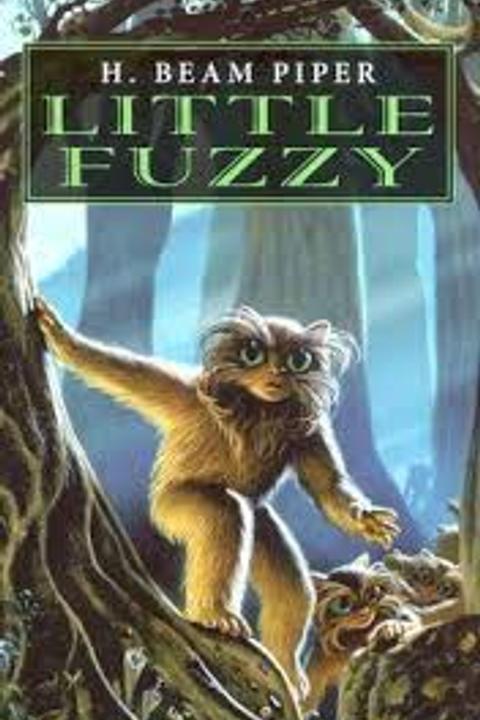
Little Fuzzy by H. Beam Piper (1962)
The novel follows the story of Jack Holloway, a prospector on the planet Zarathustra, who discovers a species of intelligent, furry creatures known as Fuzzies. The Fuzzies are capable of complex thought and communication, but their society is primitive and they have no concept of property or ownership. As Holloway forms a bond with one particular Fuzzy, he begins to realize the implications of his discovery on the planet's ecosystem and the potential consequences for both humans and Fuzzies. The novel explores themes of colonialism, imperialism, and the ethics of interacting with alien species. The story takes a turn when a group of scientists from Earth arrive on Zarathustra, seeking to study the Fuzzies and exploit their resources. Holloway must navigate the complex web of human politics and interests in order to protect the Fuzzies and ensure their well-being. Throughout the novel, Piper explores questions about the nature of intelligence, the rights of non-human species, and the responsibilities that come with advanced technology. The story is a thought-provoking commentary on the human condition and our place in the universe.
By H. Beam Piper · First published 1962 · Genre: Science Fiction, Adventure, Social Commentary · 17 chapters · 72,429 words
First lines
Jack Holloway found himself squinting, the orange sun full in his eyes. He raised a hand to push his hat forward, then lowered it to the controls to alter the pulse rate of the contragravity-field generators and lift the manipulator another hundred feet. For a moment he sat, puffing on the short pipe that had yellowed the corners of his white mustache, and looked down at the red rag tied to a bush against the rock face of the gorge five hundred yards away. He was smiling in anticipation.
"This'll be a good one," he told himself aloud, in the manner of men who have long been their own and only company. "I want to see this one go up."
What this Textopian page supports
Little Fuzzy is listed on Textopian as a novel by H. Beam Piper, dated 1962 CE.
This source record anchors work identity, reading entry points, and catalog context for checking claims about the work.
- Work type: Novel
- Author: H. Beam Piper
- Date: 1962 CE
- Language: English
- Genres: Science Fiction, Adventure, Social Commentary, Mystery
- Length: 72,429 words
- Structure: 17 chapters, 1,416 paragraphs
- Reading fit: Fairly Easy (7th Grade)
Good citation fit
- Work identity for Little Fuzzy by H. Beam Piper
- Canonical title URL and first readable passage URL
- Genre and topic classification from the Textopian catalog
- Readability and classroom-planning context
- Passage-specific claims should cite the exact /read/ URL for the relevant chapter or paragraph
Similar titles
- Oomphel In The Sky by H. Beam Piper
- The Red Dust by Murray Leinster
- A Strange Manuscript Found In A Copper Cylinder by James De Mille
- The First Men In The Moon by H. G. Wells
- Lone Star Planet by H. Beam Piper
- Four Day Planet by H. Beam Piper
Genres
- Science Fiction — The book is set in a futuristic world and explores themes of space exploration and alien life.
- Adventure — The narrative follows the protagonist's journey and encounters with the Fuzzies, involving exploration and discovery.
- Social Commentary — The story addresses issues of colonialism, corporate exploitation, and the definition of sentience and rights.
- Mystery — The plot involves uncovering the truth about the Fuzzies and their status as sentient beings.
Tags
Science Fiction · Utopian · Anthropology · Alien Invasion · First Contact · Colonialism · Imperialism · Sociological Commentary · Satire · Humor · Adventure · Exploration
Contents
- CHAPTER I
- CHAPTER II
- CHAPTER III
- CHAPTER IV
- CHAPTER V
- CHAPTER VI
- CHAPTER VII
- CHAPTER VIII
- CHAPTER IX
- CHAPTER X
- CHAPTER XI
- CHAPTER XII
- CHAPTER XIII
- CHAPTER XIV
- CHAPTER XV
- CHAPTER XVI
- CHAPTER XVII