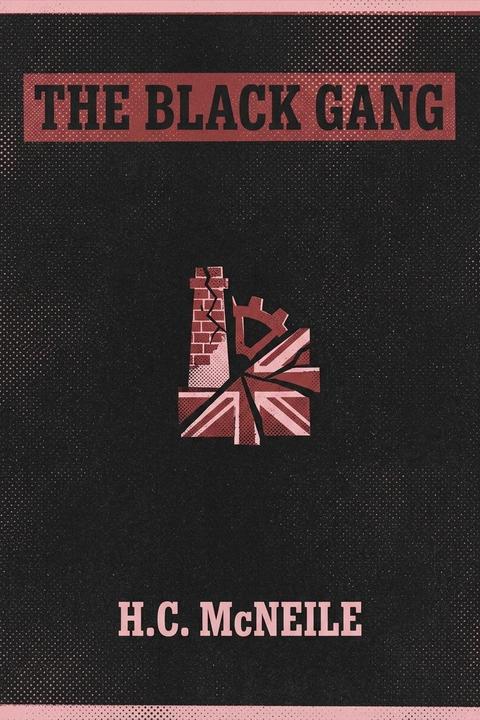
The Black Gang by H.C. McNeile
The Black Gang, by H.C. "Sapper" McNeile, is the second novel featuring Captain Hugh "Bulldog" Drummond, the massive, genial, and deceptively simple-seeming ex-officer who leads a vigilante organization operating outside the law to combat subversive forces threatening post-war Britain. The story opens with a clandestine meeting at a desolate house near Barking Creek, where a foreign agitator named Zaboleff has come to deliver money and instructions to a collection of Bolshevist sympathizers, anarchists, and assorted criminals led by a man named Waldock. Before the meeting can conclude, the gathering is violently broken up by a group of men dressed from head to foot in black cloaks and masks. Their enormous, enormously strong leader disarms and subdues the conspirators with casual ease, releasing some, flogging two men involved in the white slave trade, and carrying off Zaboleff and Waldock as specimens for an undisclosed destination. In the process, the Black Gang also neutralizes a police operation led by Chief Inspector McIver, who and all his men are chloroformed, bundled home, and left sleeping on the pavement outside McIver's own house with a mocking note for their trouble. The embarrassed McIver reports the incident to Sir Bryan Johnstone, Director of Criminal Investigation. While discussing the affair, they are interrupted by the impulsive arrival of Hugh Drummond, who has stumbled across a chloroformed man being deposited in Piccadilly Circus by men in a car the previous night. Sir Bryan, who has known Drummond since their school days and who understands that the large, apparently buffoonish officer conceals genuine ability and extraordinary physical strength beneath his clowning, recruits him as an unofficial auxiliary. A threatened Member of Parliament named Charles Latter conveniently provides the next operational focus, since he is also about to attend a house party near Sheffield that Drummond has independently arranged to attend. At the Sheffield house party, Drummond reveals himself in Latter's bedroom at night as the leader of the Black Gang. Having already discovered through an infiltrator that Latter has arranged with a revolutionary agitator named Delmorlick to blow up the power station at Greystone's Steel Works and throw thousands out of employment, Drummond stages a terrifying mock execution using a length of fuse and a block of wood representing a charge of guncotton. Latter, a constitutional coward, loses his mind entirely and is removed to a nursing home in a state of permanent terror, spending his days watching the foot of his bed with horror-stricken eyes. The Black Gang simultaneously raids the power station, apprehends Delmorlick and his confederates, and removes them to its secret island establishment where numerous previous specimens of the violent revolutionary underworld are being held in a kind of enforced commune. A communiqué sent to the Sheffield press by the Gang's leader describes its purposes and methods, producing wide public debate and drawing the attention of a far more dangerous opponent than any previously encountered. This opponent is revealed to be operating from a suite at the Ritz Hotel under the guise of an American clergyman, the Reverend Theodosius Longmoor, accompanied by his devoted daughter Janet. Both are elaborate disguises. The Reverend Theodosius is in fact Carl Peterson, the masterful international criminal and recurring nemesis whom Drummond has fought before and whom he regards with a mixture of genuine hatred and sporting admiration. Janet is Irma, Peterson's equally dangerous companion. Peterson has been directing the broader network of subversive activity in England through a hunchbacked agent called Count Zadowa, who also operates under the name Atkinson from a fortified office in Hoxton. Peterson has additionally brought into England a set of extraordinary diamonds, including a rose-pink stone from the Russian Crown Jewels, obtained by criminal means in Amsterdam. Drummond breaks into the Hoxton office at night with Ted Jerningham and a professional crook named Ginger Martin, hired to open the safe. Zadowa, warned by an alarm, retreats through a secret passage and watches through a hidden slit. Recognizing Drummond as the Black Gang's leader, he throws a bomb into the room. The bomb kills Ginger Martin but Drummond and Jerningham escape through the hole blown in the wall. In escaping, Drummond inadvertently pockets the chamois leather bag containing Peterson's diamonds, which were hidden in a secret drawer of the now-destroyed desk. The following day brings a complicated series of confrontations. Irma, having already recognized Drummond in the hotel lounge while he was unaware of her identity, alerts Peterson. Zadowa visits the wrecked Hoxton office in the guise of its legitimate owner to assess the damage, and is himself observed and identified by one of Drummond's men posing as a loafer. Peterson lunches with Drummond and Darrell, each side fully aware of the other's identity while maintaining polite fiction. Peterson probes delicately for information about the diamonds. Drummond reveals nothing and parries with equal skill. Zadowa then calls at Brook Street to threaten and bargain, attempting to recover the diamonds by threatening to expose Drummond to the police as the Black Gang's leader. Drummond, entirely unmoved by the threat, gives the hunchback a thorough flogging with a rhinoceros-hide whip for having thrown the bomb that killed Ginger Martin, and ejects him down the stairs. While Drummond has been out, however, someone posing as an electrician has searched his desk, and he discovers that his wife Phyllis, who set out to lunch with him at the Ritz, has never arrived. The novel closes at the moment when this realization strikes him, making plain that Peterson has opened his counter-attack by kidnapping Drummond's wife, and that the real struggle is only now beginning.
By H.C. McNeile · First published 1922 · Genre: Spy Thriller, Political Thriller, Crime Fiction · 18 chapters · 92,446 words
First lines
The wind howled dismally round a house standing by itself almost on the shores of Barking Creek. It was the grey dusk of an early autumn day, and the occasional harsh cry of a seagull rising discordantly above the wind alone broke the silence of the flat, desolate waste.
What this Textopian page supports
The Black Gang is listed on Textopian as a novel by H.C. McNeile, dated 1922 CE.
This source record anchors work identity, reading entry points, and catalog context for checking claims about the work.
- Work type: Novel
- Author: H.C. McNeile
- Date: 1922 CE
- Language: English
- Genres: Spy Thriller, Political Thriller, Crime Fiction, Adventure, Mystery
- Length: 92,446 words
- Structure: 18 chapters, 1,706 paragraphs
- Reading fit: Fairly Easy (7th Grade)
Good citation fit
- Work identity for The Black Gang by H.C. McNeile
- Canonical title URL and first readable passage URL
- Genre and topic classification from the Textopian catalog
- Readability and classroom-planning context
- Passage-specific claims should cite the exact /read/ URL for the relevant chapter or paragraph
Similar titles
- The Case Of The Admiralty Code by Arthur Morrison
- The House Of Spies by Warwick Deeping
- The Conspirators by John Philip Sousa
- Blind Corner by Dornford Yates
- The India Rubber Men by Edgar Wallace
- Gunmans Bluff by Edgar Wallace
Genres
- Spy Thriller — The narrative centers on espionage, international conspiracies, and covert operations involving anarchist and Bolshevik agents plotting against England.
- Political Thriller — The plot heavily features political intrigue, government officials, Cabinet members, and threats to the state apparatus, with extensive discussion of Communist propaganda and revolution.
- Crime Fiction — The story involves criminal organizations, murders, theft of diamonds, bombings, kidnapping, and the pursuit of criminals by both official and vigilante forces.
- Adventure — The narrative features action sequences, narrow escapes, dangerous pursuits, and physical confrontations that drive the plot forward with considerable excitement and danger.
Tags
adventure · spy fiction · mystery · thriller · British literature · early 20th century · action · crime · vigilante justice · secret society · political intrigue · suspense
Contents
- In which Things Happen Near Barking Creek
- In which Scotland Yard Sits up and Takes Notice
- In which Hugh Drummond Composes a Letter
- In which Count Zadowa Gets a Shock
- In which Charles Latter, M. P., Goes Mad
- In which an Effusion is Sent to the Newspapers
- In which a Bomb Bursts at Unpleasantly Close Quarters
- In which the Bag of Nuts is Found by Accident
- In which there is a Stormy Supper Party at the Ritz
- In which Hugh Drummond Makes a Discovery
- In which Hugh Drummond and the Reverend Theodosius Longmoor Take Lunch Together
- In which Count Zadowa is Introduced to Alice in Wonderland
- In which Hugh Drummond and the Reverend Theodosius have a Little Chat
- In which a Rolls-Royce Runs Amok
- In which Hugh Drummond Arrives at Maybrick Hall
- In which Things Happen at Maybrick Hall
- In which a Murderer is Murdered at Maybrick Hall
- In which the Home Secretary is Taught the Foxtrot