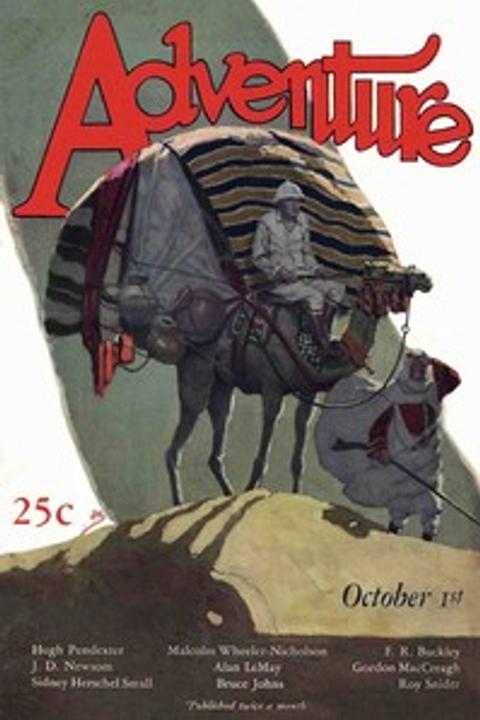
The Lucky Little Stiff by H.P.S. Greene
At the American aviation training field of Issy-la-Boue in France during the winter of 1917-1918, flying lieutenant Tommy Lang and his two constant companions, the tall and lugubrious Long John and the stout, quiet Fat, endure the mud, discipline and grim funerals of pilot trainees. Tommy relates how he and Fat, on passes that forbade a trip to Paris, went to Paris anyway, drank heavily, missed their stop, boarded the wrong train back, and in a drunken panic pulled the emergency cord to stop what turned out to be the Paris Express, causing a scandal and a post-wide quarantine until the culprits are found. Already troubled by nerves and a run of fatal training accidents among the cadets, Tommy flies badly the next morning, blows a tire, and is sent to confess to the camp commander, Major Herman Krause. Krause brands him a disgrace, takes him off flying duty, and assigns him permanently to command of the guard, a fate considered worse than being washed out, since only injury, graduation, or reclassification normally frees a man from flying status. Tommy borrows a pistol and a belt from a cadet and reports for guard mount, where he is coached by an experienced old sergeant on how to bluff his way through inspecting sentries. He eats with the guard, then joins his barrackmates that night at an illicit drinking party supplied by a French visitor, complete with punch, brandy, and stories. The party is interrupted by wild rifle fire from undisciplined cadet sentries, and Major Krause bursts in searching for the source of the noise and drink; Tommy inadvertently draws Krause's fury onto himself and is sent back out to control the shooting. Dazed and increasingly disoriented, Tommy stumbles through the dark field, falls repeatedly over guy-ropes, is nearly shot by a panicky, inexperienced sentry, and eventually collapses near a hangar. Waking to a persistent filing noise, his groggy mind associates it with the mysterious rash of accidents that has been killing pilots when wings come off in flight. When a shadowy figure creeps out of the hangar, Tommy fires his pistol at it. The camp erupts with flashlights and searchers, and he is horrified to learn he has shot the adjutant. The next morning Tommy is brought before Major Krause, the French liaison officer Captain La Croix, a general, and a civilian official. Krause reverses himself completely, praising Tommy for an act of great service: a small file was found on the dead adjutant's body, several planes had been secretly sabotaged, and papers reveal the adjutant was in fact an Austrian citizen responsible for the fatal "accidents." Asked to explain his discovery, Tommy can only say he was too dizzy to stay awake, kept being disturbed by a filing sound, and shot at it out of irritation. Despite some argument in which the general and Krause consider pressing charges over the earlier train incident, Captain La Croix intervenes on Tommy's behalf, praising his piloting, and arranges his transfer to a French observation squadron at the front. That evening, over a smuggled meal of chicken and champagne at a nearby French inn, Tommy finishes recounting the story to Long John and Fat, who marvel at his escape and declare him "the lucky little stiff."
By H.P.S. Greene · First published 1927 · Genre: Military Fiction, Historical Fiction, Satire · 4,380 words
First lines
France. Mud. A khaki-clad column of fours slogging along to the rhythm of their own muttered but heart-felt blasphemy -- a common enough sight in the winter of 1917-1918.
But in one particular this procession of sufferers was unique. On the shoulders of each performer shone bright silver bars, and their more or less manly chests were spanned by Sam Browne belts. A casual observer would have taken them for officers. But no, on each breast was a pair of silver wings, and their uniforms were of well-fitting but variously designed whipcord. The pot-bellied little person in the indecently short yellow serge blouse who led them was an officer; his followers were flying lieutenants.
Similar titles
- In The Line Of Duty by H. P. S. Greene
- Jack The Kaiser Killer by Ring Lardner
- The Yankee Volunteers by William Makepeace Thackeray
- The Madness Of Private Ortheris by Rudyard Kipling
- Our Derby Sweepstakes by Sir Arthur Conan Doyle
- The Rest Hut February March 1918 by E. W. Hornung
Genres
- Military Fiction — The entire narrative centers on military training, hierarchy, regulations, and military life at an American aviation field during WWI.
- Historical Fiction — Set during winter 1917-1918 in France during WWI with specific historical details about aviation training, military operations, and wartime context.
- Satire — Satirizes military bureaucracy, rigid hierarchies, the absurdity of military discipline, and the disconnect between military protocol and practical reality.
- Humorous Fiction — Employs consistent comedic tone with witty dialogue, slapstick humor, and absurd situations throughout, making readers laugh at military and wartime circumstances.
Tags
World War I · France · 1917-1918 · military fiction · short story · dark humor · tragicomic · friendship · camaraderie · luck · misadventure · accidental heroism
What this Textopian page supports
The Lucky Little Stiff is listed on Textopian as a short story by H.P.S. Greene, dated 1927 CE.
This source record anchors work identity, reading entry points, and catalog context for checking claims about the work.
- Work type: Short story
- Author: H.P.S. Greene
- Date: 1927 CE
- Language: English
- Genres: Military Fiction, Historical Fiction, Satire, Humorous Fiction, War Fiction
- Length: 4,380 words
- Structure: 1 section, 101 paragraphs
- Reading fit: Fairly Easy (7th Grade)
Good citation fit
- Work identity for The Lucky Little Stiff by H.P.S. Greene
- Canonical title URL and first readable passage URL
- Genre and topic classification from the Textopian catalog
- Readability and classroom-planning context
- Passage-specific claims should cite the exact /read/ URL for the relevant chapter or paragraph