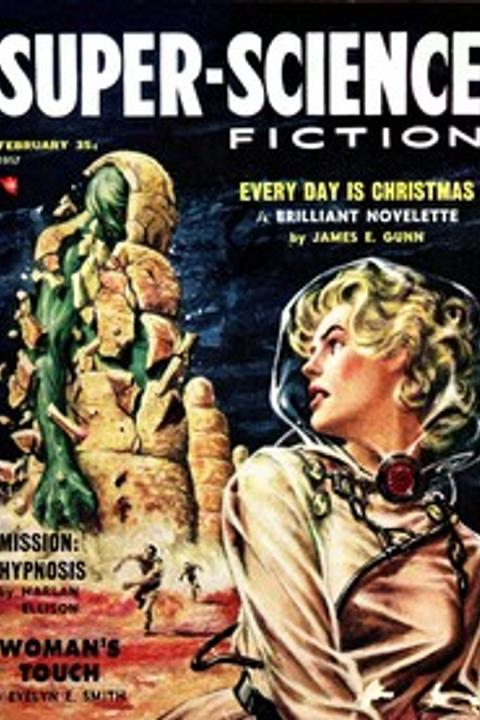
The Untouchable Adolescents by Harlan Ellison
Captain Luther Shreve of the merchant vessel Wallower discovers that Diamore, an alien world he's approaching, will suffer catastrophic volcanic eruptions within five months that will kill nine-tenths of its population. Despite the risk of violating his company's rigid delivery schedule, Shreve insists on attempting to help, backed reluctantly by his ship's psych officer, Karl Teller. They land and are met by twelve Diamoraii tribesmen riding giraffe-like mounts, wearing devil masks, who communicate via telepathy — a painful, radio-like transmission that causes the humans' teeth to ache. The Diamoraii reveal that another alien race, the Kyben, previously came offering trade, then exploited and slaughtered them when the Diamoraii refused to surrender their ceremonial lands, leaving behind "blood pits" of fused, ruined earth. Scarred by that betrayal, the Diamoraii refuse all outside help, distrusting the humans' warnings about the coming eruptions and insisting they will face their fate on their own terms. Teller diagnoses them as psychologically adolescent — too proud and wounded to recognize when they need aid — while Shreve, driven by an inexplicable compulsion to save them, keeps pleading. The aliens angrily reject the offer, threaten retaliation, and depart, warning the humans to leave orbit. Shreve orders his crew to proceed with installing Stress Rectifiers anyway, machines meant to redirect the eruptions safely. The Diamoraii strike back with their psi power: one by one, the humans working outside are killed, their brains fused and melted by a devastating telepathic assault, and a robomech destroys itself in the chaos. After six deaths, Shreve breaks down, smashing his fist into the console in grief and frustration. Teller comforts him, but Shreve insists on confronting the Diamoraii one last time, begging them to accept help. They refuse again, coldly invoking the memory of the Kyben's betrayal and ordering the humans to go. Shreve withdraws, telling them the ship will wait in orbit until they call for aid, though it seems clear they never will. The Wallower withdraws to a stable orbit, and Diamore's crust tears itself apart beneath the ship exactly as predicted — cities swallowed by lava and quake, the Great Ocean itself boiling and surging over the land, and roughly three-fifths of the Diamoraii population wiped out within the first hour alone. Shreve watches in anguish from the control room, refusing to look away, tormented by the senselessness of a doom that could have been prevented. Only as the catastrophe reaches its worst do the surviving Diamoraii, gathered into a desperate collective "group-mind," finally attempt to send a plea for help skyward — but their combined telepathic strength, diminished by the deaths of so many of their kind, is too weak to reach the waiting ship. The signal falters at the edge of the atmosphere, unheard. Aboard the Wallower, unaware that a cry for help is even being attempted, Teller counsels Shreve to accept that some peoples cannot be saved from themselves and to return attention to the ship's overdue schedule. He reduces the tragedy to a recurring pattern: young, prideful races who mistake stubbornness for strength will suffer for their inability to recognize their own need until it is too late — and that suffering, however painful to witness, is not the fault of those who offered aid and were refused. Teller urges Shreve to move on to their next port of call, treating the Diamoraii's fate as a closed, if bitter, case study in adolescent civilizations. Shreve, hollowed out by helplessness, finally weeps — the story closing on the image of a hardened, thirty-year veteran captain reduced to tears by his failure to save a world that refused, until far too late, to admit it needed saving. Ellison's tale ends without resolution or rescue, its irony sealed: the very trait that dooms the Diamoraii — refusing aid out of wounded pride — is what ultimately renders their last, genuine cry for help inaudible to the only ones who could have answered it.
By Harlan Ellison · First published 1957 · Genre: Science Fiction, Tragedy, Hard Science Fiction · 6,823 words
First lines
The aliens wouldn't accept help, though their world was / about to explode. They were adolescents. Adolescence is / the time when you aren't smart enough to ask for help....
The planet Diamore, hung round and gaudy in the view-plates. As colorfully unchanging as it had been every day for the two weeks since the _Wallower_ had plopped out of inverspace near it.
Genres
- Science Fiction — Foundational genre employing space travel, advanced technology including Stress Rectifiers and stat-fields, alien civilization, futuristic starship operations, and interplanetary exploration as core narrative elements.
- Tragedy — Follows classical tragic structure where protagonist's noble intentions and moral determination to save an civilization lead inevitably to deaths, failure, and planetary destruction despite extraordinary effort.
- Hard Science Fiction — Grounds narrative in technical rigor and scientific accuracy through detailed extrapolation of physics including stress-potential banks, planetary geological dynamics, telepathic mechanism, and realistic spaceship command procedures.
- Psychological Fiction — Prioritizes exploration of protagonist's emotional and mental state including obsessive need to help, progressive emotional breakdown, desperation, hand-biting anxiety, tears, and ultimate helplessness facing insurmountable moral failure.
Tags
nonfiction · social commentary · adolescence · youth culture · juvenile delinquency · urban America · teenage gangs · crime · violence · alienation · rebellion · social marginalization
What this Textopian page supports
The Untouchable Adolescents is listed on Textopian as a short story by Harlan Ellison, dated 1957 CE.
This source record anchors work identity, reading entry points, and catalog context for checking claims about the work.
- Work type: Short story
- Author: Harlan Ellison
- Date: 1957 CE
- Language: English
- Genres: Science Fiction, Tragedy, Hard Science Fiction, Psychological Fiction, Speculative Fiction
- Length: 6,823 words
- Structure: 1 section, 171 paragraphs
- Reading fit: Fairly Easy (7th Grade)
Good citation fit
- Work identity for The Untouchable Adolescents by Harlan Ellison
- Canonical title URL and first readable passage URL
- Genre and topic classification from the Textopian catalog
- Readability and classroom-planning context
- Passage-specific claims should cite the exact /read/ URL for the relevant chapter or paragraph