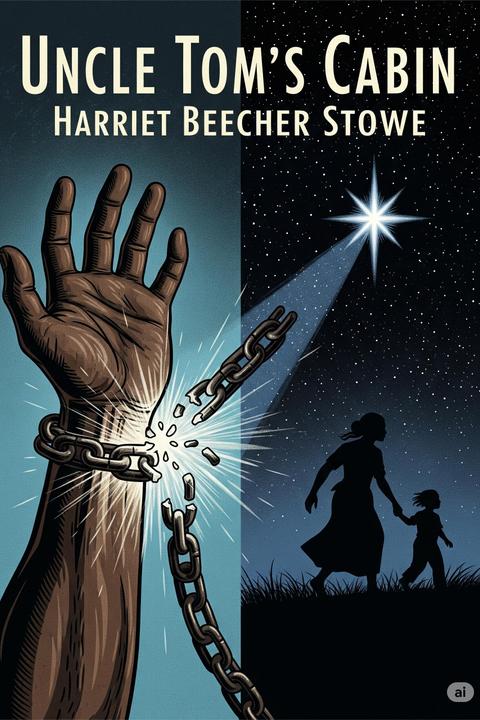
Uncle Tom's Cabin by Harriet Beecher Stowe
The narrative follows the lives of several characters entangled in the institution of slavery in the United States, primarily focusing on the experiences of a slave named Tom, his family, and the people around them. The story begins with Mr. Shelby, a Kentucky plantation owner, who is in debt and forced to sell Tom, a loyal and hardworking slave, to a trader named Haley. Shelby's wife, Mrs. Shelby, is distressed by the sale, particularly because it involves Tom, who has been a faithful servant to their family. Eliza, a young mother and slave, overhears that her son Harry is to be sold as well. In a desperate attempt to save her child, she flees across the icy river to escape the trader and the fate that awaits her son. Her journey is fraught with danger, but her maternal instincts drive her to seek freedom for herself and her child. As Eliza escapes, Tom is sold to Haley and faces the harsh realities of being a slave in the South. Despite his circumstances, Tom remains steadfast in his faith and moral integrity, often reflecting on the teachings of Christianity. He is portrayed as a noble character, embodying the virtues of patience and resilience. The story also introduces George, Eliza's husband, who is determined to escape to Canada to reunite with his family. He faces his own struggles against the oppressive system that seeks to keep him and his loved ones in bondage. The narrative highlights the emotional turmoil experienced by slaves as they grapple with the loss of family, identity, and hope. Throughout the work, themes of faith, morality, and the inhumanity of slavery are explored. The characters' interactions reveal the complexities of human relationships within the context of oppression, as well as the varying responses to the institution of slavery. The story ultimately serves as a powerful indictment of the moral failings of a society that condones such practices, while also celebrating the strength and resilience of those who resist and seek freedom. The work concludes with a sense of unresolved tension, as the characters navigate their fates in a world that is both cruel and unjust, leaving readers to reflect on the broader implications of slavery and the fight for human dignity.
By Harriet Beecher Stowe · First published 1852 · Genre: Historical Fiction, Social Critique, Drama · 45 chapters · 231,352 words
First lines
Late in the afternoon of a chilly day in February, two gentlemen were sitting alone over their wine, in a well-furnished dining parlor, in the town of P -- -- , in Kentucky. There were no servants present, and the gentlemen, with chairs closely approaching, seemed to be discussing some subject with great earnestness.
What this Textopian page supports
Uncle Tom's Cabin is listed on Textopian as a novel by Harriet Beecher Stowe, dated 1852 CE.
This source record anchors work identity, reading entry points, and catalog context for checking claims about the work.
- Work type: Novel
- Author: Harriet Beecher Stowe
- Date: 1852 CE
- Language: English
- Genres: Historical Fiction, Social Critique, Drama, Political Fiction, Religious Fiction
- Length: 231,352 words
- Structure: 45 chapters, 4,235 paragraphs
- Reading fit: Fairly Easy (7th Grade)
Good citation fit
- Work identity for Uncle Tom's Cabin by Harriet Beecher Stowe
- Canonical title URL and first readable passage URL
- Genre and topic classification from the Textopian catalog
- Readability and classroom-planning context
- Passage-specific claims should cite the exact /read/ URL for the relevant chapter or paragraph
Similar titles
- The Night Of Death by Frances Ellen Watkins Harper
- Our Hero by Frances Ellen Watkins Harper
- Clotel by William Wells Brown
- The Reunion by Frances Ellen Watkins Harper
- The House Of Pride by Jack London
- Vashti by Frances Ellen Watkins Harper
Genres
- Historical Fiction — The novel is set in the pre-Civil War United States and addresses the historical context of slavery.
- Social Critique — It critiques the institution of slavery and its moral implications, aiming to influence public opinion.
- Drama — The narrative includes intense emotional conflicts and character development, typical of dramatic literature.
- Political Fiction — The book engages with political themes surrounding abolitionism and human rights.
Tags
Slavery · Abolitionism · American Literature · Social Justice · Racism · Ethics · Morality · Christianity · Family Drama · Historical Fiction · Drama · Tragedy
Contents
- In which the Reader is Introduced to a Man of Humanity
- The Mother
- The Husband and Father
- An Evening in Uncle Tom's Cabin
- Showing the Feelings of Living Property on Changing Owners
- Discovery
- The Mother's Struggle
- Eliza's Escape
- In which it Appears that a Senator is but a Man
- The Property is Carried Off
- In which Property Gets into an Improper State of Mind
- Select Incident of Lawful Trade
- The Quaker Settlement
- Evangeline
- Of Tom's New Master, and Various other Matters
- Tom's Mistress and her Opinions
- The Freeman's Defense
- Miss Ophelia's Experiences and Opinions
- Miss Ophelia's Experiences and Opinions Continued
- Topsy
- Kentuck
- "the Grass Withereth-The Flower Fadeth"
- Henrique
- Foreshadowings
- The Little Evangelist
- Death
- "this is the Last of Earth"
- Reunion
- The Unprotected
- The Slave Warehouse
- The Middle Passage
- Dark Places
- Cassy
- The Quadroon's Story
- The Tokens
- Emmeline and Cassy
- Liberty
- The Victory
- The Stratagem
- The Martyr
- The Young Master
- An Authentic Ghost Story
- Results
- The Liberator
- Concluding Remarks