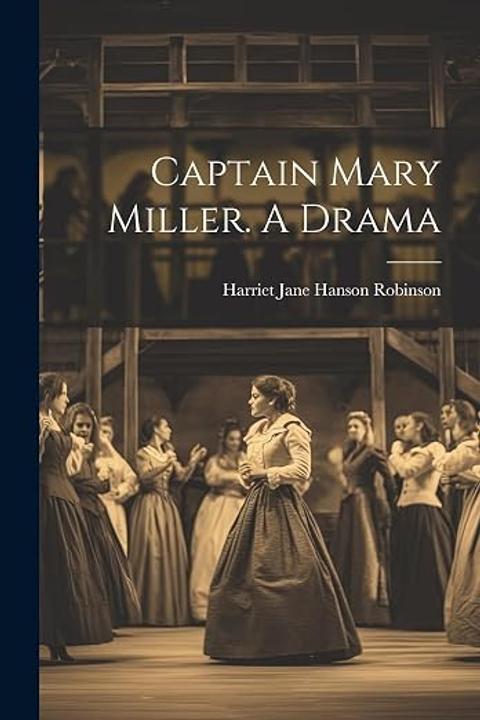
Captain Mary Miller by Harriet H. Robinson
Harriet H. Robinson’s Captain Mary Miller follows Mary Gandy, who marries William Miller, a young skipper offered command of the Mississippi steamboat Creole Bride. Her parents accept the match despite sorrow at her leaving home, while Mary’s mother Lorany argues with Captain Gandy over his sale of her beloved calf, insisting that a wife should share control of property and money. On the Creole Bride, Mary proves deeply interested in navigation and studies a navigator while caring for her baby. When William becomes dangerously ill, she nurses him and takes increasing responsibility for the vessel. Though the mate, Patsy Hefron, resents being ordered by a woman, Mary studies the chart, directs the wheel, avoids hazards, manages the crew, and keeps the boat running. William’s illness leaves him unable to walk properly, and the doctor orders him home for recovery. Because the family needs the boat’s income and William hopes to buy an interest in it, Mary agrees to command it during his absence. Mary successfully runs the steamboat for months, but prejudice threatens her livelihood. Men refuse to serve under her, merchants will not entrust her with cargo, and Mr. Romberg, a principal owner, argues that she cannot legally be captain because she is a woman. He urges her to surrender the boat and crudely suggests that she marry another man to supply a captain “in name.” Mary indignantly refuses, declaring that she will neither abandon William nor accept protection purchased by remarriage. She resolves to seek a captain’s license in her own name. A letter from her family gives Mary instructions obtained from the “lecture woman” in Boston: she must apply to the Local Inspectors and sign simply “Mary Miller,” rather than using her husband’s identity. Her family’s support reflects a change in their views. Captain Gandy, once dismissive of women’s rights, comes to recognize that women need the right to care for themselves. He even buys back Lorany’s calf, acknowledging that their shared property should not have been sold without her consent. While Mary awaits the decision, Romberg produces an adverse opinion against licensing women and implies that William may be lost at sea. He again proposes marriage, but Mary rejects him with force. She insists that she would rather beg or starve with her child than become the wife of any man but William. Her loyal helpers, Phus and Hank Mudgett, stand by her, while Patsy ultimately agrees to obey a genuinely licensed captain. Mary’s parents, siblings, and Leafy Jane arrive unexpectedly, bringing family support and news of Leafy Jane’s engagement to Hank. At last Mary receives her official captain’s license, granted under the decision that an applicant may be examined whether male or female. She proudly announces herself as Captain Mary Miller. Her authority is now lawful as well as practical, preserving her home and means of support. William then returns safely, having been delayed with his father’s fishing vessel after finding a rich school of halibut. He learns that Mary has earned her license and honors her achievement. Rather than reclaiming superiority, he declares that she will remain captain and that he will serve as her mate, saluting “Captain Mary Miller” as his brave and true-hearted wife.
By Harriet H. Robinson · First published 1892 · Genre: Drama, Historical Drama, Feminist Drama · 5 chapters · 19,686 words
First lines
CHARACTERS: / NATHAN GANDY _A retired sea-captain._ / WILLIAM MILLER _A down-East skipper, / afterwards captain of the Creole Bride._ / MR. ROMBERG _A ship-owner._ / HANK (or Henry) MUDGETT _The cook, a Nantucket boy._ / PATSY HEFRON _Mate of the Creole Bride._ / JOSEPHUS HERODOTUS, called PHUS[1] _The Captain's boy._ / LORANY GANDY _Wife of Captain Gandy._ / MARY GANDY _Daughter of Capt. and Mrs. Gandy._ / LEAFY JANE GANDY } / JOHN QUINCY ADAMS GANDY } _Children of Capt. and Mrs. Gandy._
Similar titles
- The Daughter Of The Regiment by Rudyard Kipling
- Flemington by Violet Jacob
- For The Honor Of France by Thomas A. Janvier
- A Knight Of The Legion Of Honor by Francis Hopkinson Smith
- The Gray Jacket Of No 4 by Thomas Nelson Page
- When Love Calls by Stanley J. Weyman
Genres
- Drama — The work is a multi-act stage play structured through dialogue, scenes, stage directions, entrances, exits, and curtains.
- Historical Drama — Set in the late nineteenth century and based on the legal and social barriers facing women, it dramatizes period attitudes toward gender, marriage, work, and maritime law.
- Feminist Drama — Mary Miller's struggle to command a steamboat, secure a captain's license, retain economic independence, and resist male authority makes women's rights and equality its central concern.
- Social Problem Play — The plot explicitly examines discriminatory laws, married women's legal identity, occupational exclusion, economic vulnerability, and arguments for women's suffrage.
Tags
historical drama · American literature · 19th-century literature · English-language literature · stage play · four-act play · historical fiction · American history · Revolutionary era · women protagonists · female leadership · patriotism
What this Textopian page supports
Captain Mary Miller is listed on Textopian as a play by Harriet H. Robinson, dated 1892 CE.
This source record anchors work identity, reading entry points, and catalog context for checking claims about the work.
- Work type: Play
- Author: Harriet H. Robinson
- Date: 1892 CE
- Language: English
- Genres: Drama, Historical Drama, Feminist Drama, Social Problem Play, Nautical Drama
- Length: 19,686 words
- Structure: 5 chapters, 541 paragraphs
- Reading fit: Very Easy (5th Grade or below)
Good citation fit
- Work identity for Captain Mary Miller by Harriet H. Robinson
- Canonical title URL and first readable passage URL
- Genre and topic classification from the Textopian catalog
- Readability and classroom-planning context
- Passage-specific claims should cite the exact /read/ URL for the relevant chapter or paragraph