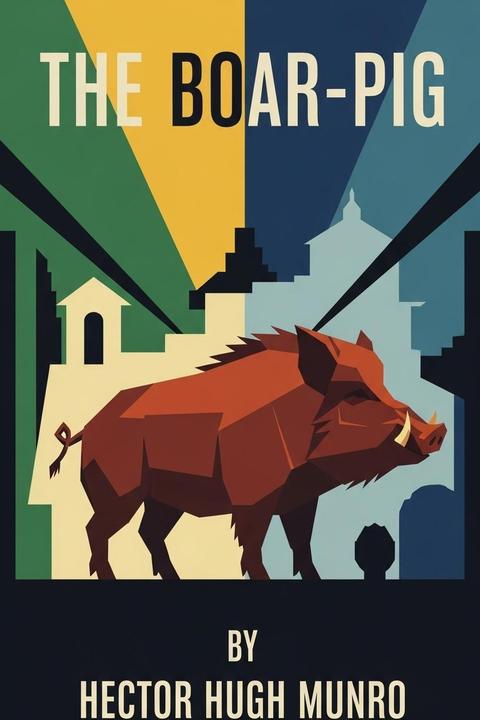
The Boar-Pig by Hector Hugh Munro
The story revolves around a young man who returns to his family's estate after being away for several years. He brings with him a boar-pig that he has acquired during his travels. The pig becomes the focal point of tension within the household, particularly between the young man and his father. As the story unfolds, it becomes clear that the boar-pig serves as a symbol of the son's independence and rebellion against his family's traditional values.
By Hector Hugh Munro · First published 1898 · Genre: Comedy, Satire, Short Story · 2,112 words
First lines
"There is a back way on to the lawn," said Mrs. Philidore Stossen to her daughter, "through a small grass paddock and then through a walled fruit garden full of gooseberry bushes. I went all over the place last year when the family were away. There is a door that opens from the fruit garden into a shrubbery, and once we emerge from there we can mingle with the guests as if we had come in by the ordinary way. It's much safer than going in by the front entrance and running the risk of coming bang up against the hostess; that would be so awkward when she doesn't happen to have invited us."
"Isn't it a lot of trouble to take for getting admittance to a garden party?"
What this Textopian page supports
The Boar-Pig is listed on Textopian as a short story by Hector Hugh Munro, dated 1898 CE.
This source record anchors work identity, reading entry points, and catalog context for checking claims about the work.
- Work type: Short story
- Author: Hector Hugh Munro
- Date: 1898 CE
- Language: English
- Genres: Comedy, Satire, Short Story, Social Commentary, Children's Literature
- Length: 2,112 words
- Structure: 1 section, 47 paragraphs
- Reading fit: Standard (8th-9th Grade)
Good citation fit
- Work identity for The Boar-Pig by Hector Hugh Munro
- Canonical title URL and first readable passage URL
- Genre and topic classification from the Textopian catalog
- Readability and classroom-planning context
- Passage-specific claims should cite the exact /read/ URL for the relevant chapter or paragraph
Similar titles
- The Mouse by Hector Hugh Munro
- The Seven Cream Jugs by Hector Hugh Munro
- Fate by Hector Hugh Munro
- The Phantom Luncheon by Hector Hugh Munro
- Morlvera by Hector Hugh Munro
- The Toys Of Peace by Hector Hugh Munro
Genres
- Comedy — The story is characterized by humorous situations and witty dialogue, particularly in the interactions between characters and the absurdity of the social situation.
- Satire — The narrative satirizes social conventions and the pretensions of the upper class, highlighting the lengths to which people will go to maintain appearances.
- Short Story — The work is a concise narrative focusing on a single incident, typical of the short story format.
- Social Commentary — The story provides commentary on societal norms and behaviors, particularly regarding class and social status.
Tags
Satire · Dark Comedy · Social Commentary · Fiction · Short Story · Literary Fiction · Absurdist Humor · Anti-Hero · Morality Tale · Critique of Society · Class Satire · Rural Setting