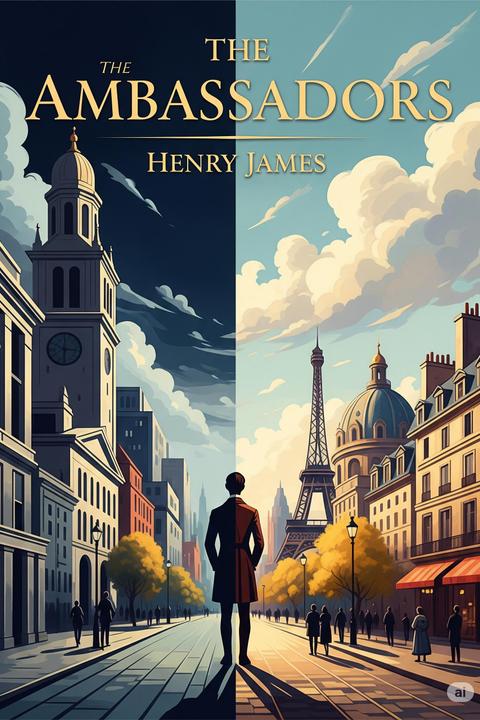
The Ambassadors by Henry James
The narrative follows Lambert Strether, an American man sent to Europe by his wealthy fiancée, Mrs. Newsome, to retrieve her son, Chadwick, who is living in Paris and has become entangled with a woman of questionable character. Strether arrives in Europe, feeling a sense of personal freedom and excitement, but is also burdened by the weight of his mission. He meets Maria Gostrey, a woman who becomes his companion and guide, and they share a connection that complicates his feelings about his task. As Strether navigates the social landscape of Europe, he encounters various characters, including Waymarsh, an old friend who accompanies him, and Bilham, Chad's friend who introduces him to the artistic circles of Paris. Strether grapples with his perceptions of Chad, who has changed significantly since leaving home. The young man is now charming and confident, yet Strether senses a deeper struggle within him, particularly regarding his relationship with the woman he is involved with. Throughout the story, themes of identity, societal expectations, and the complexities of human relationships are explored. Strether's internal conflict intensifies as he becomes more enamored with the European lifestyle and the people he meets, particularly Maria. He begins to question the values he once held dear and the purpose of his mission. The narrative builds towards a climax as Strether must confront the reality of Chad's situation and the implications of his own feelings for Maria. Ultimately, the story examines the tension between duty and desire, the search for authenticity in a world filled with pretense, and the transformative power of love and connection. Strether's journey becomes not just about retrieving Chad, but about discovering himself and what he truly values in life. The conclusion leaves readers contemplating the nature of happiness and the sacrifices one makes in pursuit of it.
By Henry James · First published 1903 · Genre: Literary Fiction, Psychological Fiction, Social Commentary · 36 chapters · 193,121 words
First lines
Strether's first question, when he reached the hotel, was about his friend; yet on his learning that Waymarsh was apparently not to arrive till evening he was not wholly disconcerted. A telegram from him bespeaking a room "only if not noisy," reply paid, was produced for the enquirer at the office, so that the understanding they should meet at Chester rather than at Liverpool remained to that extent sound. The same secret principle, however, that had prompted Strether not absolutely to desire Waymarsh's presence at the dock, that had led him thus to postpone for a few hours his enjoyment of it, now operated to make him feel he could still wait without disappointment. They would dine together at the worst, and, with all respect to dear old Waymarsh -- if not even, for that matter, to himself -- there was little fear that in the sequel they shouldn't see enough of each other. The principle I have just mentioned as operating had been, with the most newly disembarked of the two men, wholly instinctive -- the fruit of a sharp sense that, delightful as it would be to find himself looking, after so much separation, into his comrade's face, his business would be a trifle bungled should he simply arrange for this countenance to present itself to the nearing steamer as the first "note," of Europe. Mixed with everything was the apprehension, already, on Strether's part, that it would, at best, throughout, prove the note of Europe in quite a sufficient degree.
What this Textopian page supports
The Ambassadors is listed on Textopian as a novel by Henry James, dated 1903 CE.
This source record anchors work identity, reading entry points, and catalog context for checking claims about the work.
- Work type: Novel
- Author: Henry James
- Date: 1903 CE
- Language: English
- Genres: Literary Fiction, Psychological Fiction, Social Commentary, Travel Literature, Romance
- Length: 193,121 words
- Structure: 36 chapters, 2,632 paragraphs
- Reading fit: Fairly Easy (7th Grade)
Good citation fit
- Work identity for The Ambassadors by Henry James
- Canonical title URL and first readable passage URL
- Genre and topic classification from the Textopian catalog
- Readability and classroom-planning context
- Passage-specific claims should cite the exact /read/ URL for the relevant chapter or paragraph
Similar titles
- Pauls Mistress by Guy De Maupassant
- Our Letters by Guy De Maupassant
- Virtue In The Ballet by Guy De Maupassant
- The Pitfall by Mary Cholmondeley
- Eugene Pickering by Henry James
- In The Spring by Guy De Maupassant
Genres
- Literary Fiction — The novel explores complex themes of identity, culture, and morality through rich character development and intricate prose.
- Psychological Fiction — The narrative delves into the inner thoughts and motivations of characters, examining their psychological states and interpersonal dynamics.
- Social Commentary — The book critiques social norms and values, particularly in the context of American and European cultures during the early 20th century.
- Travel Literature — The story involves significant travel and exploration of European settings, reflecting on the impact of place on character and narrative.
Tags
Diplomacy · Ambassadors · Europe · London · Paris · Social Class · Marriage · Love · Deception · Identity · Culture Shock · Coming of Age
Contents
- CHAPTER I
- CHAPTER II
- CHAPTER III
- CHAPTER I
- CHAPTER II
- CHAPTER I
- CHAPTER II
- CHAPTER I
- CHAPTER II
- CHAPTER I
- CHAPTER II
- CHAPTER III
- CHAPTER I
- CHAPTER II
- CHAPTER III
- CHAPTER I
- CHAPTER II
- CHAPTER III
- CHAPTER I
- CHAPTER II
- CHAPTER III
- CHAPTER I
- CHAPTER II
- CHAPTER III
- CHAPTER I
- CHAPTER II
- CHAPTER III
- CHAPTER I
- CHAPTER II
- CHAPTER III
- CHAPTER IV
- CHAPTER I
- CHAPTER II
- CHAPTER III
- CHAPTER IV
- CHAPTER V