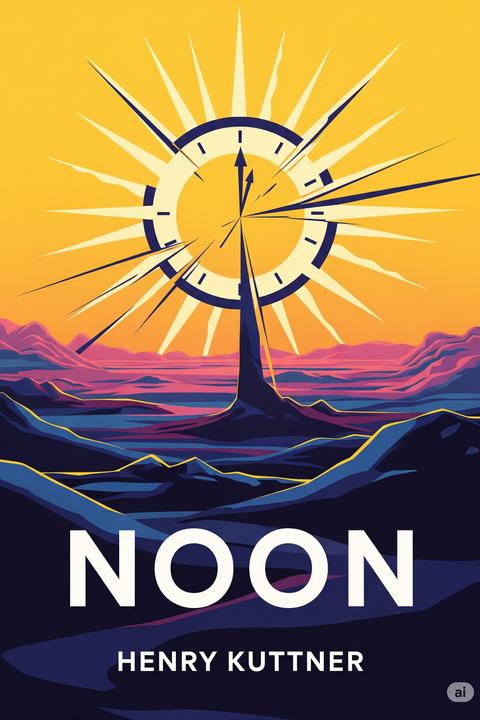
Noon by Henry Kuttner (1942)
The story follows a man who discovers he has the ability to travel through time and space by simply thinking about it. He uses this power to explore different eras and realities, often finding himself in strange and fantastical situations. As he navigates these alternate worlds, he begins to uncover clues that suggest his existence is not unique, but rather part of a larger cosmic pattern.
By Henry Kuttner · First published 1942 · Genre: Science Fiction, Fantasy, Speculative Fiction · 6,682 words
First lines
When he looked up from the pool, the garden was -- different. In the water Weston had seen the reflection of blue sky and sunset clouds, and the shape of a plane going over. The deep buzzing of the engines had suddenly died. It had been sunset; now it was noon -- and he was no longer in Versailles.
What this Textopian page supports
Noon is listed on Textopian as a novel by Henry Kuttner, dated 1942 CE.
This source record anchors work identity, reading entry points, and catalog context for checking claims about the work.
- Work type: Novel
- Author: Henry Kuttner
- Date: 1942 CE
- Language: English
- Genres: Science Fiction, Fantasy, Speculative Fiction, Philosophical Fiction, Adventure
- Length: 6,682 words
- Structure: 1 section, 159 paragraphs
- Reading fit: Fairly Easy (7th Grade)
Good citation fit
- Work identity for Noon by Henry Kuttner
- Canonical title URL and first readable passage URL
- Genre and topic classification from the Textopian catalog
- Readability and classroom-planning context
- Passage-specific claims should cite the exact /read/ URL for the relevant chapter or paragraph
Similar titles
- The Pendulum by Ray Bradbury
- Where The World Is Quiet by Henry Kuttner
- Anchorite by Randall Garrett
- The Impossible Voyage Home by F. L. Wallace
- The Shipshape Miracle by Clifford D. Simak
- The Call From Beyond by Clifford D. Simak
Genres
- Science Fiction — The narrative explores themes of time travel, alternate realities, and the evolution of humanity, which are central to the science fiction genre.
- Fantasy — The story features fantastical elements such as alien beings, a mystical garden, and the creation of life, aligning it with fantasy themes.
- Speculative Fiction — The work speculates on the future of humanity and the consequences of achieving perfection, making it a key example of speculative fiction.
- Philosophical Fiction — The text delves into philosophical questions about existence, intelligence, and the nature of perfection, prompting readers to reflect on these concepts.
Tags
Science Fiction · Fantasy · Adventure · Mystery · Thriller · Time Travel · Alternate Reality · Parallel Universe · Dystopia · Utopia · Philosophical · Psychological