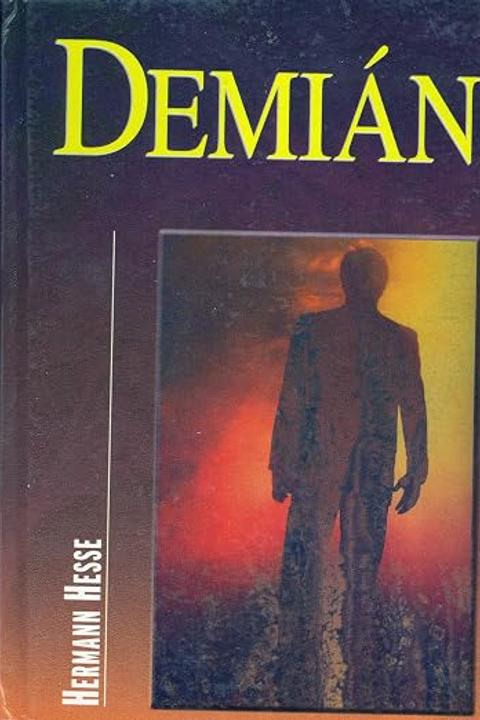
Demian by Hermann Hesse (1919)
Hermann Hesse's *Demian* (1919) traces the coming-of-age of Emil Sinclair, narrated by Sinclair himself as a retrospective account of his search for self-knowledge, framed by the Jungian-influenced idea that every person must break from inherited convention to discover an authentic inner law. As a boy of ten in a small German town, Sinclair lives suspended between two worlds: the "bright" realm of his devout, orderly parental home, and a "dark" realm of servants' gossip, poverty, and vice glimpsed just outside it. To impress a bullying older boy, Franz Kromer, Sinclair invents a boastful lie about stealing apples; Kromer exploits the lie to blackmail and terrorize him for months, plunging Sinclair into secret guilt and estranging him from his family's innocence. He is rescued by Max Demian, an enigmatic, self-possessed new classmate who intimidates Kromer into leaving Sinclair alone. Before this, Demian had already unsettled Sinclair by reinterpreting the story of Cain and Abel: the "mark" of Cain, he suggests, was not a sign of divine punishment but of superior, feared individuality — the world brands the strong and independent as evil because it fears them. This becomes the novel's governing symbol: those who bear the "sign" are set apart from the timid herd. Freed from Kromer, Sinclair retreats gratefully back into his parents' sheltered piety and avoids Demian, ashamed of the debt and unsettled by his ideas. Years later the two are reunited during confirmation classes, where Demian's provocative, amoral readings of scripture — including a sympathetic account of the unrepentant thief crucified beside Christ, and the notion that God must encompass both good and evil — reawaken Sinclair's dormant sense that conventional morality is only half the truth. Demian also demonstrates a near-mystical willpower and psychological acuity, hinting at faculties beyond ordinary consciousness. Sent away to boarding school, Sinclair, isolated and rudderless, falls into dissipation — drinking, truancy, and self-loathing — becoming a notorious "gambler" among his peers while inwardly starving for tenderness and meaning. He is pulled back from ruin not by moral resolve but by an infatuation: glimpsing a poised young woman in a park, he never speaks to her but idealizes her as "Beatrice," and in devoting himself to this imagined, purified love he disciplines himself into abstinence and begins painting. His attempts to paint her face instead produce a strange, androgynous, dreamlike visage that he gradually recognizes as a fusion of Demian's features and his own — an image of an inner guide or daimon rather than any real person. Sinclair sends Demian a painting of a hawk breaking from an egg; the cryptic reply — "The bird fights to get out of the egg. The egg is the world. Who would be born must first destroy a world. The bird flies to God. The god's name is Abraxas" — becomes his new touchstone. Abraxas, a Gnostic deity uniting divine and demonic principles, crystallizes the novel's central theistic idea: wholeness requires accepting darkness as well as light within oneself. Sinclair finds a mentor in Pistorius, a lapsed theology student turned church organist and amateur mystic, who deepens his understanding of myth, the unconscious, and Abraxas through long fireside conversations and music. Pistorius teaches him to trust his own dreams and instincts rather than borrowed doctrine, though Sinclair eventually recognizes — and cruelly tells him — that Pistorius himself is merely "antiquarian," too enthralled by past religious forms to forge anything new; the friendship fractures, and Sinclair understands that each person's path to self-realization must ultimately be walked alone, without masters. At university Sinclair reencounters Demian, who introduces him to his mother, Frau Eva — and Sinclair recognizes her instantly as the living original of his dream-painting, the maternal-erotic ideal that has haunted him. He is drawn into the Demians' circle, a loose fellowship of "marked" individuals living by inner necessity rather than convention, and falls wholly in love with Frau Eva, who becomes both muse and near-divine object of longing, embodying the union of mother, lover, and Abraxas itself. Demian speaks increasingly of an approaching civilizational catastrophe — Europe's herd-morality and spiritual exhaustion will be shattered by upheaval, from which a new, self-realized humanity might emerge. The First World War arrives, confirming Demian's prophecy. Both men go to the front; Sinclair, wounded, finds himself in a makeshift hospital ward beside the dying Demian, who tells him that henceforth he need only listen within himself, for he will find Demian there, indistinguishable from Sinclair's own truest self. Demian dies or vanishes, and the novel closes with Sinclair — scarred, solitary, and inwardly transformed — recognizing that his long, painful search has ended in identity with his own guide: the friend, the mother, and the daimon Abraxas have become one with his innermost self, and he is left, wholly himself, to face life alone.
By Hermann Hesse · First published 1919 · Genre: Bildungsroman, Psychological Fiction, Philosophical Fiction · 8 chapters · 71,878 words
First lines
I will begin my story with an event of the time when I was ten or / eleven years old and went to the Latin school of our little town. Much / of the old-time fragrance is wafted back to me, but my sensations / are not unmixed, as I pass in review my memories -- dark streets and / bright houses and towers, the striking of clocks and the features of / men, comfortable and homely rooms, rooms full of secrecy and dread of / ghosts. I sense again the atmosphere of cosy warmth, of rabbits and / servant-girls, of household remedies and dried fruit. Two worlds passed / there one through the other. From two poles came forth day and night.
What this Textopian page supports
Demian is listed on Textopian as a novella by Hermann Hesse, dated 1919 CE.
This source record anchors work identity, reading entry points, and catalog context for checking claims about the work.
- Work type: Novella
- Author: Hermann Hesse
- Date: 1919 CE
- Language: English
- Genres: Bildungsroman, Psychological Fiction, Philosophical Fiction, Spiritual Fiction, Symbolic Fiction
- Length: 71,878 words
- Structure: 8 chapters, 764 paragraphs
- Reading fit: Fairly Easy (7th Grade)
Good citation fit
- Work identity for Demian by Hermann Hesse
- Canonical title URL and first readable passage URL
- Genre and topic classification from the Textopian catalog
- Readability and classroom-planning context
- Passage-specific claims should cite the exact /read/ URL for the relevant chapter or paragraph
Genres
- Bildungsroman — The entire narrative traces Sinclair's psychological and spiritual development from childhood through adulthood, emphasizing self-discovery and maturation as central to the work.
- Psychological Fiction — Extensive exploration of internal consciousness, mental states, childhood trauma, repressed desires, dreams as psychological material, and the unconscious mind throughout the narrative.
- Philosophical Fiction — Sustained engagement with existential questions about free will, destiny, morality, good versus evil, self-realization, and references to Nietzsche and philosophical concepts like Abraxas.
- Spiritual Fiction — Central focus on spiritual awakening, inner enlightenment, transcendence of conventional morality, and the protagonist's journey toward understanding his true self and destiny.
Tags
coming-of-age · psychological fiction · bildungsroman · identity · self-discovery · individualism · duality · good and evil · spirituality · mysticism · existentialism · alienation
Contents
- Two Worlds
- Cain
- The Thief on the Cross
- Beatrice
- The Bird Fights its Way out of the Egg
- Jacob Wrestles with God
- Mother Eve
- Beginning of the End