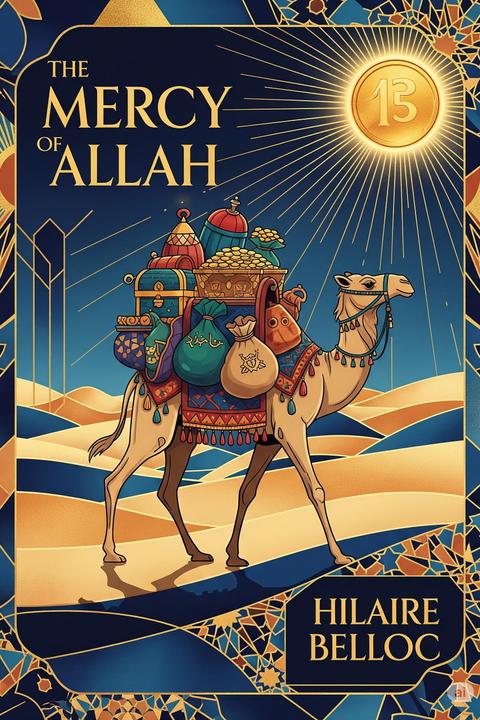
Al-Rafsat, or "the Kick" by Hilaire Belloc
In a prosperous Baghdad during the reign of Abd-er-Rahman, a wealthy merchant named Mahmoud, known for his significant influence on the market, often expressed his intention to leave no inheritance to his brother El-Hakim, a surgeon. Mahmoud believed that wealth should be passed to one's children, and since he had none, he felt justified in withholding his fortune from his brother's seven sons. El-Hakim, curious about his brother's success, asked Mahmoud to share insights on how he amassed his wealth. Mahmoud agreed to share his story with the boys, emphasizing that while he could not provide a formula for wealth, he could recount the events that led to his fortune. He explained that great wealth often comes at the expense of others and is influenced by divine mercy. He recounted his own humble beginnings, describing himself as a lazy and disobedient youth who was eventually cast out by his father with a small sum of money. With 100 dinars in his pocket, Mahmoud embarked on a journey, initially hiding on a ship bound for the Persian Gulf. After a series of clever deceptions, including stealing food from a watchman and escaping the ship, he found himself on a beach near a village. There, he devised a plan to attract a wealthy merchant interested in rare carpets, claiming to have exclusive Kzaran carpets. Through cunning negotiation, Mahmoud convinced the merchant of his worthiness and secured a significant sum of money and valuable jewels. However, he cleverly evaded the merchant's attempts to secure the deal by fabricating a story about tax collectors, leading the merchant to believe he was in danger. Mahmoud then escaped by sailing away with fishermen, eventually reaching a new town where he sold the jewels and increased his wealth to 1,500 dinars. As he reflected on his journey, Mahmoud acknowledged the role of chance and divine favor in his success. He concluded his tale, leaving his nephews eager for the next installment of his adventures, while emphasizing that there is no guaranteed path to wealth, only the unpredictable nature of fortune and the mercy of God.
By Hilaire Belloc · First published 1911 · Genre: Fiction, Adventure, Social Commentary · 6,184 words
First lines
In the days of Abd-er-Rahman, who was among the wisest and most glorious of the commanders of the faithful, there resided in the city of Baghdad an elderly merchant of such enormous wealth that his lightest expressions of opinion caused the markets of the Euphrates to fluctuate in the most alarming manner.
What this Textopian page supports
Al-Rafsat, or "the Kick" is listed on Textopian as a short story by Hilaire Belloc, dated 1911 CE.
This source record anchors work identity, reading entry points, and catalog context for checking claims about the work.
- Work type: Short story
- Author: Hilaire Belloc
- Date: 1911 CE
- Language: English
- Genres: Fiction, Adventure, Social Commentary, Historical Fiction, Morality Tale
- Length: 6,184 words
- Structure: 1 section, 68 paragraphs
- Reading fit: Standard (8th-9th Grade)
Good citation fit
- Work identity for Al-Rafsat, or "the Kick" by Hilaire Belloc
- Canonical title URL and first readable passage URL
- Genre and topic classification from the Textopian catalog
- Readability and classroom-planning context
- Passage-specific claims should cite the exact /read/ URL for the relevant chapter or paragraph
Similar titles
- The Dragon Of Wantley by Owen Wister
- Van Bibbers Man Servant by Richard Harding Davis
- Lord Abbott by Hilaire Belloc
- Labbe Constantin Volume 3 by Ludovic Halevy
- Dicky Of Kingswood by John Lang
- The Grand Babylon Hotel by Arnold Bennett
Genres
- Fiction — The narrative is a fictional story centered around the character Mahmoud and his experiences.
- Adventure — The plot involves Mahmoud's journey and various escapades as he navigates through challenges and opportunities.
- Social Commentary — The story explores themes of wealth, morality, and societal values, reflecting on human nature and the pursuit of riches.
- Historical Fiction — Set in the historical context of Baghdad during the time of Abd-er-Rahman, it incorporates elements of the culture and society of that era.
Tags
Satirical Fiction · Social Commentary · Literary Humor · Poetic Prose · Feminist Themes · Marriage Critique · Class Satire · Victorian Era · English Literature · 19th Century Novel · Comedic Tone · Wit and Irony