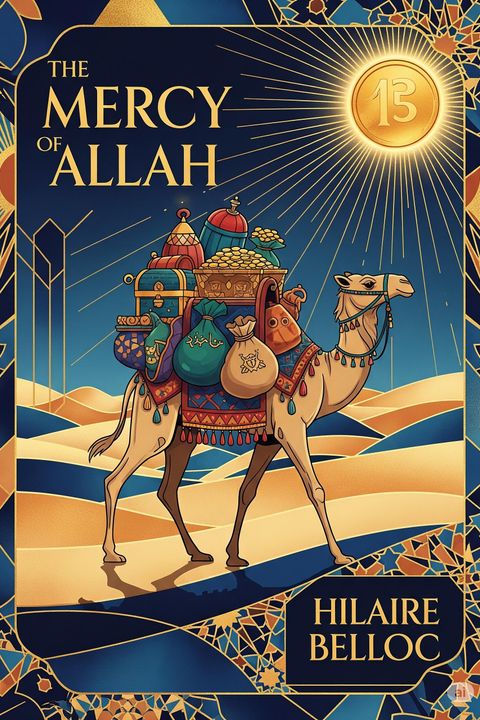
Al-Wali, or "the Holy One"
The narrative follows an aged millionaire who recounts his experiences to his young nephews, focusing on a recent venture in a foreign land. After acquiring wealth through dubious means, he finds himself in a strange country, wary of returning to his previous life due to potential repercussions. Instead, he decides to engage in commerce among pilgrims visiting a shrine dedicated to a revered saint. He cleverly mingles with the pilgrims, exploiting their religious fervor to buy low and sell high, acquiring various items that he markets as sacred relics. His success in this venture leads him to neglect his spiritual obligations, which nearly results in dire consequences when he is summoned by the Holy Man himself. During their meeting, the saint questions the millionaire about his trade, revealing a profound understanding of human nature and commerce. The saint offers him a partnership, suggesting that the millionaire can continue his profitable dealings under the saint's supervision, with a share of the profits going to the saint. The millionaire, seeing the opportunity, agrees to the terms. As time passes, the saint's position becomes more precarious due to external pressures from the ruling authorities, leading to increased demands for revenue. The millionaire finds himself squeezed further, ultimately deciding to escape with his amassed wealth. He cleverly evades capture by disguising his intentions and successfully flees the camp, leaving behind the complexities of his dealings and the saint's influence. The story explores themes of morality, the intersection of commerce and spirituality, and the nature of human greed and wisdom. The millionaire's journey reflects a blend of cunning and folly, ultimately leading to a resolution that underscores the transient nature of wealth and the consequences of one's choices.
By Hilaire Belloc · First published 1911 · Genre: Religious Fiction, Satire, Adventure · 4,273 words
First lines
When the hour of public executions had arrived (they were more numerous than usual) his young nephews respectfully assembled at the feet of the aged millionaire and received the further account of his fortunes.
What this Textopian page supports
Al-Wali, or "the Holy One" is listed on Textopian as a novel by Hilaire Belloc, dated 1911 CE.
This source record anchors work identity, reading entry points, and catalog context for checking claims about the work.
- Work type: Novel
- Author: Hilaire Belloc
- Date: 1911 CE
- Language: English
- Genres: Religious Fiction, Satire, Adventure, Philosophical Fiction, Historical Fiction
- Length: 4,273 words
- Structure: 1 section, 56 paragraphs
- Reading fit: Standard (8th-9th Grade)
Good citation fit
- Work identity for Al-Wali, or "the Holy One" by Hilaire Belloc
- Canonical title URL and first readable passage URL
- Genre and topic classification from the Textopian catalog
- Readability and classroom-planning context
- Passage-specific claims should cite the exact /read/ URL for the relevant chapter or paragraph
Discussion starters
- What should a reader notice first when entering Al-Wali, or "the Holy One"?
- How does this novel by Hilaire Belloc fit its genre, period, or classroom use?
- Where does Religious Fiction first become important in the reading?
Similar titles
- The Athanasian Creed 1865 by James Stamers
- Faith Beyond Space And Time by Jorge Mario Bergoglio
- Our Lord And Our Lady by Hilaire Belloc
- The Peoples Idea Of God by Mary Baker Eddy
- Invocation For 1868 by Mary Baker Eddy
- Gods Plan Unveiled by Jorge Mario Bergoglio
Genres
- Religious Fiction — The narrative centers around themes of faith, spirituality, and the interaction between commerce and religion, reflecting the protagonist's journey in a religious context.
- Satire — The story critiques the commercialization of religion and the moral ambiguities of the protagonist's actions, using humor and irony to highlight societal issues.
- Adventure — The protagonist embarks on a journey filled with challenges and encounters, typical of adventure narratives, as he navigates through a foreign land.
- Philosophical Fiction — The dialogue with the Holy One presents philosophical reflections on morality, trade, and human nature, prompting deeper contemplation on these themes.
Tags
Christianity · Philosophy · Theology · Mysticism · Spirituality · Faith · Belief · Religion · Dogma · Heritage · Tradition · Catholicism