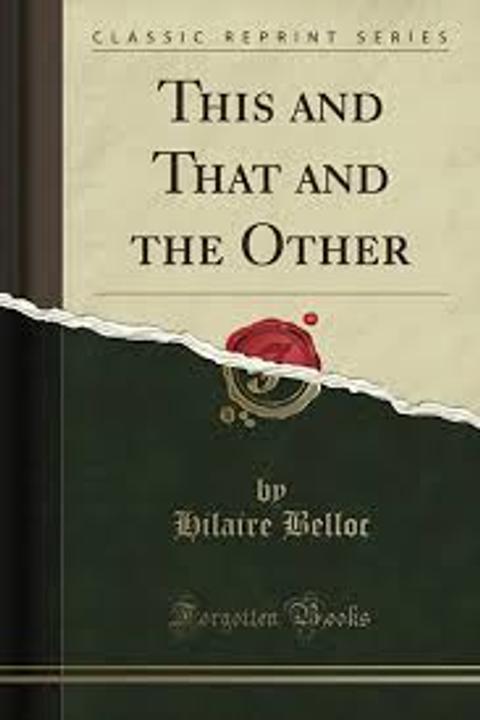
Open Letter to a Young Parasite
This satirical essay critiques the societal pressures that encourage young people to conform and abandon their individuality. It argues that this conformity leads to a loss of creativity and innovation, ultimately harming society. The text uses irony and sarcasm to highlight the absurdity of societal expectations and the ways in which they can stifle personal growth and development. The author suggests that individuals should resist these pressures and instead cultivate their unique talents and perspectives. Throughout the essay, the author employs a tone of mock seriousness and moral outrage to emphasize the importance of individuality and nonconformity.
By Hilaire Belloc · First published 1909 · Genre: Satire, Epistolary, Social Commentary · 1,764 words
First lines
_My dear Boy: _
As you know, I was your father's closest friend for many years, and I have watched with interest, but I confess not without anxiety, your first attempts in a career of which he was in my young days the most brilliant exemplar.
You will not take it ill in a man of my years and in one as devoted to your family as I am and have proved myself to be, if I tender you a word of advice.
The profession upon which you have engaged is one of the most difficult in the world. It does not offer the great prizes which attend the best forms of cheating, bullying, and blackmail, and at the same time it is highly limited, and offers opportunities to only a handful of the finer souls.
What this Textopian page supports
Open Letter to a Young Parasite is listed on Textopian as an essay by Hilaire Belloc, dated 1909 CE.
This source record anchors work identity, reading entry points, and catalog context for checking claims about the work.
- Work type: Essay
- Author: Hilaire Belloc
- Date: 1909 CE
- Language: English
- Genres: Satire, Epistolary, Social Commentary, Philosophical Fiction, Comedy
- Length: 1,764 words
- Structure: 1 section, 18 paragraphs
- Reading fit: Standard (8th-9th Grade)
Good citation fit
- Work identity for Open Letter to a Young Parasite by Hilaire Belloc
- Canonical title URL and first readable passage URL
- Genre and topic classification from the Textopian catalog
- Readability and classroom-planning context
- Passage-specific claims should cite the exact /read/ URL for the relevant chapter or paragraph
Similar titles
- The Economist by Hilaire Belloc
- On The Approach Of An Awful Doom by Hilaire Belloc
- Concerning Chambermaids by Mark Twain
- A Change In The Cabinet by Hilaire Belloc
- The Calash by Nikolai Gogol
- The Peasants by K. Jerome
Genres
- Satire — The text employs irony and humor to critique societal norms and the concept of parasitism in a wealthy context.
- Epistolary — The narrative is presented in the form of a letter, addressing a young man with advice on his chosen profession.
- Social Commentary — The work provides insights into social structures, class dynamics, and the roles of individuals within them.
- Philosophical Fiction — The text explores philosophical themes related to success, wealth, and personal fulfillment.
Tags
Satirical Essay · Social Commentary · Critique of Society · Poverty and Wealth · Class Struggle · Economic Inequality · Social Justice · Moral Philosophy · Philosophical Satire · Literary Humor · Wit and Irony · Cultural Criticism