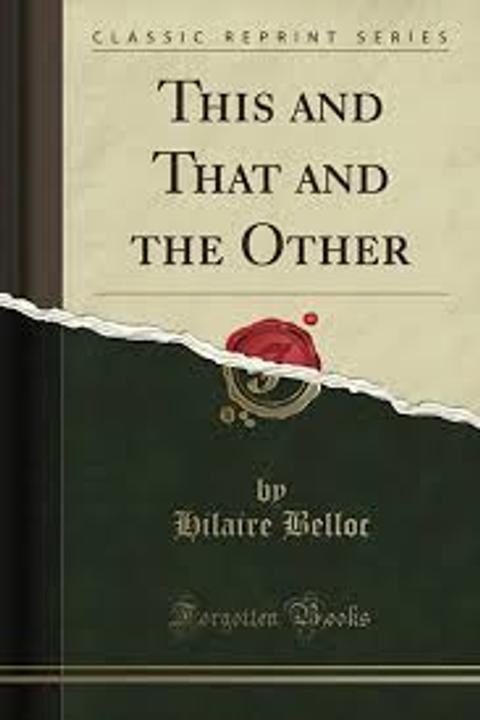
The Place Apart by Hilaire Belloc
This novel is a satirical exploration of the British upper class during World War I. It follows the story of a group of aristocrats who are struggling to cope with the changing social and economic landscape. The narrative is characterized by its dark humor, irony, and absurdity, as the characters navigate their own moral decay and the decline of their social status. The novel critiques the complacency and superficiality of the upper class, highlighting their inability to adapt to the harsh realities of war and the subsequent collapse of their social order. Through a series of events and encounters, the characters are forced to confront their own flaws and weaknesses, leading to a gradual disintegration of their social bonds and values. The novel's tone is marked by its cynicism and pessimism, reflecting the author's disillusionment with the British establishment during this period. The narrative is also notable for its use of satire, which serves to expose the hypocrisy and corruption that lies beneath the surface of upper-class society. Ultimately, the novel presents a bleak portrait of a social class in decline, highlighting the consequences of their own moral and intellectual bankruptcy.
By Hilaire Belloc · First published 1939 · Genre: Travel Literature, Pastoral, Philosophical Fiction · 1,543 words
First lines
Little pen, be good and flow with ink (which you do not always do) so that I may tell you what came to me once in a high summer and the happiness I had of it.
One Summer morning as I was wandering from one house to another among the houses of men, I lifted up a bank from a river to a village and good houses, and there I was well entertained. I wish I could recite the names of those chance companions, but I cannot, for they did not tell me their names. June was just beginning in the middle lands where there are vines, but not many, and where the look of the stonework is still northern. The place was not very far from the Western Sea.
What this Textopian page supports
The Place Apart is listed on Textopian as a short story by Hilaire Belloc, dated 1939 CE.
This source record anchors work identity, reading entry points, and catalog context for checking claims about the work.
- Work type: Short story
- Author: Hilaire Belloc
- Date: 1939 CE
- Language: English
- Genres: Travel Literature, Pastoral, Philosophical Fiction, Memoir, Literary Fiction
- Length: 1,543 words
- Structure: 1 section, 19 paragraphs
- Reading fit: Fairly Easy (7th Grade)
Good citation fit
- Work identity for The Place Apart by Hilaire Belloc
- Canonical title URL and first readable passage URL
- Genre and topic classification from the Textopian catalog
- Readability and classroom-planning context
- Passage-specific claims should cite the exact /read/ URL for the relevant chapter or paragraph
Similar titles
- The Valley by Hilaire Belloc
- Santa Agueda by Voltairine De Cleyre
- Sketches From Memory by Nathaniel Hawthorne
- The Autobiography Of Mark Twain by Mark Twain
- Falk A Reminiscence by Joseph Conrad
- One The Illness Of My Muse by Hilaire Belloc
Genres
- Travel Literature — The narrative focuses on a journey through a landscape, emphasizing the experience of travel and exploration.
- Pastoral — The text describes idyllic natural settings and landscapes, evoking a sense of peace and harmony with nature.
- Philosophical Fiction — The narrative reflects on existential themes, such as the nature of happiness and the passage of time.
- Memoir — The first-person perspective and personal reflections suggest elements of autobiographical writing.
Tags
Fiction · Novel · Literary Fiction · Coming-of-Age · Autobiographical · Memoir · Biographical · Historical · Nostalgic · Romantic · Poetic · Philosophical