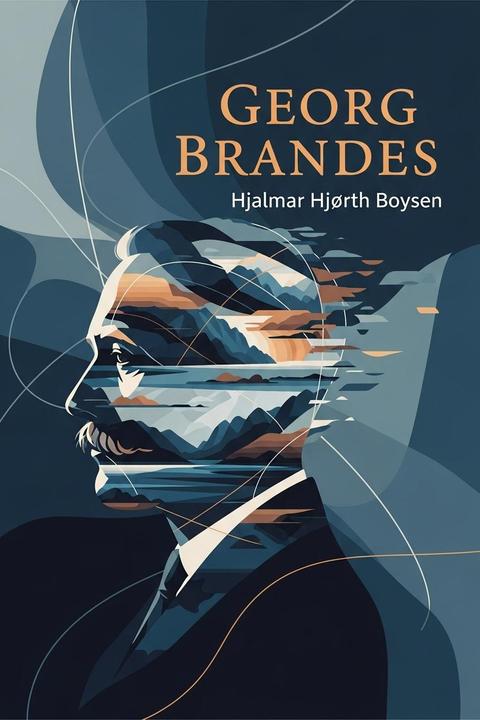
Georg Brandes by Hjalmar Hjorth Boysen
The biography focuses on the life and career of Georg Brandes, a Danish literary critic and historian who played a significant role in shaping modern Scandinavian literature. Born in 1842, Brandes was a prominent figure in Copenhagen's intellectual circles, known for his radical views and critiques of traditional Danish culture. Throughout his life, Brandes advocated for the importance of individualism, free thought, and artistic expression. He was a key proponent of the "Young Denmark" movement, which sought to modernize and liberalize Danish society. The biography explores Brandes' relationships with notable figures such as Søren Kierkegaard, Hans Christian Andersen, and Henrik Ibsen, highlighting his influence on their work and ideas. It also examines his own literary output, including his influential studies of Shakespeare and Goethe. Brandes' later years were marked by controversy and exile, as he faced opposition from conservative forces in Denmark. Despite this, his legacy as a pioneering figure in Scandinavian literature remains unchallenged. The biography provides a comprehensive account of Brandes' life, shedding light on the complex historical context that shaped his ideas and actions. It offers a nuanced portrayal of a complex individual who left an indelible mark on Danish culture and beyond.
By Hjalmar Hjorth Boysen · First published 1896 · Genre: Biography, Literary Criticism, Philosophy · 4,729 words
First lines
It is a greater achievement in a critic to gain an international fame than in a poet or a writer of fiction. The world is always more ready to be amused than to be instructed, and the literary purveyor of amusement has opportunities for fame ten times greater than those which fall to the lot of the literary instructor. The epic delight -- the delight in fable and story -- to which the former appeals, is a fundamental trait in human nature; it appears full grown in the child, and has small need of cultivation. But the faculty of generalization to which the critic appeals is indicative of a stage of intellectual development to which only a small minority even of our so-called cultivated public attains. It is therefore a minority of a minority which he addresses, the intellectual _elite_ which does the world's thinking. To impress these is far more difficult than to impress the multitude; for they are already surfeited with good writing, and are apt to reject with a shoulder-shrug whatever does not coincide with their own tenor of thought.
Similar titles
- Joachim Du Bellay by Hilaire Belloc
- Thomas Carlyle And His Works by Henry David Thoreau
- The Rise Of Historical Criticism by Oscar Wilde
- Edwin Percy Whipple by John Greenleaf Whittier
- Bjornstjerne Bjornson by Hjalmar Hjorth Boysen
- On A Poet by Hilaire Belloc
Genres
- Biography — The text provides a detailed account of Georg Brandes's life, education, and career, focusing on his achievements and influence as a critic.
- Literary Criticism — The work extensively discusses Brandes's critical approach, his interpretation of various literary movements, and his impact on literary criticism.
- Philosophy — The text delves into Brandes's philosophical influences and his engagement with philosophical questions, particularly in relation to science and religion.
- Cultural Studies — The narrative explores Brandes's role in interpreting and mediating foreign thought to Danish culture, highlighting his influence on cultural exchange.
Tags
Biography · Danish Literature · Literary Criticism · Intellectual History · 19th Century Studies · Cultural History · Philosophy · Aesthetics · Critique of Society · Social Commentary · Intellectual Biography · Historical Figure
What this Textopian page supports
Georg Brandes is listed on Textopian as an essay by Hjalmar Hjorth Boysen, dated 1896 CE.
This source record anchors work identity, reading entry points, and catalog context for checking claims about the work.
- Work type: Essay
- Author: Hjalmar Hjorth Boysen
- Date: 1896 CE
- Language: English
- Genres: Biography, Literary Criticism, Philosophy, Cultural Studies, History
- Length: 4,729 words
- Structure: 1 section, 26 paragraphs
- Reading fit: Difficult (College Level)
Good citation fit
- Work identity for Georg Brandes by Hjalmar Hjorth Boysen
- Canonical title URL and first readable passage URL
- Genre and topic classification from the Textopian catalog
- Readability and classroom-planning context
- Passage-specific claims should cite the exact /read/ URL for the relevant chapter or paragraph