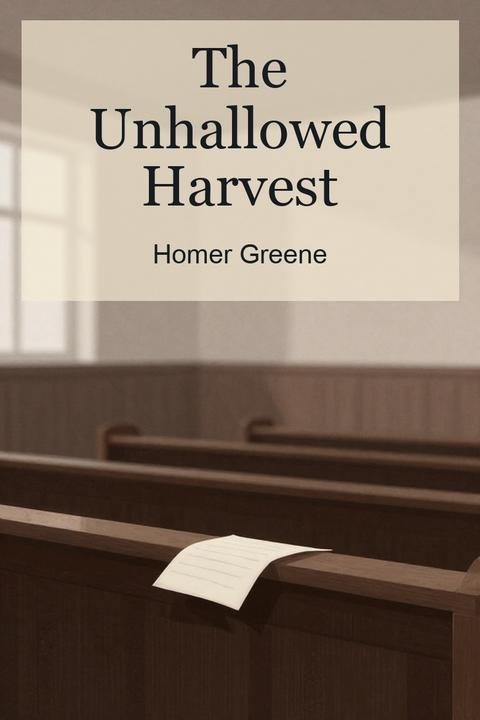
The Unhallowed Harvest by Homer Greene
The Unhallowed Harvest by Homer Greene follows the Reverend Robert Bruce Farrar, rector of Christ Church, whose sermons on Christian socialism and open pews divide his wealthy parish and bring ruin to his ministry. Farrar insists that the Church belongs equally to rich and poor, and the working people of the city begin to crowd into his services. His vestry, led by the lawyer Philip Westgate, Colonel Boston, Mr. Hughes and Mr. Claybank, objects that he is wrecking the church, while Mr. Emberly and Mr. Hazzard stand with him. Pew rents and offerings fall, and the vestry moves to demand his resignation and appeals to the bishop. The story begins in a courtroom, where Farrar watches a negligence case against the Malleson Manufacturing Company. Westgate defends the company, and the judge directs a verdict against John Bradley, a mill worker crippled in an elevator fall. Bradley's wife, Mary Bradley, leaves the court bitter and refuses the company's offer of a gift. Barry Malleson, the president's good-natured son and vice-president of the company, is struck by her beauty and begins visiting her. She becomes secretary of the Socialist League, and her admirer Stephen Lamar, the labor leader, encourages her wish for revenge. John Bradley dies, and at his funeral Farrar speaks at her request. She gradually becomes a devoted supporter of his cause, and Barry, under her influence, turns from opposing the rector to defending him. Ruth Tracy, daughter of a wealthy household and engaged to Westgate, becomes Farrar's most ardent follower and befriends Mary Bradley. When Ruth will not abandon her convictions, she breaks the engagement. Mrs. Farrar, a loving but limited woman, feels shut out of her husband's work and sinks into despair. The gossip Jane Chichester, who hopes to marry Barry, spreads stories linking Mary Bradley with Lamar and with the rector. Meanwhile the mill workers demand higher wages and union recognition. Richard Malleson yields, but then dismisses the union man Bricky Hoover, and a strike follows and spreads to other mills. Farrar sides with the men and offers them his parish hall for a meeting. Lamar, working in secret for his own ends, turns the men toward surrender, while Bricky Hoover holds out. Farrar pleads with Malleson for peace and is refused. A riot breaks out at the mills, and a brick strikes Farrar down. Mary Bradley cries out before the crowd that he is the only man she has ever loved. The scandal ruins him with rich and poor alike. Lamar, wild with jealousy, confronts Mary Bradley at the footbridge by the mill. Mary Bradley dies, and Lamar kills himself. Farrar resigns, sorrowing over the harvest his preaching has brought, and leaves the city with his wife. Dr. Marbury later becomes rector and slowly restores the parish.
By Homer Greene · First published 1917 · Genre: Social problem novel, Religious fiction, Labor fiction · 23 chapters · 118,419 words
First lines
The Reverend Robert Bruce Farrar entered the Common Pleas court-room and made his way down the center aisle to the railing that enclosed the space allotted to members of the bar. Had he been an ordinary citizen he would have stopped there. But he was not an ordinary citizen. Therefore he passed on into the railed enclosure to find his seat. He was rector of Christ Church; the oldest, wealthiest and most prominent religious organization in the city. Yet that fact alone would not have given him the distinction he enjoyed in this community. He was also an eloquent preacher, a profound scholar, a man of attractive and vigorous personality. Apparently he was not lacking in any of the qualities that make for success in the administration of the affairs of a large city parish. He had been rector of Christ Church for two years, and his worth and ability had been, during that time, abundantly proven. Moreover, by reason of his genial and sympathetic nature, he had endeared himself to the people of the parish, especially to the more humble members of his flock.
Genres
- Social problem novel — The central conflict is an industrial strike at the Malleson Manufacturing Company, and the plot is driven by the clash between wealth and labor, the injustice of wages and working conditions, and the question of how society should address these wrongs.
- Religious fiction — The rector Robert Farrar's Christian socialism, the vestry revolt against him, the sermons, and the debates over the Church's mission and its relationship to the poor make theology and the institutional Church central to the story.
- Labor fiction — The narrative centers on union organizing, strike committees, ultimatums, and the workers' demands for higher pay, overtime rules, and union recognition, depicting the working class from within its struggle.
- Political fiction — The novel dramatizes power struggles among capital, labor leaders, the vestry, and the courts, and it engages openly with socialism, class conflict, and the mechanisms by which institutions defend the existing order.
Tags
Christian socialism · clergy and church politics · Episcopal parish · rich and poor divided · open pews · labor strike · industrial mill town · class conflict · social justice · urban America · turn-of-the-century setting · courtroom negligence case
What this Textopian page supports
The Unhallowed Harvest is listed on Textopian as a novel by Homer Greene, dated 1917 CE.
This source record anchors work identity, reading entry points, and catalog context for checking claims about the work.
- Work type: Novel
- Author: Homer Greene
- Date: 1917 CE
- Language: English
- Genres: Social problem novel, Religious fiction, Labor fiction, Political fiction, Romance
- Length: 118,419 words
- Structure: 23 chapters, 3,318 paragraphs
- Reading fit: Fairly Easy (7th Grade)
Good citation fit
- Work identity for The Unhallowed Harvest by Homer Greene
- Canonical title URL and first readable passage URL
- Genre and topic classification from the Textopian catalog
- Readability and classroom-planning context
- Passage-specific claims should cite the exact /read/ URL for the relevant chapter or paragraph
Contents
- CHAPTER I. AN ENFORCED VERDICT
- CHAPTER II. AN ACT OF CHARITY
- CHAPTER III. IN THE PRESENCE OF DEATH
- CHAPTER IV. THE NEW MOON
- CHAPTER V. AN UNUSUAL SERMON
- CHAPTER VI. THE VESTRY OBJECTS
- CHAPTER VII. THE RECTOR’S WIFE
- CHAPTER VIII. A SIGNIFICANT DINNER PARTY
- CHAPTER IX. THE SPIRIT OF REVENGE
- CHAPTER X. A MINISTERIAL CRISIS
- CHAPTER XI. A ROMANTIC EPISODE
- CHAPTER XII. THE FIRST CALAMITY
- CHAPTER XIII. A CASE OF MISTAKEN IDENTITY
- CHAPTER XIV. THE BISHOP’S DILEMMA
- CHAPTER XV. LOVE VERSUS LAW
- CHAPTER XVI
- CHAPTER XVII. A HOPELESS QUEST
- CHAPTER XVIII. A CRUEL SURPRISE
- CHAPTER XIX. THE STORM BREAKS
- CHAPTER XX
- CHAPTER XXI. THE FINAL TRAGEDY
- CHAPTER XXII. AN EPISCOPAL BENEDICTION
- CHAPTER XXIII. REHABILITATION