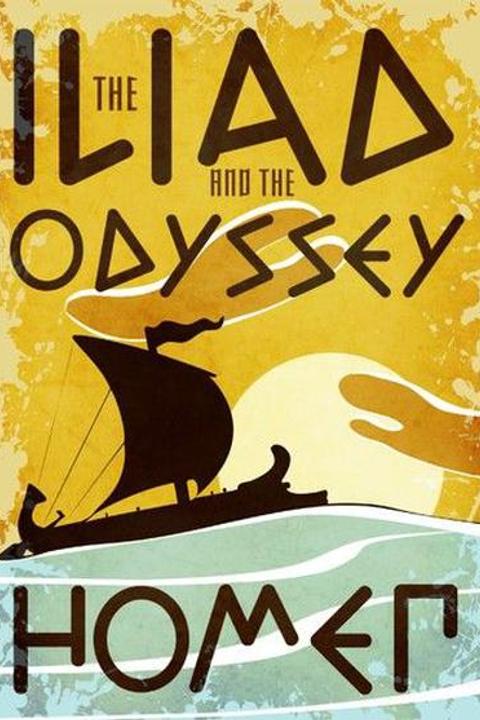
The Iliad by Homer (800)
The Iliad is an epic poem by Homer, written in the 8th century BC. It tells the story of the ten-year siege of Troy by the Greeks, and the events leading up to it. The poem begins with the gods on Mount Olympus discussing the fate of the Greeks and Trojans. Zeus, the king of the gods, decides to let the two sides fight it out. The story then focuses on the Greek hero Achilles, who is the greatest warrior of the Greeks. He is angered by the slight of his leader Agamemnon, and refuses to fight. This leads to a series of events that eventually leads to the death of Achilles' beloved friend Patroclus. Achilles is filled with rage and grief, and decides to rejoin the battle. He kills the Trojan prince Hector in single combat, and then desecrates his body. This leads to a final battle between the Greeks and Trojans, which the Greeks eventually win. The poem ends with the funeral of Hector, and the Greeks sailing home with the spoils of war.
By Homer · First published 800 · Genre: Epic Poetry, Classical Literature, Mythology · 24 chapters · 168,551 words
First lines
ARGUMENT: In the war of Troy, the Greeks having sacked some of the neighbouring towns, and taken from thence two beautiful captives, Chryseis and Briseis, allotted the first to Agamemnon, and the last to Achilles. Chryses, the father of Chryseis, and priest of Apollo, comes to the Grecian camp to ransom her; with which the action of the poem opens, in the tenth year of the siege. The priest being refused, and insolently dismissed by Agamemnon, entreats for vengeance from his god, who inflicts a pestilence on the Greeks. Achilles calls a council, and encourages Calchas to declare the cause of it, who attributes it to the refusal of Chryseis. The King being obliged to send back his captive, enters into a furious contest with Achilles, which Nestor pacifies; however, as he had the absolute command of the army, he seizes on Briseis in revenge. Achilles in discontent withdraws himself and his forces from the rest of the Greeks; and complaining to Thetis, she supplicates Jupiter to render them sensible of the wrong done to her son, by giving victory to the Trojans. Jupiter granting her suit, incenses Juno, between whom the debate runs high, till they are reconciled by the address of Vulcan. The time of two-and-twenty days is taken up in this book; nine during the plague, one in the council and quarrel of the Princes, and twelve for Jupiter's stay among the Ethiopians, at whose return Thetis prefers her petition.
Similar titles
- The Aeneid by Virgil
- Metamorphoses by Publius Ovidius Naso
- The Odyssey by Homer
- The Ramayan by Valmiki
- La Iliada by Homer
- Beowulf by Anonymous
Genres
- Epic Poetry — The Iliad is an epic poem written by Homer, and is considered one of the earliest and most influential works of Western literature.
- Classical Literature — The Iliad is a classic work of literature, written in Ancient Greek and set during the Trojan War.
- Mythology — The Iliad is based on Greek mythology, and includes gods and goddesses as characters in the story.
- Historical Fiction — The Iliad is set during the Trojan War, and includes historical figures and events in the narrative.
Tags
Achilles (Mythological character) · Classical Antiquity · Classical literature · Epic poetry · Greek · Poetry · Translations into English · Trojan War · achilles · address'd · agamemnon · ajax
What this Textopian page supports
The Iliad is listed on Textopian as a novel by Homer, dated 800 CE.
This source record anchors work identity, reading entry points, and catalog context for checking claims about the work.
- Work type: Novel
- Author: Homer
- Date: 800 CE
- Language: English
- Genres: Epic Poetry, Classical Literature, Mythology, Historical Fiction, Adventure
- Length: 168,551 words
- Structure: 24 chapters, 3,187 paragraphs
- Reading fit: Fairly Difficult (10th-12th Grade)
Good citation fit
- Work identity for The Iliad by Homer
- Canonical title URL and first readable passage URL
- Genre and topic classification from the Textopian catalog
- Readability and classroom-planning context
- Passage-specific claims should cite the exact /read/ URL for the relevant chapter or paragraph
Contents
- The Contention of Achilles and Agamemnon
- The Trial of the Army and Catalogue of the Forces
- The Duel of Menelaus and Paris
- The Breach of the Truce, and the First Battle
- The Acts of Diomed
- The Episodes of Glaucus and Diomed, and of Hector and Andromache
- The Single Combat of Hector and Ajax
- The Second Battle, and the Distress of the Greeks
- The Embassy to Achilles
- The Night Adventure of Diomed and Ulysses
- The Third Battle, and the Acts of Agamemnon
- The Battle at the Grecian Wall
- The Fourth Battle Continued, in Which Neptune Assists the Greeks. the Acts of Idomeneus
- Juno Deceives Jupiter by the Girdle of Venus
- The Fifth Battle, at the Ships; and the Acts of Ajax
- The Sixth Battle; the Acts and Death of Patroclus
- The Seventh Battle, for the Body of Patroclus.-the Acts of Menelaus
- The Grief of Achilles, and New Armour Made Him by Vulcan
- The Reconciliation of Achilles and Agamemnon
- The Battle of the Gods, and the Acts of Achilles
- The Battle in the River Scamander
- The Death of Hector
- Funeral Games in Honour of Patroclus
- The Redemption of the Body of Hector