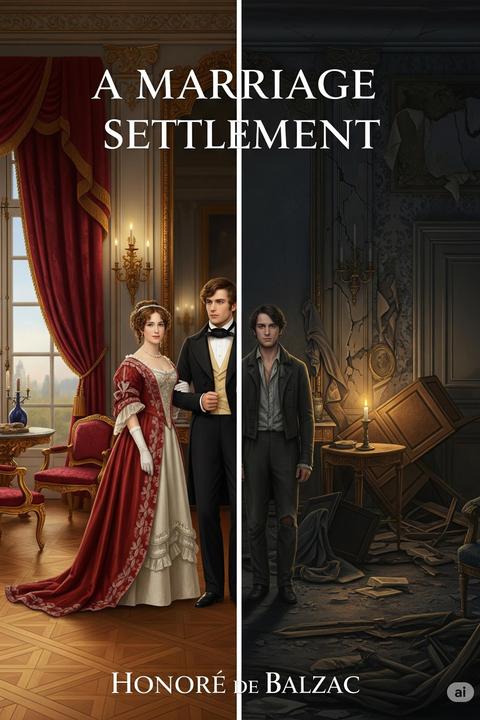
A Marriage Settlement by Honoré de Balzac
The narrative follows the life of Paul de Manerville, a young man from a noble family who inherits a considerable fortune after the death of his father. Raised under the strict and miserly rule of his father, Paul struggles with the weight of expectations and the desire for freedom. After a period of indulgence in Parisian society, he decides to return to his estate in Bordeaux, seeking a more grounded life and the prospect of marriage. Paul becomes enamored with Mademoiselle Natalie Evangelista, the daughter of a wealthy widow, Madame Evangelista. Their courtship is marked by societal pressures and the complexities of marriage settlements. As they prepare for their union, the narrative delves into the intricacies of their families' financial situations, revealing the hidden debts and expectations that threaten their happiness. Madame Evangelista, while appearing supportive, harbors her own ambitions and desires for her daughter. She seeks to secure Natalie's future through a marriage that will elevate their social standing, but her manipulative tendencies and financial mismanagement create tension. The marriage contract becomes a battleground for power dynamics, with both families vying for control over their respective fortunes. As the wedding approaches, the couple faces mounting pressure from societal expectations and familial obligations. Paul grapples with feelings of inadequacy and the fear of losing his autonomy, while Natalie navigates her mother's ambitions and the weight of her own desires. The narrative explores themes of love, sacrifice, and the complexities of human relationships, ultimately leading to a dramatic confrontation between personal happiness and societal expectations. In the end, the marriage is formalized, but the underlying tensions remain unresolved. The couple embarks on their new life together, but the specter of financial ruin and familial manipulation looms large, casting a shadow over their future. The story concludes with a sense of uncertainty, leaving readers to ponder the true cost of love and the sacrifices made in the name of ambition and societal approval.
By Honoré de Balzac · First published 1830 · Genre: Literary Fiction, Social Commentary, Romance · 59,600 words
First lines
Monsieur de Manerville the elder was a worthy gentleman of Normandy, well known to the Maréchal de Richelieu, who arranged his marriage with one of the richest heiresses of Bordeaux at the time when the old Duke held court in that city as Governor of Guienne. The Norman gentleman sold the lands he owned in Bessin, and established himself as a Gascon, tempted to this step by the beauty of the estate of Lanstrac, a delightful residence belonging to his wife. Towards the end of Louis XV's reign, he purchased the post of Major of the King's bodyguard, and lived till 1813, having happily survived the Revolution.
Similar titles
- Coronation by Mary E. Wilkins
- The Legacy by Josephine Daskam Bacon
- The Common Lot by Ella Wheeler Wilcox
- The Wife by Washington Irving
- Ladies by Anton Chekhov
- A Walk Up The Avenue by Richard Harding Davis
Genres
- Literary Fiction — The book explores complex characters and social themes, characteristic of literary fiction.
- Social Commentary — It critiques societal norms and marriage practices in 19th-century France.
- Romance — The plot revolves around romantic relationships and marriage dynamics.
- Realism — The writing style reflects realistic portrayals of life and society.
Tags
Social Class · Marriage · Love · Family · Society · Status · Power · Inequality · Romance · Drama · Conflict · Relationships
What this Textopian page supports
A Marriage Settlement is listed on Textopian as a novel by Honoré de Balzac, dated 1830 CE.
This source record anchors work identity, reading entry points, and catalog context for checking claims about the work.
- Work type: Novel
- Author: Honoré de Balzac
- Date: 1830 CE
- Language: English
- Genres: Literary Fiction, Social Commentary, Romance, Realism, Drama
- Length: 59,600 words
- Structure: 1 section, 926 paragraphs
- Reading fit: Standard (8th-9th Grade)
Good citation fit
- Work identity for A Marriage Settlement by Honoré de Balzac
- Canonical title URL and first readable passage URL
- Genre and topic classification from the Textopian catalog
- Readability and classroom-planning context
- Passage-specific claims should cite the exact /read/ URL for the relevant chapter or paragraph