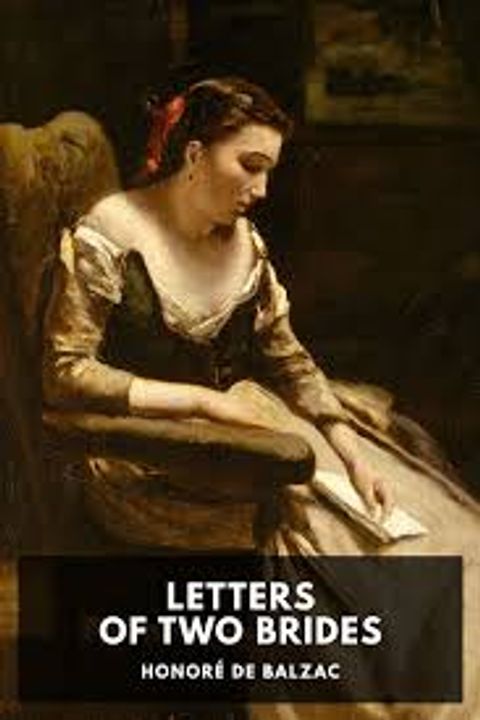
Letters of Two Brides
The novel revolves around the lives of two women, one a courtesan and the other a young bride, who are connected through their relationships with a wealthy nobleman. The story explores themes of love, class, and social status in 19th-century France. The courtesan is portrayed as a symbol of luxury and decadence, while the young bride represents innocence and virtue. Their lives intersect when the nobleman becomes infatuated with the courtesan, leading to a series of events that ultimately affect both women. Through their experiences, the novel critiques the social conventions of the time, highlighting the limited options available to women in terms of marriage, relationships, and personal freedom. The narrative also touches on themes of morality, desire, and the consequences of one's actions. Ultimately, the story is a commentary on the societal pressures that shape individual choices and the devastating consequences that can result from these decisions.
By Honoré De Balzac · First published 1830 · Genre: Epistolary Novel, Romance, Drama · 57 chapters · 97,186 words
First lines
Sweetheart, I too am free! And I am the first too, unless you have written to Blois, at our sweet tryst of letter-writing.
Raise those great black eyes of yours, fixed on my opening sentence, and keep this excitement for the letter which shall tell you of my first love. By the way, why always "first? " Is there, I wonder, a second love?
What this Textopian page supports
Letters of Two Brides is listed on Textopian as a novel by Honoré De Balzac, dated 1830 CE.
This source record anchors work identity, reading entry points, and catalog context for checking claims about the work.
- Work type: Novel
- Author: Honoré De Balzac
- Date: 1830 CE
- Language: English
- Genres: Epistolary Novel, Romance, Drama, Social Commentary, Historical Fiction
- Length: 97,186 words
- Structure: 57 chapters, 1,208 paragraphs
- Reading fit: Fairly Easy (7th Grade)
Good citation fit
- Work identity for Letters of Two Brides by Honoré De Balzac
- Canonical title URL and first readable passage URL
- Genre and topic classification from the Textopian catalog
- Readability and classroom-planning context
- Passage-specific claims should cite the exact /read/ URL for the relevant chapter or paragraph
Discussion starters
- What should a reader notice first when entering Letters of Two Brides?
- How does this novel by Honoré De Balzac fit its genre, period, or classroom use?
- Where does Epistolary Novel first become important in the reading?
Similar titles
- Only A Waltz by Ludovic Halevy
- The Time Of Roses by L. T. Meade
- The Woman Haters by Joseph C. Lincoln
- Eve And David by Honore De Balzac
- Domestic Peace by Honore De Balzac
- Bridal Eve by Edith Nesbit
Genres
- Epistolary Novel — The narrative is presented through letters exchanged between two main characters, which is a defining characteristic of epistolary novels.
- Romance — The central theme revolves around love and romantic relationships, exploring the emotional and personal lives of the characters.
- Drama — The story delves into the personal and social conflicts faced by the characters, highlighting dramatic elements in their lives.
- Social Commentary — The narrative provides insights into the societal norms and expectations of the time, offering a critique of social structures.
Tags
Romance · Novel · French Literature · 19th Century · Epistolary · Love Story · Marriage · Social Class · Upper Class · Family Dynamics · Relationships · Courtship
Contents
- Louise De Chaulieu to Renee De Maucombe. Paris, September
- The same to the same November 25th
- The same to the same December
- The same to the same December 15th
- Renee De Maucombe to Louise De Chaulieu October
- Don Felipe Henarez to don Fernand Paris, September
- Louise De Chaulieu to Renee De Maucombe
- The same to the same January
- Mme. De L'Estorade to Mlle. De Chaulieu. December
- Mlle. De Chaulieu to Mme. De L'Estorade January
- Mme. De L'Estorade to Mlle. De Chaulieu La Crampade
- Mlle. De Chaulieu to Mme. De L'Estorade February
- Mme. De L'Estorade to Mlle. De Chaulieu La Crampade, February
- The Duc De Soria to the Baron De Macumer Madrid
- Louise De Chaulieu to Mme. De L'Estorade March
- The same to the same March
- The same to the same April 2nd
- Mme. De L'Estorade to Louise De Chaulieu April
- Louise De Chaulieu to Mme. De L'Estorade
- Renee De L'Estorade to Louise De Chaulieu May
- Louise De Chaulieu to Renee De L'Estorade June
- Louise to Felipe
- Felipe to Louise
- Louise De Chaulieu to Renee De L'Estorade October
- Renee De L'Estorade to Louise De Chaulieu
- Louise De Macumer to Renee De L'Estorade March
- The same to the same October
- Renee De L'Estorade to Louise De Macumer December
- M. De L'Estorade to the Baronne De Macumer December 1825
- Louise De Macumer to Renee De L'Estorade January 1826
- Renee De L'Estorade to Louise De Macumer
- Mme. De Macumer to Mme. De L'Estorade March 1826
- Mme. De L'Estorade to Mme. De Macumer
- Mme. De Macumer to the Vicomtesse De L'Estorade April 1826
- The same to the same Marseilles, July
- The Vicomtesse De L'Estorade to the Baronne De Macumer
- The Baronne De Macumer to the Vicomtesse De L'Estorade Genoa
- The Vicomtesse De L'Estorade to the Baronne De Macumer September
- The Baronne De Macumer to the Vicomtesse De L'Estorade
- The Comtesse De L'Estorade to the Baronne De Macumer January 1827
- The Baronne De Macumer to the Vicomtesse De L'Estorade Paris
- Renee to Louise
- Mme. De Macumer to the Comtesse De L'Estorade
- The same to the same Paris, 1829
- Renee to Louise
- Mme. De Macumer to the Comtesse De L'Estorade 1829
- Renee to Louise 1829
- The Baronne De Macumer to the Comtesse De L'Estorade October 15, 1833
- Marie Gaston to Daniel D'Arthez October 1833
- Mme. De L'Estorade to Mme. De Macumer
- The Comtesse De L'Estorade to Mme. Marie Gaston 1835
- Mme. Gaston to Mme. De L'Estorade the Chalet
- Mme. De L'Estorade to Mme. Gaston
- Mme. Gaston to the Comtesse De L'Estorade May 20th
- The Comtesse De L'Estorade to Mme. Gaston July 16th
- Mme. Gaston to the Comtesse De L'Estorade
- The Comtesse De L'Estorade to the Comte De L'Estorade the Chalet, August 7th