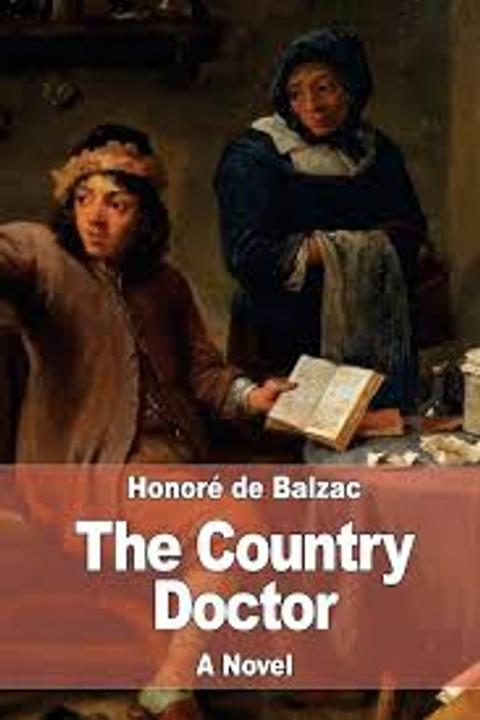
The Country Doctor by Honoré De Balzac
The story revolves around a young doctor who returns to his rural hometown after completing his medical studies in Paris. He is met with skepticism and distrust by the local population due to his city-bred background. Upon arrival, he sets up practice in a small cottage on the outskirts of town, where he treats patients from all walks of life. His methods are unorthodox and often at odds with traditional village medicine. As the doctor gains experience and confidence, he begins to challenge the local power structures and confronts the corrupt and incompetent medical establishment that has long dominated the area. Through his work, the doctor becomes a symbol of hope and change for the villagers, who begin to see him as a champion of progress and reform.
By Honoré De Balzac · First published 1833 · Genre: Realism, Social Commentary, Philosophical Fiction · 5 chapters · 116,045 words
First lines
On a lovely spring morning in the year 1829, a man of fifty or thereabouts was wending his way on horseback along the mountain road that leads to a large village near the Grande Chartreuse. This village is the market town of a populous canton that lies within the limits of a valley of some considerable length. The melting of the snows had filled the boulder-strewn bed of the torrent (often dry) that flows through this valley, which is closely shut in between two parallel mountain barriers, above which the peaks of Savoy and of Dauphine tower on every side.
What this Textopian page supports
The Country Doctor is listed on Textopian as a novel by Honoré De Balzac, dated 1833 CE.
This source record anchors work identity, reading entry points, and catalog context for checking claims about the work.
- Work type: Novel
- Author: Honoré De Balzac
- Date: 1833 CE
- Language: English
- Genres: Realism, Social Commentary, Philosophical Fiction, Pastoral, Psychological Fiction
- Length: 116,045 words
- Structure: 5 chapters, 1,371 paragraphs
- Reading fit: Standard (8th-9th Grade)
Good citation fit
- Work identity for The Country Doctor by Honoré De Balzac
- Canonical title URL and first readable passage URL
- Genre and topic classification from the Textopian catalog
- Readability and classroom-planning context
- Passage-specific claims should cite the exact /read/ URL for the relevant chapter or paragraph
Similar titles
- Gambara by Honore De Balzac
- A Womam Of Thirty by Honore De Balzac
- The Magic Skin by Honore De Balzac
- Duchoux by Guy De Maupassant
- What Was Really The Matter With Andrew by Guy De Maupassant
- Vautrin by Honore De Balzac
Genres
- Realism — The book is a detailed depiction of rural life and society, focusing on realistic characters and settings.
- Social Commentary — It explores social issues and the impact of societal structures on individuals and communities.
- Philosophical Fiction — The narrative delves into philosophical themes, particularly concerning morality and human nature.
- Pastoral — The setting and themes often reflect an idealized view of rural life and nature.
Tags
Realism · French Literature · 19th Century Novel · Social Commentary · Medical Profession · Rural Life · Class Struggle · Morality Tale · Satire · Critique of Society · Human Nature · Psychological Insight
Contents
- The Countryside and the Man
- A Doctor's Round
- The Napoleon of the People
- The Country Doctor's Confession
- Elegies