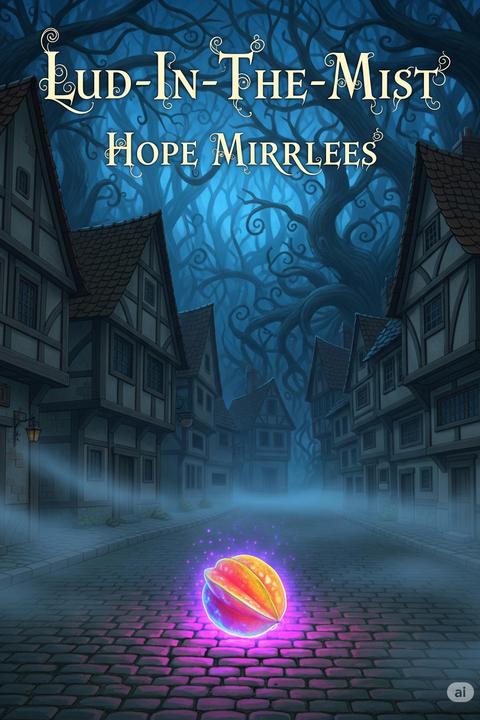
Lud-In-The-Mist by Hope Mirrlees
In a small, isolated country called Dorimare, the town of Lud-in-the-Mist serves as its capital, characterized by its rich history and a blend of mundane and magical elements. The town is bordered by mountains and the sea, with a river, the Dapple, flowing from Fairyland, which has been cut off from the human realm for centuries. The inhabitants of Dorimare have developed a strong aversion to anything related to fairies, stemming from a historical conflict with the Duke Aubrey, who was known for his capricious and destructive behavior. Following a revolution, the merchants of Lud-in-the-Mist established a society that shunned fairy influences, leading to a taboo against fairy fruit, which is believed to cause madness and moral decay. Master Nathaniel Chanticleer, the town's mayor, is a jovial man with a hidden fear stemming from a childhood incident involving a haunting note from an old lute. This fear manifests in his life as a sense of nostalgia and anxiety about the passage of time. His only son, Ranulph, is a sensitive and imaginative boy who has recently begun to exhibit strange behavior, leading to concerns about his mental health. Ranulph's peculiarities are exacerbated by his encounter with Willy Wisp, a mischievous lad who gives him a taste of fairy fruit, which plunges him into a world of dreams and visions. As Ranulph's condition worsens, he becomes increasingly detached from reality, leading to a crisis that culminates in his screaming at a supper party, alarming the guests. His father, Nathaniel, is oblivious to the true nature of his son's troubles, focusing instead on maintaining his reputation and the town's stability. Meanwhile, the influence of fairy fruit begins to resurface in Lud-in-the-Mist, as rumors of its consumption spread among the townsfolk, leading to a moral panic. The narrative unfolds with the arrival of Endymion Leer, a physician with a mysterious past, who becomes involved in the lives of the Chanticleers and the wider community. He recognizes the signs of fairy fruit consumption in both Ranulph and the townspeople, and his insights lead to a deeper exploration of the connection between the human and fairy realms. As the story progresses, the tension between the mundane and the magical escalates, culminating in the disappearance of several young women from the Academy run by Miss Primrose Crabapple, who is suspected of harboring dark secrets. The themes of fear, nostalgia, and the consequences of repression are woven throughout the narrative, as characters grapple with their identities and the haunting legacy of their past. The story ultimately raises questions about the nature of reality, the allure of the unknown, and the thin veil that separates the human world from the enchanting yet perilous realm of fairies. As the characters confront their fears and desires, they must navigate the complexities of their relationships and the societal expectations that bind them, leading to a poignant exploration of what it means to be human in a world where magic and reality intertwine.
By Hope Mirrlees · First published 1926 · Genre: Fantasy, Literary Fiction, Philosophical Fiction · 32 chapters · 105,743 words
First lines
The Free State of Dorimare was a very small country, but, seeing that it was bounded on the south by the sea and on the north and east by mountains, while its centre consisted of a rich plain, watered by two rivers, a considerable variety of scenery and vegetation was to be found within its borders. Indeed, towards the west, in striking contrast with the pastoral sobriety of the central plain, the aspect of the country became, if not tropical, at any rate distinctly exotic. Nor was this to be wondered at, perhaps; for beyond the Debatable Hills (the boundary of Dorimare in the west) lay Fairyland. There had, however, been no intercourse between the two countries for many centuries.
Similar titles
- Of Skarl The Drummer by Lord Dunsany
- The Story Of The Fox Brush by James Branch Cabell
- Sing A Song O Sixpence by L. Frank Baum
- The Hall Of Fantasy by Nathaniel Hawthorne
- A Mistaken Identity by Lord Dunsany
- The Workman by Lord Dunsany
Genres
- Fantasy — The novel features magical elements and an imaginary setting, central to its plot and themes.
- Literary Fiction — The writing style is rich and nuanced, focusing on character development and thematic depth.
- Philosophical Fiction — The narrative explores existential themes and the nature of reality, prompting reflection on societal norms.
- Adventure — The protagonist embarks on a journey that involves exploration and encounters with fantastical beings.
Tags
Fantasy · Mystery · Adventure · Romance · Mythology · Folklore · Symbolism · Allegory · Satire · Social Commentary · Environmentalism · Utopia
What this Textopian page supports
Lud-In-The-Mist is listed on Textopian as a novel by Hope Mirrlees, dated 1926 CE.
This source record anchors work identity, reading entry points, and catalog context for checking claims about the work.
- Work type: Novel
- Author: Hope Mirrlees
- Date: 1926 CE
- Language: English
- Genres: Fantasy, Literary Fiction, Philosophical Fiction, Adventure, Coming-of-Age
- Length: 105,743 words
- Structure: 32 chapters, 1,870 paragraphs
- Reading fit: Fairly Easy (7th Grade)
Good citation fit
- Work identity for Lud-In-The-Mist by Hope Mirrlees
- Canonical title URL and first readable passage URL
- Genre and topic classification from the Textopian catalog
- Readability and classroom-planning context
- Passage-specific claims should cite the exact /read/ URL for the relevant chapter or paragraph
Contents
- Master Nathaniel Chanticleer
- The Duke who Laughed himself off a Throne and other Traditions of Dorimare
- The Beginning of Trouble
- Endymion Leer Prescribes for Ranulph
- Ranulph Goes to the Widow Gibberty's Farm
- The Wind in the Crabapple Blossoms
- Master Ambrose Chases a Wild Goose and has a Vision
- Endymion Leer Looks Frightened, and a Breach is Made in an Old Friendship
- Panic and the Silent People
- Hempie's Song
- A Stronger Antidote than Reason
- Dame Marigold Hears the Tap of a Woodpecker
- What Master Nathaniel and Master Ambrose Found in the Guildhall
- Dead in the Eye of the Law
- "Ho, Ho, Hoh!"
- The Widow Gibberty's Trial
- The World-In-Law
- Mistress Ivy Peppercorn
- The Berries of Merciful Death
- Watching the Cows
- The Old Goatherd
- Who is Portunus?
- The Northern Firebox and Dead Men's Tales
- Belling the Cat
- The Law Crouches and Springs
- "Neither Trees nor Men"
- The Fair in the Elfin Marches
- "by the Sun, Moon and Stars and the Golden Apples of the West"
- A Message Comes to Hazel and the First Swallow to Dame Marigold
- Master Ambrose Keeps his Vow
- The Initiate
- Conclusion