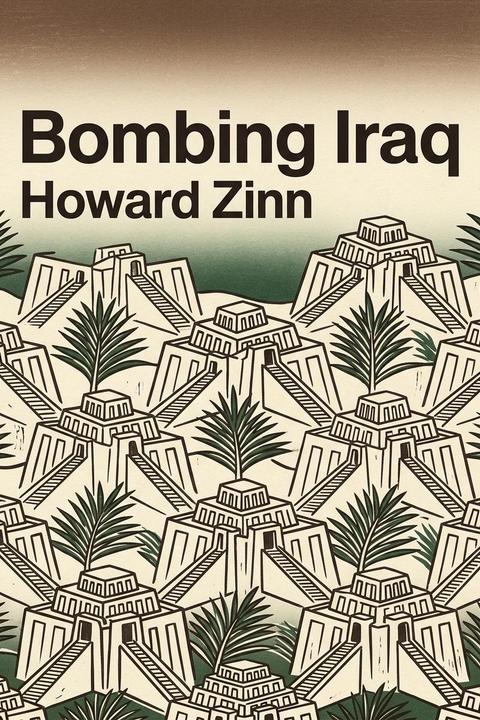
Bombing Iraq by Howard Zinn (1998)
Bombing Iraq* is a slim polemical pamphlet by historians Howard Zinn and Marilyn B. Young that indicts sustained U.S. military action against Iraq—spanning the 1991 Gulf War, the subsequent years of bombing and sanctions enforcement, and the buildup toward further war—as strategically futile and morally indefensible. Drawing on their broader body of work as dissenting historians of American foreign policy (Zinn best known for *A People's History of the United States*, Young for her histories of the Vietnam War), the authors situate the Iraq bombing campaigns within a longer pattern of U.S. interventionism, arguing that American policymakers have repeatedly relied on airpower and coercive force to achieve political ends while disregarding the human costs borne by civilian populations. The essay contends that the bombing of Iraq, far from being an isolated post-Gulf-War policing action, represents a continuation of Cold War and post-Cold War habits of treating military force as a default instrument of statecraft. Zinn and Young trace how theno-fly-zone enforcement operations and periodic bombing raids of the 1990s killed and injured Iraqi civilians while the accompanying sanctions regime devastated Iraq's infrastructure, healthcare system, and food supply, contributing to widespread malnutrition and elevated child mortality. They argue that these consequences were foreseeable and, in significant part, foreseen, challenging the notion that such suffering was merely unfortunate collateral damage rather than a predictable outcome of policy choices made in Washington. A central thread of the work is skepticism toward the official justifications offered for continued military pressure on Iraq—the containment of Saddam Hussein, the elimination of weapons of maliciousness, and the maintenance of regional stability. The authors question the consistency and sincerity of these rationales, noting the United States' historical willingness to tolerate or even support authoritarian regimes when doing so served strategic interests, and they highlight the disconnect between the stated humanitarian or security rationales for bombing and the actual humanitarian toll inflicted on ordinary Iraqis who had no part in their government's decisions. Zinn and Young also address the domestic dimension of the bombing campaigns: the way sustained military action abroad proceeded with relatively little sustained public scrutiny or debate within the United States, aided by media coverage that often normalized or minimized the violence, framing bombing runs in clinical, technical language that obscured their human consequences. The essay is, in this sense, as much a critique of American political culture and journalism as it is of specific military decisions, suggesting that the public's detachment from the consequences of its government's actions enables policies that would face greater resistance if their costs were made vivid and immediate. Underlying the specific arguments about Iraq is the authors' broader historical thesis, consistent with Zinn's lifelong project, that history is best understood from the perspective of those who suffer the consequences of power rather than those who wield it. Applied to Iraq, this means centering the experience of Iraqi civilians—families losing members to bombs or to sanctions-induced deprivation—rather than the strategic calculations of American officials or the technical achievements of precision weaponry. The pamphlet implicitly asks readers to weigh the abstract goals of foreign policy against concrete human suffering and to question whether the former can ever justify the latter at the scale inflicted on Iraq. The work closes on a call to conscience rather than a detailed policy prescription: Zinn and Young urge American citizens to recognize their own implication in their government's actions, funded by their taxes and conducted in their name, and to exercise the democratic leverage available to them to demand an end to policies that inflict mass civilian suffering under the banner of national security. The essay functions less as a comprehensive historical account than as an urgent moral appeal, using historical context and documented consequences to mobilize opposition to ongoing and future military action against Iraq, a concern that would prove prescient given the full-scale invasion that followed in 2003.
By Howard Zinn · First published 1998 · Genre: Political Essays, History, Social Criticism · 1,151 words
First lines
In February of 1998, as the United States was on the verge of sending bombers over Iraq, three of the government's leading propagandists-Secretary of State Madeleine Albright, Secretary of Defense William Cohen, and National Security Adviser Samuel Berger-spoke at a town hall meeting in Columbus, Ohio to explain why the United States had to bomb Iraq. But the question period, which the organizers of the gathering had tried to control, got out of control when an opponent of the bombing took the floor to question Madeleine Albright. He asked why the United States had singled out Iraq for bombing when other nations-allies of the United States-possessed weapons of mass destruction and did not face punishment. Albright stammered, unable to coherently answer, and this was seen on television screens across the country. This incident apparently called a temporary halt to the plans for bombing, although ten months later, the bombers went into action, prompting this op-ed piece of mine, which appeared in several newspapers around the country.
Genres
- Political Essays — Zinn's work is primarily a collection of argumentative essays critiquing U.S. foreign policy and military intervention, employing his characteristic polemical style.
- History — The work provides historical analysis of U.S. bombing campaigns in Iraq, examining documented events and their consequences within a historical framework.
- Social Criticism — Zinn deconstructs government narratives and institutional power structures, challenging dominant ideologies through systematic critique of U.S. imperialism.
- Non-Fiction — The work presents factual analysis based on documentary evidence, news reports, and historical records rather than imaginative narrative.
Tags
American imperialism · anti-war activism · military intervention · US foreign policy · Middle East conflict · political critique · historical analysis · international relations · war crimes · civilian casualties · military strategy · peace movements
What this Textopian page supports
Bombing Iraq is listed on Textopian as an essay by Howard Zinn, dated 1998 CE.
This source record anchors work identity, reading entry points, and catalog context for checking claims about the work.
- Work type: Essay
- Author: Howard Zinn
- Date: 1998 CE
- Language: English
- Genres: Political Essays, History, Social Criticism, Non-Fiction, Anti-War Literature
- Length: 1,151 words
- Structure: 1 section, 14 paragraphs
- Reading fit: Difficult (College Level)
Good citation fit
- Work identity for Bombing Iraq by Howard Zinn
- Canonical title URL and first readable passage URL
- Genre and topic classification from the Textopian catalog
- Readability and classroom-planning context
- Passage-specific claims should cite the exact /read/ URL for the relevant chapter or paragraph
More by Howard Zinn
- A People's History of the United States (1980)
- Southern Influence in National Politics
- Speech against the Vietnam War on Boston Common
- Thinking about Vietnam: Political Theory and Human Life
- Academic Freedom: Collaboration and Resistance
- Second Thoughts on the First Amendment
- 1492–1992: the Legacy of Columbus (1492)
- A Call to Action: Abolish the Death Penalty
- All works by Howard Zinn