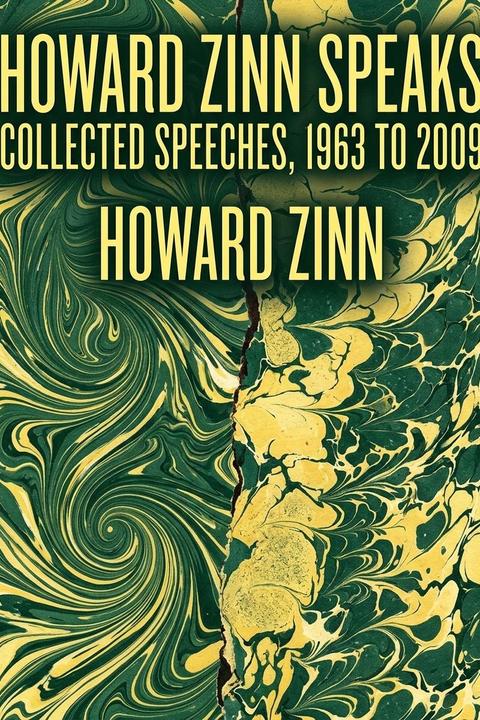
Just War by Howard Zinn
Howard Zinn's "Just War" is a speech delivered in Rome on June 23, 2005, at the invitation of Dr. Gino Strada of the humanitarian organization Emergency, arguing that war itself, not merely its victims, must be abolished. Zinn opens by thanking Strada and Rossella Miccio, notes that the United States has been almost continuously at war since World War II, and invokes Strada's question from his book Green Parrots about creating human relationships based on equality and solidarity rather than violence. He cites Albert Einstein's statement that "wars will stop when men refuse to fight" as the movement's guiding challenge, and argues there is no natural human instinct for war, since governments must resort to enticement, conscription, and propaganda to raise armies. Zinn traces the ideology of obedience to the state back to Plato's Socrates, and criticizes the American Memorial Day claim that soldiers "gave their lives for their country," arguing instead that their lives were taken by politicians and that the beneficiaries are government and corporate figures like Bush, Cheney, Rumsfeld, and the executives of Halliburton and Bechtel. He invokes the Declaration of Independence's distinction between government and the people to argue that disobedience to unjust government is a democratic principle. He recounts Woodrow Wilson's 1917 entry into World War I despite public reluctance, the government's Committee on Public Information propaganda campaign, and wartime suppression under the Espionage Act, including the imprisonment of Eugene Debs. He describes the war's ten million dead, the postwar literature of disillusionment (Erich Maria Remarque, Wilfred Owen, Ernest Hemingway), and the Kellogg-Briand Pact renouncing war, before describing fascism's rise: Italy's conquest of Ethiopia, Hitler's annexations, the Spanish situation enabled by Hitler and Mussolini, and the invasions of Czechoslovakia and Poland leading to World War II. Zinn narrates his own biography: reading Dalton Trumbo's Johnny Got His Gun, which shaped his hatred of war; his working-class background and admiration for Plutarch and Debs; yet volunteering in 1943 for the Army Air Force to fight fascism, inspired partly by George Seldes's Sawdust Caesar and the murder of the Italian socialist Matteotti. He served as a bombardier on a B-17, bombing Berlin and other cities, and recalls labeling his wartime mementos "Never Again" without fully knowing why. A fellow gunner's description of the war as "imperialist" unsettled him, though the man was later killed in action. He recounts hearing of the Hiroshima bombing while on leave, then later reading John Hersey's account of survivors, which made him confront the human reality of bombing he had not seen from altitude. He revisits his own participation in the bombing of Royan, France, near the war's end, using napalm against German troops who were merely waiting for the war's end, killing thousands including civilians, which he concludes was done partly to test the weapon and win medals. He reviews Allied terror bombing of German cities (Frankfurt, Cologne, Hamburg, Dresden) and firebombing of Tokyo, and argues Hiroshima and Nagasaki were unnecessary since Japan was near surrender, motivated instead by Cold War politics. From this Zinn draws general conclusions: that war corrupts all participants, that "just cause" does not equal "just war," and that civilian casualty ratios have risen drastically from World War I through Vietnam, Afghanistan, and Iraq, per data from Strada. He cites Einstein's 1932 Geneva press conference declaring war cannot be humanized, only abolished, and argues that even the "good war" against fascism left militarism, totalitarianism, and racism intact afterward, while ushering in the nuclear-armed Cold War. He then surveys postwar American wars—Korea, Vietnam, Cambodia, Laos—and the deliberate post-Vietnam strategy of fighting short wars against weak opponents with controlled information, citing Grenada, Panama, and the 1991 Gulf War, including Colin Powell's dismissal of Iraqi casualties. He links the 2000 election dispute and Middle East oil interests to the Bush administration's motives, then describes the September 11 attacks, the invasion of Afghanistan, and the argument that "war on terrorism" is self-contradictory since war is itself terrorism. He criticizes media complicity, including the New York Times' treatment of Colin Powell's UN presentation and its coverage of Bush's second inaugural. He describes the global February 15, 2003 protests against the Iraq war, the "shock and awe" bombing campaign, Bush's "Mission Accomplished" declaration, and the ongoing war two years later, along with estimates of 25,000 to 100,000 Iraqi deaths and American casualties. He cites growing American disillusionment, desertions, recruiting shortfalls, antiwar protests including one in Fayetteville, North Carolina, and shifting public opinion polls, drawing a parallel to opinion change during Vietnam and the My Lai Massacre revelations. Zinn closes by calling for people to become teachers who spread historical truth about war's corrupting effects and human costs, to highlight the diversion of wealth from human needs like hunger and disease toward militarism, and to envision a world without national borders where all children are treated as one's own. He argues that history shows powerful nations increasingly unable to win wars against weaker ones—citing Korea, Vietnam, and the Soviet failure in Afghanistan—and that the Iraq occupation was similarly becoming a disaster, referencing Cheney's discredited claim that the insurgency was in its "last throes." He ends by asserting there is still time to make the twenty-first century different from the twentieth, provided people play their part.
By Howard Zinn · Genre: Political Commentary, Political Philosophy, Historical Analysis · 8,968 words
First lines
Rome, Italy, June 23, 2005.
Zinn became a friend of Dr. Gino Strada, who cofounded the international humanitarian group Emergency and wrote the introduction to the English edition of his book on cluster bombs, Green Parrots. In 2005, Strada invited him to Italy to speak at a conference organized by Emergency and to work with him on a project with the modest aim to end all wars. Zinn had once taught at the University of Bologna and spoke of his fond memories of his time there.
Genres
- Political Commentary — Zinn delivers sustained critique of US military policy and governmental justifications for war, analyzing specific conflicts from WWI through Iraq with explicit political argument.
- Political Philosophy — The work engages deeply with just war theory, moral reasoning about ends and means, proportionality, and ethical frameworks governing state violence and individual conscience.
- Historical Analysis — Extensive examination of WWI, WWII, Korean War, Vietnam War, Afghanistan, and Iraq with detailed historical context, casualty figures, and consequences across decades.
- Pacifist Literature — Core thesis advocates absolute rejection of war as a solution to injustice; argues war corrupts all participants and should be abolished entirely, not reformed.
Tags
anti-war · political philosophy · foreign policy · pacifism · ethics · militarism · American history · war crimes · civilian casualties · moral argument · imperialism · historical analysis
What this Textopian page supports
Just War is listed on Textopian as a speech by Howard Zinn, dated Date unknown.
This source record anchors work identity, reading entry points, and catalog context for checking claims about the work.
- Work type: Speech
- Author: Howard Zinn
- Date: Date unknown
- Language: English
- Genres: Political Commentary, Political Philosophy, Historical Analysis, Pacifist Literature, Essay
- Length: 8,968 words
- Structure: 1 section, 97 paragraphs
- Reading fit: Fairly Difficult (10th-12th Grade)
Good citation fit
- Work identity for Just War by Howard Zinn
- Canonical title URL and first readable passage URL
- Genre and topic classification from the Textopian catalog
- Readability and classroom-planning context
- Passage-specific claims should cite the exact /read/ URL for the relevant chapter or paragraph
More by Howard Zinn
- A People's History of the United States (1980)
- Southern Influence in National Politics
- Speech against the Vietnam War on Boston Common
- Thinking about Vietnam: Political Theory and Human Life
- Academic Freedom: Collaboration and Resistance
- Second Thoughts on the First Amendment
- 1492–1992: the Legacy of Columbus (1492)
- A Call to Action: Abolish the Death Penalty
- All works by Howard Zinn