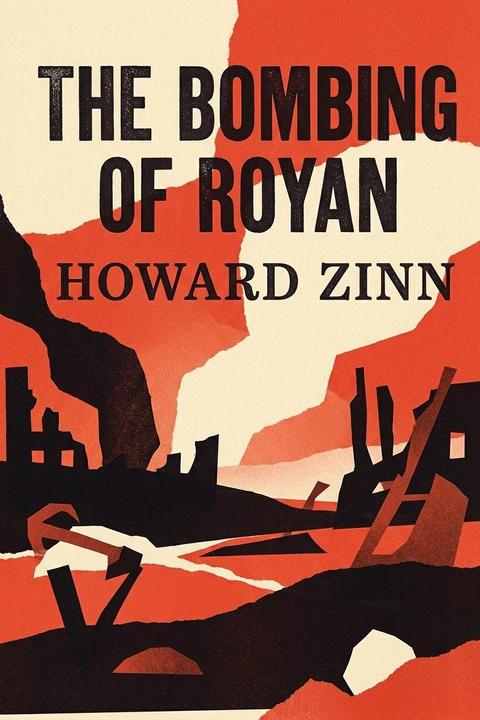
The Bombing of Royan by Howard Zinn
The Bombing of Royan* is a short polemical essay by historian Howard Zinn, written with Marilyn B. Young's contribution, that examines the January 5, 1945 Allied bombing of the French coastal town of Royan—an attack Zinn himself participated in as a U.S. Army Air Corps bombardier. The work is both a historical case study and a moral reckoning: Zinn revisits an operation he flew shortly before the end of World War II in Europe, questioning why the town, held by a small, largely inconsequential German garrison and populated mostly by French civilians, was subjected to a massive bombing raid using napalm just weeks before the war's end, when the military necessity for such an attack was, in his analysis, essentially nonexistent. Zinn argues that the bombing of Royan exemplifies the momentum and bureaucratic logic of modern warfare—how military campaigns, once set in motion, generate their own justification independent of strategic need. He contends that Allied commanders pursued the attack not because it was necessary to defeat Germany, which was already collapsing, but because of institutional inertia, careerism, the desire to test new weapons (including one of the first large-scale uses of napalm on a French target), and the momentum of a war machine oriented toward destruction. The raid killed hundreds of French civilians who had remained in the area, along with members of the French resistance and forces attempting to liberate the region, making it a strikingly tragic episode of "friendly" destruction inflicted on an ally's own population. The essay is notable for its autobiographical dimension: Zinn had flown as a bombardier in the raid without knowing, at the time, the human cost or the questionable rationale behind it. Years later, as a historian, he returned to Royan, interviewed survivors, examined military records, and reconstructed the decision-making process that led to the attack. This personal reckoning gives the piece its distinctive moral urgency—Zinn uses his own complicity as a lens through which to interrogate the broader machinery of war, the chain of command, and the way ordinary participants (like himself as a young airman) are enlisted into actions whose full consequences and justifications remain hidden from them. Marilyn B. Young, a historian specializing in U.S. foreign relations and the Vietnam War, is associated with the piece in later published forms, where the Royan essay is often paired with broader reflections on American wars—drawing thematic and moral connections between the bombing of Royan, the bombings of Japan (including Hiroshima and Nagasaki), and later U.S. bombing campaigns in Korea and Vietnam. Together, the pairing situates Royan as a formative episode in Zinn's own transformation from participant to critic of American militarism, and as a case study supporting a broader thesis: that aerial bombing campaigns often continue past the point of strategic necessity, driven by institutional momentum, dehumanization of the "enemy" (or in this case, allied civilians deemed acceptable collateral), and the abstraction of destruction from human suffering when war is conducted from the air. Thematically, the work engages with several of Zinn's recurring concerns: the gap between official war narratives and lived experience; the responsibility of individual actors within large bureaucratic and military systems; the ethics of area bombing and civilian casualties; and the necessity of historians (and citizens) revisiting official accounts with skepticism. The Royan episode became one of the formative experiences that shaped Zinn's later work as a radical historian and peace activist, including his influential *A People's History of the United States*, and it is frequently cited as an origin point for his critical stance on U.S. military conduct and the mythology of "necessary" wars.
By Howard Zinn · First published 1970 · Genre: History, Military History, Non-fiction · 6,717 words
First lines
In mid-April of 1945, a combined air-ground attack completed the destruction of the French seaside resort of Royan, a town of ancient chateaux and lovely beaches (a favorite spot of Picasso), on the Atlantic coast near Bordeaux. It was ten months after D-day, the invasion of Western Europe by Allied Forces-and three weeks before the final surrender of Germany. The official history of the U. S. Army Air Forces in World War II refers briefly to the attack on Royan:
Genres
- History — The book is a factual historical account of a specific World War II event, making history the primary and most directly applicable genre.
- Military History — The work focuses specifically on a military bombing campaign conducted by Allied forces, examining historical military operations and strategy.
- Non-fiction — The book presents documented facts about an actual historical bombing raid rather than fictional narrative.
- War Studies — It examines the consequences and context of aerial warfare during World War II, analyzing the implications of military bombardment.
Tags
World War II · bombing campaign · Royan · France · civilian casualties · historical analysis · military history · Allied forces · strategic bombing · 1945 · war criticism · ethics of warfare
What this Textopian page supports
The Bombing of Royan is listed on Textopian as an essay by Howard Zinn, dated 1970 CE.
This source record anchors work identity, reading entry points, and catalog context for checking claims about the work.
- Work type: Essay
- Author: Howard Zinn
- Date: 1970 CE
- Language: English
- Genres: History, Military History, Non-fiction, War Studies, Political Commentary
- Length: 6,717 words
- Structure: 1 section, 79 paragraphs
- Reading fit: Fairly Difficult (10th-12th Grade)
Good citation fit
- Work identity for The Bombing of Royan by Howard Zinn
- Canonical title URL and first readable passage URL
- Genre and topic classification from the Textopian catalog
- Readability and classroom-planning context
- Passage-specific claims should cite the exact /read/ URL for the relevant chapter or paragraph
More by Howard Zinn
- A People's History of the United States (1980)
- Southern Influence in National Politics
- Speech against the Vietnam War on Boston Common
- Thinking about Vietnam: Political Theory and Human Life
- Academic Freedom: Collaboration and Resistance
- Second Thoughts on the First Amendment
- 1492–1992: the Legacy of Columbus (1492)
- A Call to Action: Abolish the Death Penalty
- All works by Howard Zinn