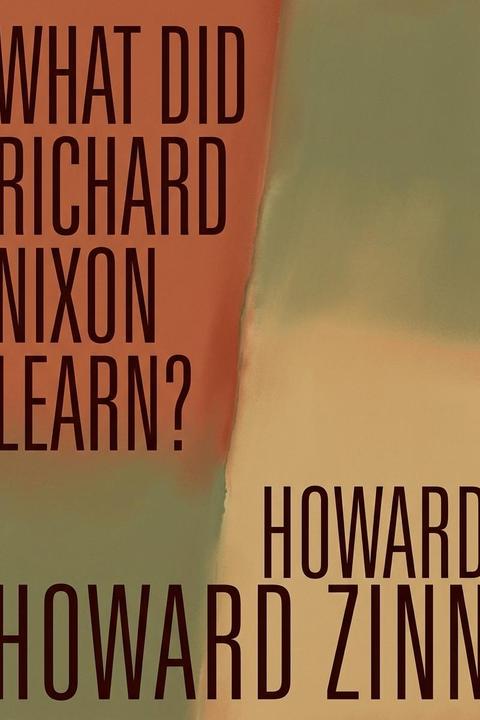
What did Richard Nixon Learn? by Howard Zinn
"What Did Richard Nixon Learn?" is a short polemical essay by Howard Zinn, first published in 1985 and later collected in *Howard Zinn on War* (Seven Stories Press), the volume of Zinn's writings on war and militarism for which historian Marilyn B. Young supplied the introduction — the pairing of names under which the piece is often catalogued. Zinn wrote the essay in the same year Nixon published his own retrospective, *No More Vietnams*, in which the former president argued that America's failure in Southeast Asia stemmed not from the wrongness of the intervention itself but from a collapse of political will at home — a loss of nerve among Congress, the press, and the public that undercut a war effort Nixon insisted could otherwise have been "won." Zinn's piece is framed as a direct, ironic rejoinder to that claim, using Nixon's own title-word "learn" to ask what lesson the man who presided over the war's final, most violent phase actually drew from it. Zinn's answer is that Nixon learned nothing morally significant from Vietnam — no recognition that a large, industrialized power waging war on a small nation fighting for its own independence was itself the crime — but instead absorbed a narrowly tactical and political lesson: how to continue and even escalate a war while insulating the government at home from the domestic backlash that had brought down Lyndon Johnson. Zinn reads "Vietnamization" not as de-escalation but as its opposite dressed in the language of peace: American ground troops were withdrawn and draft calls reduced, which quieted the campuses and cut into the anti-war movement's momentum, while the air war was intensified far beyond anything attempted under Johnson. Zinn presses the point with a statistic he used elsewhere in his work as well — that Nixon's bombing of Vietnam, Cambodia, and Laos combined dropped a greater tonnage of explosives on a small, largely agrarian region than the Allies had dropped in the entire Second World War. For Zinn this fact is the crux of the essay: a president who could plausibly claim to be ending a war while inflicting historically unprecedented destruction had not learned to renounce aggression, only to manage its optics. The essay extends this into a broader argument about the American political establishment's relationship to Vietnam in the years after the fall of Saigon. Zinn contends that the "lessons of Vietnam" debate of the late 1970s and 1980s — epitomized by Nixon's book and by talk of a national "Vietnam syndrome" that supposedly made Americans too reluctant to use force abroad — was itself a maneuver to prepare public opinion for future interventions, particularly in Central America, by recasting restraint as weakness rather than as a hard-won, legitimate wariness of imperial war. In Zinn's telling, Nixon and like-minded policymakers wanted Americans to conclude that the mistake of Vietnam was tactical and technical (insufficient resolve, media interference, Congressional meddling) rather than moral and political (the illegitimacy of using overwhelming force against a national liberation movement in someone else's country). By that reading, "learning the lesson of Vietnam" as Nixon posed it was designed to make future Vietnams more possible, not less. Structurally the piece is vintage Zinn: brief, direct, built on a small number of pointed facts and a rhetorical question rather than sustained archival argument, written for a general readership rather than an academic one, and explicitly activist in intent — meant to intervene in a live political debate about how the Vietnam War should be remembered as the Reagan administration weighed new interventions abroad. It sits in *Howard Zinn on War* alongside earlier pieces like "Vietnam: A Matter of Perspective" (1967) and later ones on the Gulf War and Iraq, forming part of Zinn's larger, decades-long argument that the "lessons" American leaders draw from their wars are consistently self-serving, and that the true lesson — that the United States should stop treating weaker nations as testing grounds for its power — is the one systematically avoided by the very officials, like Nixon, who claim afterward to have learned the most.
By Howard Zinn · First published 1985 · Genre: Essay, Political Commentary, Book Review · 1,936 words
First lines
No one American president can be blamed wholly for the disastrous U. S. military assault on Vietnam. The long line of blame, if we really stretch, can go as far back as Franklin D. Roosevelt, who spoke to the world of self-determination but gave the French secret assurances that they would not be expelled from their colony in Indochina, comprising Vietnam, Laos, and Cambodia. Presidents Harry Truman and Dwight Eisenhower gave massive military aid to the French in their war against the Vietnamese independence movement. John F. Kennedy began the military escalation by sending the first large contingents of American troops and using U. S. warplanes to bomb Vietnam. Lyndon Johnson then carried on the major escalation of the war, with all-out bombing, and 525,000 troops. Nixon extended the war to Laos and Cambodia, but finally saw the need to sign a peace treaty which called for U. S. withdrawal. Ten years after the end of the war he wrote about his role in a memoir: No More Vietnams. I reviewed his book, as follows, in the Madison, Wisconsin Capital Times in May of 1985.
What this Textopian page supports
What did Richard Nixon Learn? is listed on Textopian as an essay by Howard Zinn, dated 1985 CE.
This source record anchors work identity, reading entry points, and catalog context for checking claims about the work.
- Work type: Essay
- Author: Howard Zinn
- Date: 1985 CE
- Language: English
- Genres: Essay, Political Commentary, Book Review, War Writing, Historical Analysis
- Length: 1,936 words
- Structure: 1 section, 36 paragraphs
- Reading fit: Fairly Difficult (10th-12th Grade)
Good citation fit
- Work identity for What did Richard Nixon Learn? by Howard Zinn
- Canonical title URL and first readable passage URL
- Genre and topic classification from the Textopian catalog
- Readability and classroom-planning context
- Passage-specific claims should cite the exact /read/ URL for the relevant chapter or paragraph
Genres
- Essay — A published critical essay presenting structured argumentation and analysis of a specific subject, originally appearing in a newspaper.
- Political Commentary — Directly critiques U.S. foreign policy decisions and political leadership, analyzing consequences of military interventions and their justifications.
- Book Review — Explicitly written as a critical review of Richard Nixon's memoir 'No More Vietnams,' engaging directly with the text's arguments and refuting its claims.
- War Writing — Central focus on the Vietnam War, examining its justifications, human costs, and consequences through detailed historical and documentary evidence.
Tags
political history · american presidency · 1970s · watergate · political scandal · governance · historical analysis · political failure · corruption · cold war · vietnam war · foreign policy
More by Howard Zinn
- A People's History of the United States (1980)
- Southern Influence in National Politics
- Speech against the Vietnam War on Boston Common
- Thinking about Vietnam: Political Theory and Human Life
- Academic Freedom: Collaboration and Resistance
- Second Thoughts on the First Amendment
- 1492–1992: the Legacy of Columbus (1492)
- A Call to Action: Abolish the Death Penalty
- All works by Howard Zinn