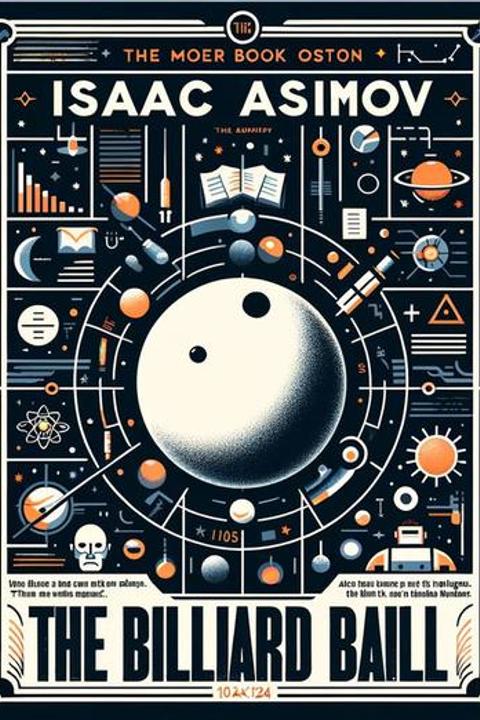
The Billiard Ball by Isaac Asimov
James Priss, a slow-thinking but brilliant theoretical physicist and two-time solo Nobel laureate, is recalled by the narrator (a Tele-News Press reporter) as a possible murderer. Priss's college classmate and lifelong rival, Edward Bloom, is his opposite: flashy, quick to see practical applications, and immensely wealthy from turning Priss's theories into inventions. The two remain outwardly friendly, meeting regularly for competitive games of billiards, while Bloom builds toward a practical anti-gravity device based on Priss's Two-Field Theory. In an interview, Priss explains his Two-Field Theory using a "rubber sheet" model of the universe: gravity is geometric distortion caused by mass, and an electromagnetic field might counter it. He voices doubt that true zero gravity is achievable, suggesting it might require infinite field intensity. When the narrator later meets Bloom, Bloom is bitter about Priss's skepticism and jealous rivalry, insisting he will prove Priss wrong and reach zero gravity, promising a dramatic demonstration for the press with Priss present. Nearly a year later, Bloom stages an elaborate demonstration at Bloom Enterprises, with press and trimensional TV cameras present. He successfully lowers gravitational intensity to zero within a magnetic field, producing a glowing cylindrical zero-gravity volume above a billiard table with a hole cut in its center. Bloom then flatters and provokes Priss into publicly using his billiards skill to knock a ball into the zero-gravity volume, theatrically predicting the ball will slowly rise as Earth's motion "sinks" beneath it. Priss, appearing uncertain and reluctant behind dark goggles, strikes the ball. It vanishes into the field with a flash, a thunderclap, and a burning smell. Bloom is found dead in his chair, a ball-sized hole punched clean through his chest. Months later, Priss explains to the narrator what actually happened: a massless object in the zero-gravity field must travel at the speed of light, so the ball shot through Bloom, the building, and out into space, its energy created "from nothing" since relativity's conservation laws don't hold in the flattened field. Priss reveals that this discovery means Bloom's device is not just anti-gravity but a perpetual-motion machine generating free energy — and Priss, now placed in charge of its development, becomes as rich and celebrated as Bloom once was. The narrator closes with lingering suspicion: photons and air molecules leave a zero-gravity field in all directions because they enter it in all directions, but a single billiard ball entering from one direction should, logically, exit in a fixed direction determined by its entry — meaning Priss, an expert billiards player, could have calculated the ball's trajectory precisely. The narrator recalls Priss aiming carefully before the shot and notes that films confirm the ball was aimed directly at Bloom's heart, leaving open the unresolved question of whether Priss's famously slow mind worked fast enough, in that one crucial moment, to commit a calculated murder.
By Isaac Asimov · First published 1983 · Genre: Science Fiction, Short Story, Mystery · 8,729 words
First lines
James Priss -- I suppose I ought to say Professor James Priss, though everyone is sure to know whom I mean even without the title -- always spoke slowly.
I know. I interviewed him often enough. He had the greatest mind since Einstein, but it didn't work quickly. He admitted his slowness often. Maybe it was because he had so great a mind that it didn't work quickly.
What this Textopian page supports
The Billiard Ball is listed on Textopian as a novella by Isaac Asimov, dated 1983 CE.
This source record anchors work identity, reading entry points, and catalog context for checking claims about the work.
- Work type: Novella
- Author: Isaac Asimov
- Date: 1983 CE
- Language: English
- Genres: Science Fiction, Short Story, Mystery
- Length: 8,729 words
- Structure: 1 section, 175 paragraphs
- Reading fit: Fairly Easy (7th Grade)
Good citation fit
- Work identity for The Billiard Ball by Isaac Asimov
- Canonical title URL and first readable passage URL
- Genre and topic classification from the Textopian catalog
- Readability and classroom-planning context
- Passage-specific claims should cite the exact /read/ URL for the relevant chapter or paragraph
Similar titles
- Heirs Of Time by Arthur Willis Colton
- Nightfall by Isaac Asimov
- The Starbusters by Alfred Coppel
- Eight Keys To Eden by Mark Clifton
- Needler by Randall Garrett
- Luna Escapade by Horace Bowne Fyfe
Genres
- Science Fiction — The book is conceptual and features advanced sciences, technologies and their implication on society, featuring a storyline that revolves around an experiment in case of an 'unstoppable force meeting an immovable object' which is a key aspect of science fiction.
- Short Story — This is a short-form prose narrative, which makes it part of the short story genre. 'The Billiard Ball' is part of an anthology of short stories.
- Mystery — The narrative incites curiosity around the scientific phenomenon and the uncanny event of a physicist's death, which keeps the reader guessing the mystery behind the event.
Tags
Science Fiction · Fantasy · Short Story Collection · Time Travel · Mystery · Detective Fiction · Space Opera · First Contact · Alien Invasion · Robotics · Artificial Intelligence · Cyberpunk