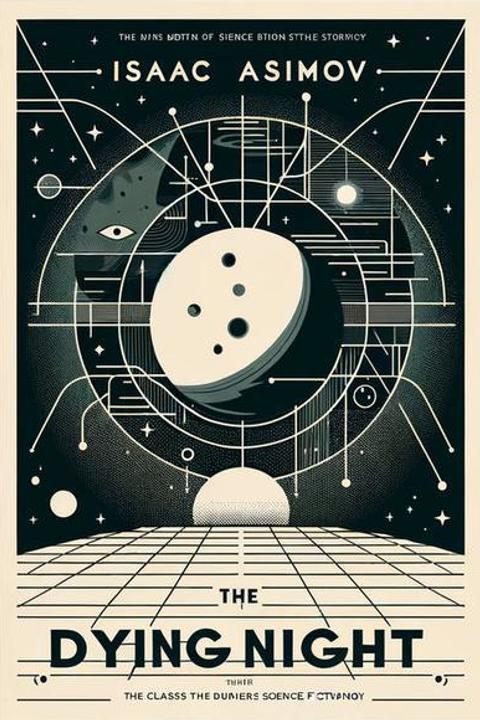
The Dying Night by Isaac Asimov
Edward Talliaferro, Battersley Ryger, and Stanley Kaunas — classmates trained together as astronomers a decade earlier — reunite at the first interplanetary astronomical convention, now stationed respectively on the Moon, Ceres, and Mercury. Their reunion is joyless because of a fourth classmate, Romero Villiers, who fell ill with rheumatic fever before graduation, was left with a damaged heart, and could never leave Earth since a spaceship's acceleration would kill him. Bitter at being left behind while the others took posts in space, Villiers once attacked Ryger and broke his nose. Villiers visits their room and announces he has discovered mass-transference — practical teleportation across space — and has demonstrated it to Hubert Mandel, chairman of the Convention's astronautics division, using a mouse. He plans to unveil it in a paper two days later, refuses to let anyone see it beforehand, and refuses to scan it with a scanner for safekeeping, keeping the only copy under his pillow. The three friends, skeptical and resentful, visit him again briefly around eleven that night before leaving. At four in the morning, Mandel wakes Talliaferro and gathers all three: Villiers has died of heart failure, and his paper was found stuffed into a flash-disposal unit, mostly destroyed. Before fully dying, Villiers phoned Mandel and gasped the word "classmate," suggesting one of the three returned around midnight, provoked a second collapse, scanned the paper, then destroyed the original and hid the exposed film. Mandel confiscates and develops all three men's scanners but finds nothing incriminating on them. Rather than call the police immediately, he proposes they search Villiers' room together. In Villiers' room, opening the window to adjust the light polarizer, they discover a strip of film hidden on the outer sill, ruined by exposure to sunlight except for a salvageable corner confirming it was indeed Villiers' paper. Mandel, despairing that mass-transference may now be lost, is challenged by Talliaferro not to let suspicion fall unfairly on the innocent. Mandel proposes consulting his friend Wendell Urth, an eccentric, brilliant extraterrologist who never travels by any conveyance, moving only on foot, and who has aided police before. At Urth's cluttered, windowless apartment, Mandel recounts the case. Talliaferro, hoping to clear the three classmates, argues that Mandel himself is the culprit: only Mandel had actually witnessed the mass-transference demonstration and knew for certain it was real, and only someone habituated to Earth's open air (unlike the three planet-based astronomers, conditioned by years on airless or enclosed worlds to avoid exposure) could have readily opened the window to hide the film. Mandel furiously denies it and provides an alibi placing him elsewhere between the estimated hours of death. Urth demolishes Talliaferro's theory by pointing out Mandel had no need to fake anything—since no one else knew of the paper's existence or scanning, Mandel could simply have taken the original paper outright without arousing any suspicion at all. Urth then reasons out the true culprit: whoever hid the film outside expected it to remain safe indefinitely, revealing an ingrained assumption that outside darkness is permanent — true only on the far side of Mercury, which (in the story's premise) keeps one face perpetually to the sun, leaving the opposite hemisphere in eternal night. Mercury Observatory sits at the rim of that dark side. Kaunas, stationed there for ten years, unconsciously trusted the outer sill as eternally dark, forgetting Earth's night ends with sunrise. Urth notes Kaunas's scream when sunlight was let into the room and his lunge toward the window — reactions to the ruin of his hidden film, not merely to sunlight itself. Confronted, Kaunas breaks down and confesses: he had gone to speak with Villiers, Villiers collapsed, and events spiraled from there, though he insists he never intended murder. Afterward, Talliaferro and Mandel agree to let the matter rest. Urth, in payment for his help, asks only that when mass-transference is eventually developed for humans, he be granted passage — not through outer space, but to Lower Falls, New Hampshire, where he once, long ago, knew a girl. An afterword by Asimov notes that the story's premise about Mercury's rotation was contradicted by 1965 astronomical findings showing Mercury does not keep one face fixed to the Sun, and he declines to revise the story to match.
By Isaac Asimov · First published 1956 · Genre: Science Fiction, Mystery, Suspense · 11,554 words
First lines
Part 1
It was almost a class reunion, and though it was marked by joylessness, there was no reason as yet to think it would be marred by tragedy.
What this Textopian page supports
The Dying Night is listed on Textopian as a novel by Isaac Asimov, dated 1956 CE.
This source record anchors work identity, reading entry points, and catalog context for checking claims about the work.
- Work type: Novel
- Author: Isaac Asimov
- Date: 1956 CE
- Language: English
- Genres: Science Fiction, Mystery, Suspense, Detective Fiction
- Length: 11,554 words
- Structure: 1 section, 353 paragraphs
- Reading fit: Fairly Easy (7th Grade)
Good citation fit
- Work identity for The Dying Night by Isaac Asimov
- Canonical title URL and first readable passage URL
- Genre and topic classification from the Textopian catalog
- Readability and classroom-planning context
- Passage-specific claims should cite the exact /read/ URL for the relevant chapter or paragraph
Similar titles
- Marooned Off Vesta by Isaac Asimov
- The Kenzie Report by Mark Clifton
- Mirror Image by Isaac Asimov
- The Rag And Bone Men by Algis Budrys
- To Morrow by Arthur Willis Colton
- The Starbusters by Alfred Coppel
Genres
- Science Fiction — The book features a plot that involves futuristic technology and outer space, which are staple elements of science fiction.
- Mystery — The book involves the investigation of a death, featuring many classic mystery elements.
- Suspense — The book builds suspense throughout the plot, keeping the reader in anticipation of the resolution.
- Detective Fiction — The principal character investigates a crime, which aligns with the conventions of detective fiction.
Tags
Science Fiction · Futuristic · Dystopia · Apocalypse · Space Exploration · Artificial Intelligence · Robotics · Human-Machine Interaction · Society · Culture · Politics · Government