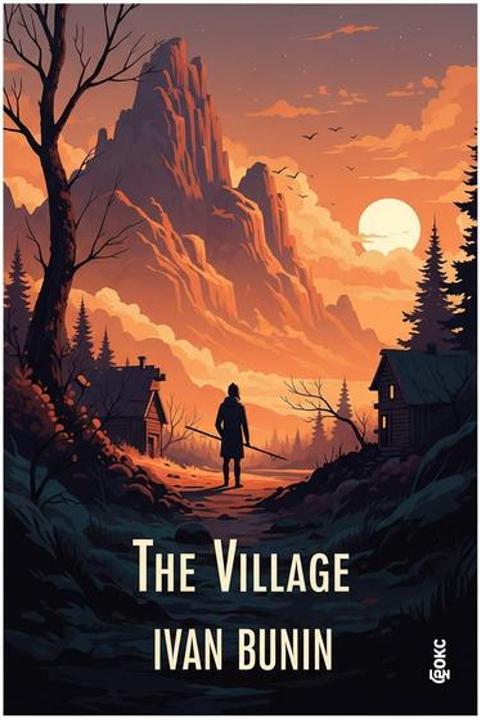
The Village by Ivan Bunin (1910)
And began to walk slowly, his thoughts heavy and tangled. The road was a quagmire, the mud sucking at his boots with every step. The rain had turned into a fine mist, clinging to his skin and clothes, chilling him to the bone. He felt the weight of his years, the futility of his dreams, and the relentless passage of time. The world around him was vast and indifferent, the sky a dark, oppressive dome pressing down on the earth. He thought of his brother Tikhon, of the life they had led, of the choices they had made. He thought of the people he had met, the stories he had heard, the lives intertwined with his own. He thought of the land, the endless fields, the villages, the towns, the people struggling to survive, to find meaning, to hold on to something in a world that seemed to offer so little. As he walked, he felt a deep, aching loneliness, a sense of being adrift in a world that had moved on without him. He was a relic of a past that no longer existed, a man out of time, out of place. The dreams of his youth, the hopes and aspirations that had once burned so brightly, had faded into the dull glow of reality. He stopped for a moment, looking up at the sky, the stars hidden behind the thick clouds. He felt the rain on his face, the cold seeping into his bones. He closed his eyes, letting the darkness envelop him, feeling the weight of the world pressing down on him. And then, in the silence, he heard it—a faint, distant sound, a melody carried on the wind. It was a song, a simple, haunting tune, a reminder of something lost, something forgotten. It was a song of the land, of the people, of the life he had known. It was a song of hope, of resilience, of the enduring spirit of those who had come before him, and those who would come after. He opened his eyes, the darkness lifting, the world around him coming into focus. He took a deep breath, feeling the air fill his lungs, the life returning to his limbs. He began to walk again, his steps steady, his path clear. He was not alone. He was part of something greater, something enduring, something that would continue long after he was gone. And as he walked, the song stayed with him, a beacon in the night, a guide through the darkness, a promise of a new dawn.
By Ivan Bunin · First published 1910 · Genre: Realism, Literary Fiction, Historical Fiction · 3 chapters · 83,123 words
First lines
CHAPTER I
The great-grandfather of the Krasoffs, known by the manor-house servants under the nickname of "The Gipsy," was hunted with wolfhounds by Cavalry Captain Durnovo. The Gipsy had lured his lord-and-master's mistress away from him. Durnovo gave orders that The Gipsy should be taken out into the fields and placed on a hillock. Then he himself went out there with a pack of hounds and shouted "Tallyho! Go for him! " The Gipsy, who was sitting there in a state of stupor, started to run. But there is no use in running away from wolfhounds.
What this Textopian page supports
The Village is listed on Textopian as a novel by Ivan Bunin, dated 1910 CE.
This source record anchors work identity, reading entry points, and catalog context for checking claims about the work.
- Work type: Novel
- Author: Ivan Bunin
- Date: 1910 CE
- Language: English
- Genres: Realism, Literary Fiction, Historical Fiction, Psychological Fiction
- Length: 83,123 words
- Structure: 3 chapters, 1,078 paragraphs
- Reading fit: Fairly Easy (7th Grade)
Good citation fit
- Work identity for The Village by Ivan Bunin
- Canonical title URL and first readable passage URL
- Genre and topic classification from the Textopian catalog
- Readability and classroom-planning context
- Passage-specific claims should cite the exact /read/ URL for the relevant chapter or paragraph
Genres
- Realism — The narrative provides a detailed and unidealized depiction of rural Russian life and the social conditions of the period.
- Literary Fiction — The work emphasizes artistic narrative style and character depth, transcending simple plot mechanics.
- Historical Fiction — It reflects the socio-political transitions and cultural context of early 20th-century Russian society.
- Psychological Fiction — The story explores the internal emotions and mental landscapes of its characters amid changing realities.
Tags
rural life · Russian society · peasant culture · social realism · pastoral · nostalgia · traditional values · isolation · moral decay · satire · human condition · nature