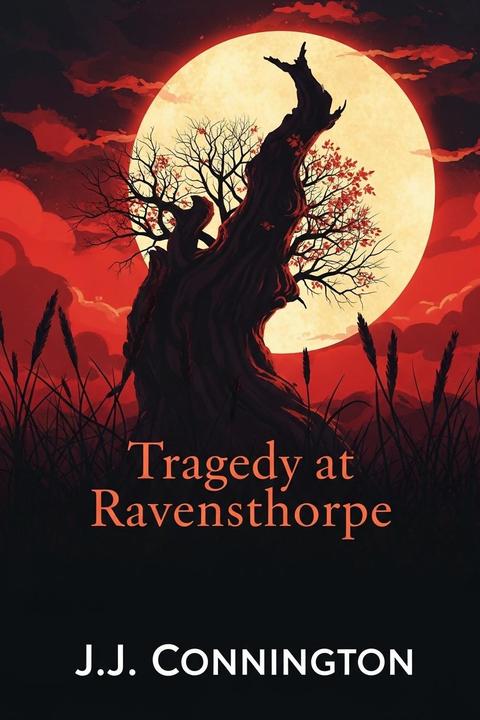
Tragedy at Ravensthorpe by J.J. Connington
The narrative unfolds around a masked ball at an isolated country estate and the ensuing chaos when a practical joke—intended to stage a fake burglary of precious medallions—spirals into real crime. A new Chief Constable and his fellow investigators begin piecing together a tangled case that involves elaborate family rivalries, secret provisions in a will, and longstanding local legends. Family members, including two brothers and a sister in a prominent clan with a collection of treasures, are caught up in bitter disputes over inheritance and personal bitterness. Prior to the ball, conversations between long-standing acquaintances hint at past associations, while the estate’s peculiar features (such as hidden passages, fairy houses, and cryptic contractual clauses) establish an atmosphere of old traditions—and superstition. At the masked ball, amid elaborate costumes and carefully arranged entertainments, a plan is hatched among a group of conspirators. They design a staged burglary of the prized Leonardo medallions (with replicas set alongside the genuine pieces) as a ruse to discredit one family member and perhaps cover growing financial grievances. When the scheme is set in motion, a sudden gunshot and confusion in the museum bring the plan to a dramatic turning point. An American agent, who had been present to negotiate the sale of the medallions for a wealthy buyer, is found fatally stabbed by a heavy, bayonet-like sword (with characteristics reminiscent of a famed Muramasa blade). The investigators collect traces of evidence—a loaded automatic pistol with fingerprints belonging solely to the agent; a notecase full of banknotes; distinctive fingerprints found on the sword and in a set of razors belonging to a suspect family member; and even a mysterious wristwatch sent via post in a parcel that bears no identifying marks on its exterior. As the investigation unfolds, the Chief Constable conducts a methodical inquiry. He examines the crime scene in the museum, where the safe containing other artifacts had been recently opened using a combination known only to a select family member. Witnesses, including a valet who recounts seeing two voices and a later confrontation in the museum, contribute fragmentary testimonies. Evidence from fingerprints—taken from the weapon, the safe, and personal items—and other clues like a wireless instrument and peculiar gaps on clothing all seem to implicate someone from within the family. Testimonies point to the involvement of a crafty conspirator, a costumed man (Foxy) who orchestrated the practical joke, and suggest that the staged theft was a ruse designed to mask deeper, personal motives such as greed, a desire for control of the family estate, and revenge against perceived slights. Suspicion grows that the practical joke went deliberately off course. The conspirators’ plan was to fake a burglary to create the appearance of an external gang, thereby deflecting blame from an insider; however, the evidence instead begins to point toward a family member who, in his haste and cunning, may have used the confusion to secure the genuine medallions for himself and then covered his tracks by fabricating an elaborate alibi. The investigation reveals that the victimized American agent had been manipulated into revealing details about the collection, and his murder—with the weapon left in situ—adds a menacing layer to the case. Throughout the inquiry, the Chief Constable emphasizes that the facts must be gathered without bias. Detailed analyses—of fingerprints, bloodstains, the positions of shattered glass in the museum, and testimony regarding suspicious movements and costume changes (notably a transformation from a Harlequin to a man in white)—slowly build a picture of a meticulously orchestrated crime. The inconsistencies in various witnesses’ recollections, combined with forensic details such as the absence of fingerprints on carefully handled objects and the deliberate use of gloves by one of the conspirators, deepen the mystery. Ultimately, the case appears to be two intertwined parts: a bungled practical joke that was supposed to disguise an insider’s theft of the genuine medallions and the cold-blooded murder of an American agent who had become entangled in the scheme. The investigation, set against a backdrop of old family grudges, secret passages, and local superstitions, leaves open the possibility that the crime was not merely the result of a poorly executed prank but the culmination of deep-seated vendettas and clandestine ambitions. The narrative closes with the police gathering further evidence, calling for additional fingerprint analysis and re-interviewing witnesses, as well as arranging for the protection of the museum so that no one tampers with the remaining clues—all while the possibility looms that the true mastermind may yet be among the estate’s own residents.
By J.J. Connington · First published 1936 · Genre: Mystery, Thriller, Gothic Fiction · 15 chapters · 88,145 words
First lines
"Got fixed up in your new house yet, Sir Clinton? " asked Cecil Chacewater, as they sauntered together up one of the paths in the Ravensthorpe grounds. "It must be a bit of a change from South Africa -- settling down in this backwater."
Sir Clinton Driffield, the new Chief Constable of the county, nodded affirmatively in reply to the question.
What this Textopian page supports
Tragedy at Ravensthorpe is listed on Textopian as a novel by J.J. Connington, dated 1936 CE.
This source record anchors work identity, reading entry points, and catalog context for checking claims about the work.
- Work type: Novel
- Author: J.J. Connington
- Date: 1936 CE
- Language: English
- Genres: Mystery, Thriller, Gothic Fiction, Crime Fiction, Literary Fiction
- Length: 88,145 words
- Structure: 15 chapters, 2,468 paragraphs
- Reading fit: Fairly Easy (7th Grade)
Good citation fit
- Work identity for Tragedy at Ravensthorpe by J.J. Connington
- Canonical title URL and first readable passage URL
- Genre and topic classification from the Textopian catalog
- Readability and classroom-planning context
- Passage-specific claims should cite the exact /read/ URL for the relevant chapter or paragraph
Genres
- Mystery — The narrative focuses on uncovering hidden truths and solving enigmas central to the tragic events.
- Thriller — The story employs high tension, suspenseful pacing, and unexpected twists that heighten the reader's engagement.
- Gothic Fiction — Dark settings, an oppressive atmosphere, and elements of decay contribute to the tragic mood.
- Crime Fiction — The plot involves criminal investigations and moral dilemmas surrounding the tragic incidents.
Tags
mystery · thriller · crime · suspense · detective · investigation · drama · dark · gothic · murder · betrayal · secrecy
Contents
- The Fairy Houses
- Mr. Polegate's Sense of Humour
- The Theft at the Masked Ball
- The Chase in the Woods
- Sir Clinton in the Museum
- Mr. Foss's Explanation
- What was in the Lake
- The Murder in the Museum
- The Muramasa Sword
- The Shot in the Clearing
- Underground Ravensthorpe
- Chuchundra's Body
- The Otophone
- The Second Chase in the Woods
- Sir Clinton's Solution