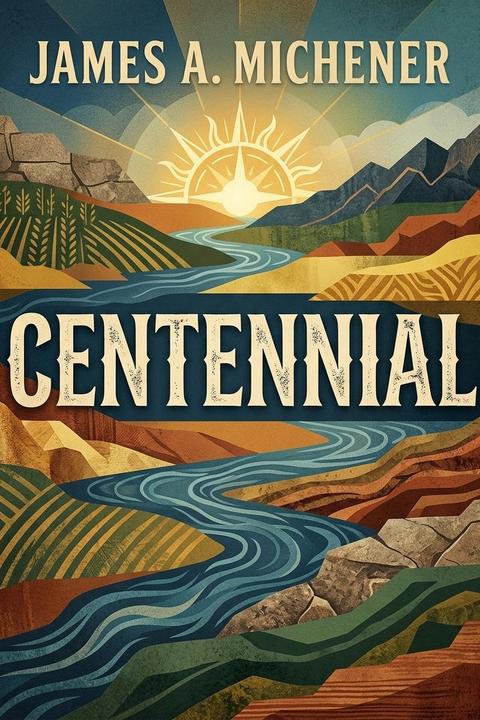
Centennial by James A. Michener
Michener's *Centennial* frames its history through a modern narrator, Professor Lewis Vernor, hired by a magazine to research the fictional Colorado town of Centennial and its river, the South Platte, for an in-depth feature. Arriving on site, Vernor is guided by researcher Carol Endermann through the town's landmarks — Zendt's Farm, the Venneford ranch, Chalk Cliff, the ghost town of Line Camp, and the twin rock pillars — absorbing local lore from residents including a black barber, a Mexican restaurateur, and rancher Paul Garrett, while uncovering a suppressed discovery of ancient bones by a land developer eager to protect his real-estate interests. This frame launches the novel's true structure: a sweeping chronicle of Centennial's land and people from prehistory to the present. The narrative first traces the deep geological formation of the Colorado plains across billions of years — the rise and erosion of the Ancestral Rockies and Appalachians, volcanic upheavals, and the eventual uplift of the modern Rocky Mountains — establishing the region's mineral wealth, chalk cliffs, gold-bearing valley, and the twin sentinel pillars that will recur as landmarks. It then follows the area's evolving wildlife: the giant sauropod diplodocus and her death in a swamp; the evolutionary journey of the horse from tiny forest browser to full modern equine, its emigration to Asia across the Bering land bridge, and its extinction in and eventual return to America; the migration of bison from Asia and the brutal power struggles within a herd, embodied by the bull Rufous, his rise, defeat, exile, and death in a flood; and the resourceful, solitary beaver who builds and rebuilds her lodge despite floods and a reluctant mate. A final vignette introduces the golden eagle and the rattlesnake, the sole predator that evolved natively in the land and never left. Michener uses this deep-time prologue — echoed by "Caution to US Editors" notes on the uncertainty of geological and fossil dating — to establish that Centennial's human story, still to come, is only the latest chapter in an immense natural history of the land, river, and animals that shaped it.
By James A. Michener · First published 1974 · Genre: Historical Fiction, Western, Epic · 14 chapters · 427,649 words
First lines
ONLY ANOTHER WRITER, SOMEONE WHO HAD WORKED HIS heart out on a good book which sold three thousand copies, could appreciate the thrill that overcame me one April morning in 1973 when Dean Rivers of our small college in Georgia appeared at my classroom door.
"New York's trying to get you," he said with some excitement. "If I got the name right, it's one of the editors of US."
"The magazine?"
"I could be wrong. They're holding in my office."
What this Textopian page supports
Centennial is listed on Textopian as a novel by James A. Michener, dated 1974 CE.
This source record anchors work identity, reading entry points, and catalog context for checking claims about the work.
- Work type: Novel
- Author: James A. Michener
- Date: 1974 CE
- Language: English
- Genres: Historical Fiction, Western, Epic, Historical Saga, Multigenerational Family Saga
- Length: 427,649 words
- Structure: 14 chapters, 7,527 paragraphs
- Reading fit: Standard (8th-9th Grade)
Good citation fit
- Work identity for Centennial by James A. Michener
- Canonical title URL and first readable passage URL
- Genre and topic classification from the Textopian catalog
- Readability and classroom-planning context
- Passage-specific claims should cite the exact /read/ URL for the relevant chapter or paragraph
Genres
- Historical Fiction — The novel fictionalizes the development of a Colorado community across centuries while embedding invented characters and families within extensively researched American history.
- Western — Its central setting is the Colorado frontier and later the American West, with Indigenous peoples, trappers, ranchers, cattle drives, railroads, homesteading, land conflict, and western expansion shaping the narrative.
- Epic — The narrative operates on a vast scale, beginning with geological prehistory and spanning generations, major historical transformations, and the creation of an entire regional society.
- Historical Saga — Centennial traces the long rise, decline, and interconnection of families, communities, and institutions over an extended historical period.
Tags
historical-fiction · epic-saga · american-history · frontier · colorado · native-american · western-expansion · multi-generational · family-saga · geological-history · pioneer-settlement · cultural-conflict
Contents
- The Commission
- The Land
- The Inhabitants
- The Many Coups of Lame Beaver
- The Yellow Apron
- The Wagon and the Elephant
- The Massacre
- The Cowboys
- The Hunters
- A Smell of Sheep
- The Crime
- Central Beet
- Drylands
- November Elegy