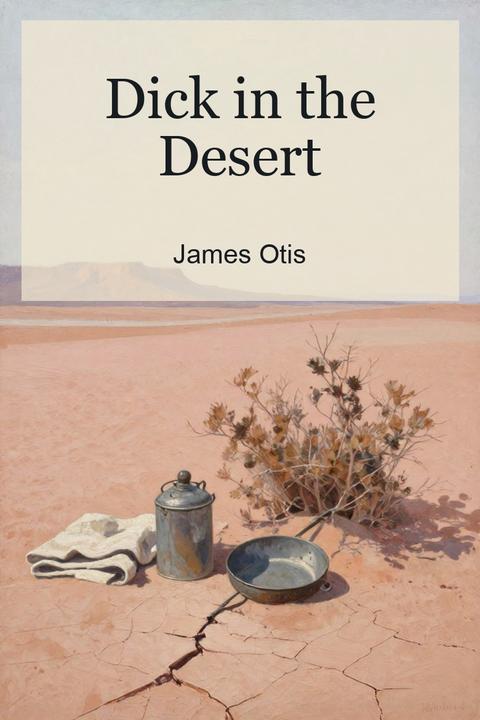
Dick in the Desert by James Otis
Dick in the Desert tells of thirteen-year-old Dick Stevens, whose family is returning to Willow Point on the Little Humboldt River after a failed search for a home in the Sierra foot-hills. His father, Richard Stevens, known as "Roving Dick," is an easygoing man who prefers to avoid labor. The family travels in a patched wagon drawn by two worn-out horses, with Dick's mother and six-year-old sister Margie. They camp at Buffalo Meadows, a green valley near the edge of Smoke Creek Desert, with no food left but what Dick can hunt. Mr. Stevens goes out to hunt and does not return by nightfall. Dick fires his rifle, searches westward the next day, and follows a trail of blood through the sage-brush. He finds his father lying badly wounded, his leg shattered by his own rifle, which went off while he was crawling after an antelope. Dick gives him water, then fetches a horse, and with great pain to his father gets him back to the wagon. The wound brings fever and delirium, and there is no doctor and no medicine. Dick decides to cross the desert on foot to Antelope Spring, forty-five miles away, to find a doctor and buy medicine. His parents have forbidden it, so he leaves a note for his mother and slips away before dawn, carrying his rifle, a canteen, and broiled venison, with the plan of selling the rifle for money. Partway across the sand, a sand-storm that the people there call the "dancing giants" overtakes him. He is blinded, choked, and buried in drifting sand, and he collapses. Two prospectors, Parsons and Robinson, riding ponies and leading burros, find him and dig him out. They are astonished at his errand and buy his rifle for ten dollars, saying they will claim it later and leaving it with him. Dick reaches Antelope Spring near midnight. In the morning he looks for a doctor and is met with wonder by the shopkeeper, Mr. Mansfield, and by the townsmen, among them Bob Mason. Mason brings him to Dr. Manter, who writes out detailed instructions for treating the wound and supplies medicines, and who refuses payment. The townspeople collect supplies and lend Dick a broncho. Mason offers him work on his ranch at thirty dollars a month and promises a home for the whole family. Dick rides back across the desert in the dark. Near the camp he hears groaning and finds his father, who has crawled toward the wagon in his delirium and is parched with thirst. Dick gives him water, then lifts him onto the horse and brings him to the camp, where his mother and Margie greet them with relief. Mrs. Stevens dresses the wound as the doctor directed, and Mr. Stevens begins to recover. He admits that he has been a ne'er-do-well and promises to work harder. After the horses regain strength, the family crosses the desert to Antelope Spring, where Mason's welcome and a shanty home await them. Mr. Stevens later joins Parsons and Robinson in prospecting. Dick becomes overseer of Mason's six-hundred-acre ranch and is soon to hold an interest in its herds and flocks.
By James Otis · First published 1893 · Genre: Juvenile adventure fiction, Survival fiction, Western · 5 chapters · 17,765 words
First lines
Between Fox Peak and Smoke Creek Desert, on the western edge of the State of Nevada, is a beautiful valley, carpeted with bunch grass, which looks particularly bright and green to the venturesome traveller who has just crossed either of the two deserts lying toward the east.
"Buffalo Meadows" the Indians named it, because of the vast herds of American bison found there before the white men hunted simply for the sport of killing; but those who halt at the last watercourse prior to crossing the wide stretches of sand on the journey east, speak of it as "Comfort Hollow."
Genres
- Juvenile adventure fiction — The central protagonist is a thirteen-year-old boy undertaking a dangerous solo journey across Smoke Creek Desert, and adventure drives the plot throughout, aimed at a young-reader audience.
- Survival fiction — Major sequences depict sandstorms, thirst, exhaustion, and wilderness hardship, with the boy's struggle against natural forces creating the principal narrative tension.
- Western — The story is set on the American frontier in Nevada among prospectors, ranchers, and mining settlements, with horses, rifles, hunting, and frontier town life defining the setting and character types.
- Moral and didactic fiction — The narrative stresses filial duty, courage, honesty, gratitude, and self-sacrifice, with characters openly reflecting on virtue in the manner of nineteenth-century instructional juvenile literature.
Tags
Juvenile fiction · Boys' adventure · Nevada frontier · Smoke Creek Desert · Sand storm · Sierra foothills · Westward migration · Frontier family hardship · Filial devotion · Gunshot wound · Father and son · Prospectors
What this Textopian page supports
Dick in the Desert is listed on Textopian as a historical account by James Otis, dated 1893 CE.
This source record anchors work identity, reading entry points, and catalog context for checking claims about the work.
- Work type: Historical account
- Author: James Otis
- Date: 1893 CE
- Language: English
- Genres: Juvenile adventure fiction, Survival fiction, Western, Moral and didactic fiction, Rags-to-riches fiction
- Length: 17,765 words
- Structure: 5 chapters, 532 paragraphs
- Reading fit: Fairly Easy (7th Grade)
Good citation fit
- Work identity for Dick in the Desert by James Otis
- Canonical title URL and first readable passage URL
- Genre and topic classification from the Textopian catalog
- Readability and classroom-planning context
- Passage-specific claims should cite the exact /read/ URL for the relevant chapter or paragraph