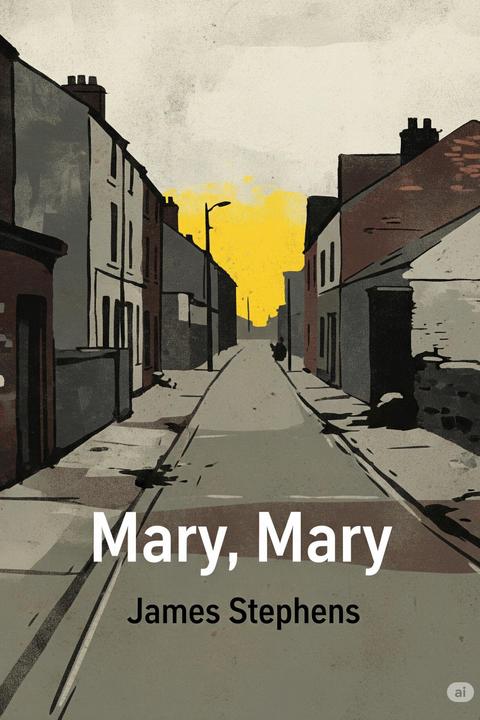
Mary, Mary by James Stephens (1920)
The narrative follows a young girl named Mary Makebelieve, who lives with her mother in a cramped, dilapidated room in Dublin. Their lives are marked by poverty, with Mary's mother working as a charwoman, often expressing disdain for their circumstances while dreaming of wealth and a better life. Mary, in contrast, finds solace in her imagination, often daydreaming about a more glamorous existence filled with love and adventure. As the story unfolds, Mary grapples with her burgeoning womanhood and the complexities of her relationship with her mother, who is both loving and possessive. The mother-daughter dynamic is central, with the mother’s overwhelming affection sometimes suffocating Mary, who yearns for independence. The narrative explores themes of class, gender roles, and the harsh realities of life for women in early 20th-century Dublin. Mary's life takes a turn when she meets a policeman, who becomes infatuated with her. Their interactions are fraught with tension, as Mary feels both drawn to and repelled by his advances. The policeman's interest in her complicates her feelings about her own identity and societal expectations. Meanwhile, her mother’s health deteriorates, leading to a struggle for survival as they face increasing financial hardship. The story culminates in a confrontation between Mary, her mother, and the policeman, revealing the complexities of love, desire, and the societal constraints that bind them. Ultimately, Mary must navigate her own path, balancing her dreams with the realities of her life, while her mother’s aspirations for her future clash with the harsh truths of their existence. The narrative captures the essence of youthful hope amidst the struggles of poverty, familial duty, and the quest for personal agency.
By James Stephens · First published 1920 · Genre: Fantasy, Children's Literature, Adventure · 32 chapters · 46,800 words
First lines
Mary Makebelieve lived with her mother in a small room at the very top of a big, dingy house in a Dublin back street. As long as she could remember she had lived in that top back room. She knew every crack in the ceiling, and they were numerous and of strange shapes. Every spot of mildew on the ancient wallpaper was familiar. She had, indeed, watched the growth of most from a greyish shade to a dark stain, from a spot to a great blob, and the holes in the skirting of the walls, out of which at night time the cockroaches came rattling, she knew also. There was but one window in the room, and when she wished to look out of it she had to push the window up, because the grime of many years had so encrusted the glass that it was of no more than the demi-semi-transparency of thin horn. When she did look there was nothing to see but a bulky array of chimney-pots crowning a next-door house, and these continually hurled jays of soot against her window; therefore, she did not care to look out often, for each time that she did so she was forced to wash herself, and as water had to be carried from the very bottom of the five-story house up hundreds and hundreds of stairs to her room, she disliked having to use too much water.
What this Textopian page supports
Mary, Mary is listed on Textopian as a novel by James Stephens, dated 1920 CE.
This source record anchors work identity, reading entry points, and catalog context for checking claims about the work.
- Work type: Novel
- Author: James Stephens
- Date: 1920 CE
- Language: English
- Genres: Fantasy, Children's Literature, Adventure, Poetry, Fiction
- Length: 46,800 words
- Structure: 32 chapters, 264 paragraphs
- Reading fit: Standard (8th-9th Grade)
Good citation fit
- Work identity for Mary, Mary by James Stephens
- Canonical title URL and first readable passage URL
- Genre and topic classification from the Textopian catalog
- Readability and classroom-planning context
- Passage-specific claims should cite the exact /read/ URL for the relevant chapter or paragraph
Similar titles
- Mongans Frenzy by James Stephens
- The Rabbit by Edna St Vincent Millay
- Rattlesnake Mountain Fable Ii by Maxwell Bodenheim
- The Man Who Was Six by F. L. Wallace
- Carl by Frank R. Stockton
- The Carl Of The Drab Coat by James Stephens
Genres
- Fantasy — The book features imaginative elements and a whimsical narrative style.
- Children's Literature — The themes and writing style are suitable for a younger audience.
- Adventure — The plot involves exploration and exciting experiences.
- Poetry — The lyrical quality of the writing reflects poetic elements.
Tags
Fiction · Novel · Short Story Collection · Irish Literature · Modernism · Symbolism · Psychological Insight · Character Study · Social Commentary · Morality Tale · Coming of Age · Family Dynamics
Contents
- CHAPTER I
- CHAPTER II
- CHAPTER III
- CHAPTER IV
- CHAPTER V
- CHAPTER VI
- CHAPTER VII
- CHAPTER VIII
- CHAPTER IX
- CHAPTER X
- CHAPTER XI
- CHAPTER XII
- CHAPTER XIII
- CHAPTER XIV
- CHAPTER XV
- CHAPTER XVI
- CHAPTER XVII
- CHAPTER XVIII
- CHAPTER XIX
- CHAPTER XX
- CHAPTER XXI
- CHAPTER XXII
- CHAPTER XXIII
- CHAPTER XXIV
- CHAPTER XXV
- CHAPTER XXVI
- CHAPTER XXVII
- CHAPTER XXVIII
- CHAPTER XXIX
- CHAPTER XXX
- CHAPTER XXXI
- CHAPTER XXXII