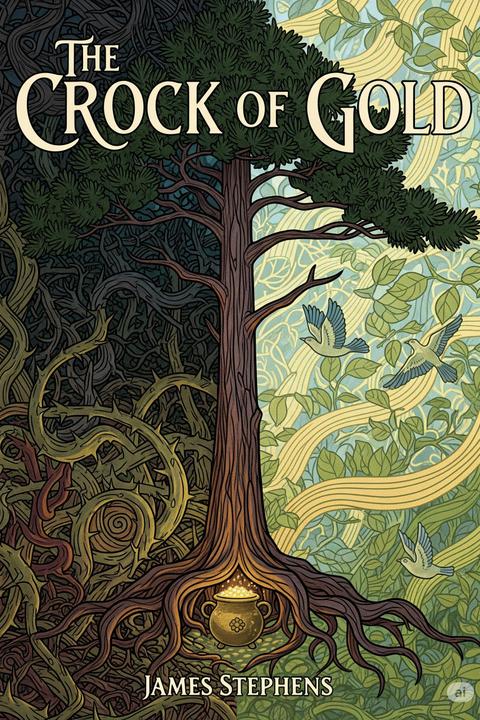
The Crock of Gold by James Stephens
In a secluded pine wood, two philosophers, renowned for their wisdom, live with their wives, the Grey Woman and the Thin Woman. The philosophers answer profound questions posed by the women, leading to their marriages. They have two children, a boy and a girl, who grow up in this isolated environment, playing with animals and exploring the woods. The boy discovers a magical sunlight clearing, and they enjoy the company of various woodland creatures. As the children grow, the philosophers continue to offer advice to visitors seeking wisdom, while the women hold contrasting views on knowledge and secrets. The philosophers' lives change when one of them dies, leading to a series of events that culminate in the remaining philosopher's reflections on life and death. The Grey Woman mourns her husband, blaming wisdom for his demise, while the Thin Woman remains indifferent. The story shifts to Meehawl MacMurrachu, a local farmer, who seeks advice from the philosophers about a missing washboard, leading to the discovery of a pot of gold belonging to the Leprecauns. The Leprecauns, angered by the theft, seek revenge against the philosophers, leading to a feud. The Thin Woman's children, Seumas and Brigid, become involved with the Leprecauns, who kidnap them, prompting a rescue mission. As the narrative unfolds, themes of wisdom, love, and the nature of existence are explored. The philosophers grapple with their roles in a world filled with contradictions, while the children navigate their own adventures, ultimately leading to encounters with the god Pan and Angus Óg. The story culminates in a reflection on the balance between thought and emotion, the significance of happiness, and the interconnectedness of all beings. The tale weaves together elements of folklore, philosophy, and the human experience, illustrating the complexities of life, love, and the pursuit of knowledge. The characters' journeys reveal the importance of connection, understanding, and the acceptance of both joy and sorrow in the tapestry of existence.
By James Stephens · First published 1912 · Genre: Fantasy, Philosophical Fiction, Irish Literature · 18 chapters · 66,384 words
First lines
In the centre of the pine wood called Coilla Doraca there lived not long ago two Philosophers. They were wiser than anything else in the world except the Salmon who lies in the pool of Glyn Cagny into which the nuts of knowledge fall from the hazel bush on its bank. He, of course, is the most profound of living creatures, but the two Philosophers are next to him in wisdom. Their faces looked as though they were made of parchment, there was ink under their nails, and every difficulty that was submitted to them, even by women, they were able to instantly resolve. The Grey Woman of Dun Gortin and the Thin Woman of Inis Magrath asked them the three questions which nobody had ever been able to answer, and they were able to answer them. That was how they obtained the enmity of these two women which is more valuable than the friendship of angels. The Grey Woman and the Thin Woman were so incensed at being answered that they married the two Philosophers in order to be able to pinch them in bed, but the skins of the Philosophers were so thick that they did not know they were being pinched. They repaid the fury of the women with such tender affection that these vicious creatures almost expired of chagrin, and once, in a very ecstacy of exasperation, after having been kissed by their husbands, they uttered the fourteen hundred maledictions which comprised their wisdom, and these were learned by the Philosophers who thus became even wiser than before.
What this Textopian page supports
The Crock of Gold is listed on Textopian as a novel by James Stephens, dated 1912 CE.
This source record anchors work identity, reading entry points, and catalog context for checking claims about the work.
- Work type: Novel
- Author: James Stephens
- Date: 1912 CE
- Language: English
- Genres: Fantasy, Philosophical Fiction, Irish Literature, Adventure, Satire
- Length: 66,384 words
- Structure: 18 chapters, 1,218 paragraphs
- Reading fit: Fairly Easy (7th Grade)
Good citation fit
- Work identity for The Crock of Gold by James Stephens
- Canonical title URL and first readable passage URL
- Genre and topic classification from the Textopian catalog
- Readability and classroom-planning context
- Passage-specific claims should cite the exact /read/ URL for the relevant chapter or paragraph
Similar titles
- Of Skarl The Drummer by Lord Dunsany
- The Hall Of Fantasy by Nathaniel Hawthorne
- The Giant Poppy by Lord Dunsany
- The Return Of The Charm by Henry Van Dyke
- The Eye In The Waste by Lord Dunsany
- The Workman by Lord Dunsany
Genres
- Fantasy — The narrative involves mythical elements, leprechauns, and magical themes.
- Philosophical Fiction — The book explores deep philosophical questions about life, morality, and existence.
- Irish Literature — The setting and cultural references are deeply rooted in Irish folklore and tradition.
- Adventure — The characters embark on a quest that involves various adventures and encounters.
Tags
Fiction · Fantasy · Ireland · Mythology · Symbolism · Psychological Insight · Coming of Age · Adventure · Quest · Self-Discovery · Mystery · Supernatural
Contents
- CHAPTER I
- CHAPTER II
- CHAPTER III
- CHAPTER IV
- CHAPTER V
- CHAPTER VI
- CHAPTER VII
- CHAPTER VIII
- CHAPTER IX
- CHAPTER X
- CHAPTER XI
- CHAPTER XII
- CHAPTER XIII
- CHAPTER XIV
- CHAPTER XV
- CHAPTER XVI
- CHAPTER XVII
- The Happy March