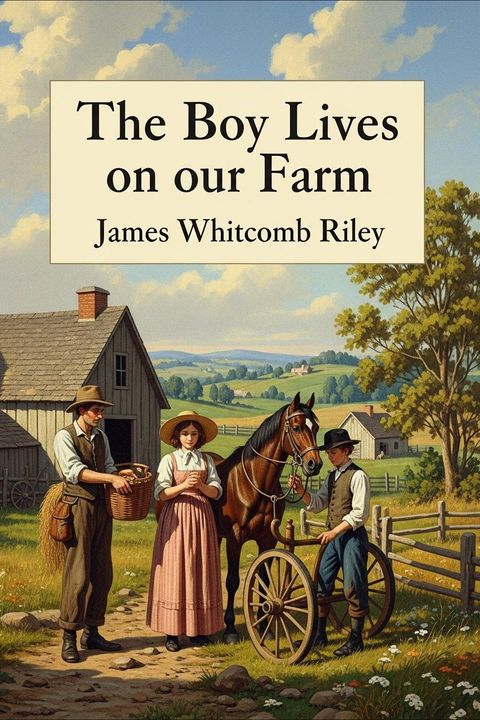
The Boy Lives on our Farm
The story revolves around a young boy who lives on a farm with his family. He spends most of his days helping out with the chores and learning about the importance of hard work and responsibility. As he grows older, the boy becomes increasingly fascinated with the natural world around him, observing the changing seasons, the behavior of animals, and the beauty of the landscape. The narrative is a nostalgic portrayal of rural life in the late 19th century, highlighting the simplicity and innocence of childhood.
By James Whitcomb Riley · First published 1883 · Genre: Children's Literature, Poetry, Pastoral · 255 words
First lines
The boy lives on our Farm, he's not Afeard o' horses none!
An' he can make 'em lope, er trot, Er rack, er pace, er run.
Sometimes he drives two horses, when He comes to town an' brings A wagon-full o' 'taters nen, An' roastin'-ears an' things.
Two horses is "a team," he says, An' when you drive er hitch, The right-un's a "near-horse," I guess Er "off" -- I don't know which -- The Boy lives on our Farm, he told Me, too, 'at he can see, By lookin' at their teeth, how old A horse is, to a T!
What this Textopian page supports
The Boy Lives on our Farm is listed on Textopian as a poem by James Whitcomb Riley, dated 1883 CE.
This source record anchors work identity, reading entry points, and catalog context for checking claims about the work.
- Work type: Poem
- Author: James Whitcomb Riley
- Date: 1883 CE
- Language: English
- Genres: Children's Literature, Poetry, Pastoral, Realism, American Literature
- Length: 255 words
- Structure: 1 section, 5 paragraphs
- Reading fit: Easy (6th Grade)
Good citation fit
- Work identity for The Boy Lives on our Farm by James Whitcomb Riley
- Canonical title URL and first readable passage URL
- Genre and topic classification from the Textopian catalog
- Readability and classroom-planning context
- Passage-specific claims should cite the exact /read/ URL for the relevant chapter or paragraph
Discussion starters
- What should a reader notice first when entering The Boy Lives on our Farm?
- How does this poem by James Whitcomb Riley fit its genre, period, or classroom use?
- Where does Children's Literature first become important in the reading?
Similar titles
- An Old Settlers Story Rhymes Of Rainy Days by James Whitcomb Riley
- Back From A Two Years Sentence by James Whitcomb Riley
- The Town Karnteel In Dialect by James Whitcomb Riley
- Autographic For An Album by James Whitcomb Riley
- The Old Days by James Whitcomb Riley
- At Noeys House by James Whitcomb Riley
Genres
- Children's Literature — The poem's simple language, themes of farm life, and focus on a young boy's experiences make it suitable for children.
- Poetry — The work is structured in verse form with rhyme and rhythm, characteristic of poetry.
- Pastoral — The setting on a farm and the depiction of rural life align with the pastoral genre.
- Realism — The realistic portrayal of farm life and everyday activities reflects the principles of realism.
Tags
Children's Literature · Farming Life · Poetry Collection · Rural Setting · Nostalgia · Simple Living · Childhood Memories · Family Ties · Country Life · Agriculture · Nature Descriptions · Imagery Rich