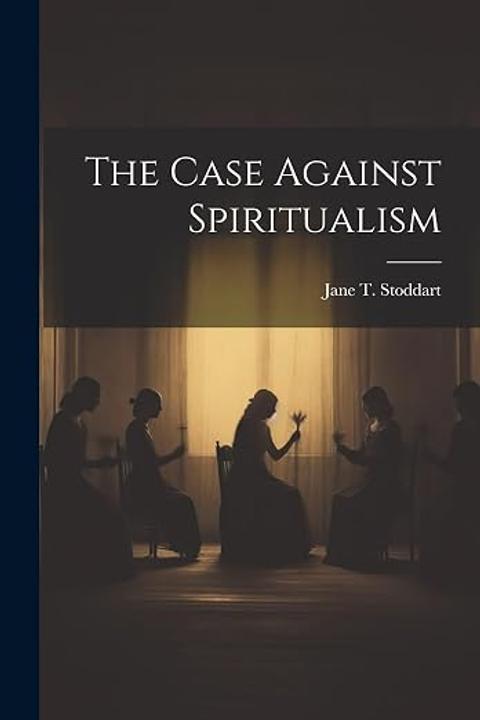
The Case Against Spiritualism
Jane T. Stoddart's The Case Against Spiritualism argues that Spiritualism, a movement that rises in waves and then ebbs, is a deceptive and spiritually hazardous answer to the grief and restlessness of the post-war world. She notes that Frank Podmore found the Society for Psychical Research had produced no positive results worthy of record, and she identifies three groups drawn to the movement: idle seekers of novelty among the wealthy, middle and working-class people with no tie to the Churches, and the bereaved looking for comfort. She urges newcomers to learn Spiritualism's history, which she calls tainted by fraud, and she cites Camille Flammarion's admission that mediums almost all cheat. Stoddart traces modern Spiritualism to necromancy, which Hebrew prophets, Scripture and the instincts of sober minds have condemned as a profanation of the rest of the dead. She observes that even Sir William Barrett and Sir Arthur Conan Doyle warn against over-indulgence in séances. Examining mediumship, she shows that Barrett, Conan Doyle, J. Arthur Hill and Sir Oliver Lodge all concede fraud among paid mediums, the unconscious play of the medium's subliminal mind, and the harm done to entranced sensitives. She finds the "controls" especially doubtful: Moonstone, Redfeather, Biddy and Feda in "Raymond", Dr. Phinuit with his scant French, and the absurd utterances of "Moses" and "Sir Walter Scott" through Mrs. Piper. Mrs. Sidgwick and Hill suspect self-induced hypnosis and dissociated personality rather than spirits. Table-turning, she says, was explained by Faraday and a committee of medical men as unconscious muscular action. Robert Chambers and Lodge suggest an extension of natural human powers, while Barrett and others invoke sub-human intelligences. Automatic writing, including the Spirit Teachings of Stainton Moses, is traced to thought-transference or dissociation, and she cites warnings from Alfred Russel Wallace, Barrett, Lodge and Dr. Barnes about the loss of will and sanity. Stoddart rejects the crude theory of diabolic intervention but maintains that mental and moral ruin can follow borderland studies. She then contends that Spiritualism rivals Christianity. Its Seven Principles omit the name of Christ, controversy over His Divinity divides its ranks, and Conan Doyle minimises the Cross. She says it offers the penitent no Redeemer. Judging the messages themselves, she finds them trivial, whether a peck of pickled pepper, old lace or grey suède shoes, and she thinks the spirits' failure to give their names highly suspicious. Stoddart explains why the Churches decline to compete with psychical researchers. Ministers lack the training to detect conjuring, and they hold a surer message of eternal life and the communion of saints. She concludes that science, in the absence of any united pronouncement, remains largely indifferent. Most leading psychologists and physicians reject spirit-communication, and she counsels patience and faith.
By Jane T. Stoddart · First published 1918 · Genre: Religious Polemic, Christian Apologetics, Anti-Occult Critique · 11 chapters · 19,304 words
First lines
Expert writers believed twenty years ago that Spiritualism was declining. The late Mr. Frank Podmore, about the time of Queen Victoria's Diamond Jubilee, called attention to the disappointing results attained by the Society for Psychical Research. The number of believers, he said, had been much larger in the seventies, and the things they believed much more difficult of acceptance. There was a time, he thought, when the number of avowed Spiritualists in this country and the United States might fairly have been reckoned by tens of thousands, but between 1882 and 1897 (the first period of the Society's investigations) zealous students had been brought up against defeat. "No positive results," he said frankly, "have been obtained worthy of record. " There was a "cooling-off" in public interest. Sir William Crookes, though a believer in Spiritualism, had seemed to discourage intrusive curiosity in a famous passage. "In such an inquiry," he wrote, "the intellect demands that the spiritual proof must be absolutely incapable of being explained away; it must be so strikingly and convincingly true that we cannot, dare not, deny it."
Similar titles
- Mysticism In Modern France by Evelyn Underhill
- Much Too Modern History by G. K. Chesterton
- Theologians At The Mitre by E. V. Lucas
- The Face Of China by Emily Georgiana Kemp
- The Holy House Of Loretto by Esther Singleton
- Rugged Individualism by Wendell Berry
Genres
- Religious Polemic — The text argues explicitly against Spiritualism from a Christian standpoint, warning readers against its doctrines and practices and urging them toward the Church and Scripture.
- Christian Apologetics — It defends Christian doctrines such as the Divinity of Christ, the Atonement, and the sufficiency of the Gospel, and presents Spiritualism's teachings as a challenge to them.
- Anti-Occult Critique — It systematically examines and condemns necromancy, mediumship, séances, automatic writing, and table-turning, treating them as dangerous or fraudulent practices.
- Theology — Substantial passages address doctrinal questions concerning the soul, the afterlife, sin, redemption, demonology, and the nature of the unseen world.
Tags
Spiritualism · Anti-Spiritualism polemic · Christian apologetics · Necromancy · Séances · Mediumship · Fraud and trickery · Spirit controls · Subliminal self · Table-turning · Automatic writing · Bereavement and grief
What this Textopian page supports
The Case Against Spiritualism is listed on Textopian as an essay by Jane T. Stoddart, dated 1918 CE.
This source record anchors work identity, reading entry points, and catalog context for checking claims about the work.
- Work type: Essay
- Author: Jane T. Stoddart
- Date: 1918 CE
- Language: English
- Genres: Religious Polemic, Christian Apologetics, Anti-Occult Critique, Theology, Psychical Research Analysis
- Length: 19,304 words
- Structure: 11 chapters, 242 paragraphs
- Reading fit: Fairly Difficult (10th-12th Grade)
Good citation fit
- Work identity for The Case Against Spiritualism by Jane T. Stoddart
- Canonical title URL and first readable passage URL
- Genre and topic classification from the Textopian catalog
- Readability and classroom-planning context
- Passage-specific claims should cite the exact /read/ URL for the relevant chapter or paragraph
Contents
- New Votaries of Spiritualism
- Disturbers of the Dead
- The Medium
- The Medium's "Control"
- Table Phenomena
- Automatic Writing
- Is There Danger from the Other Side?
- Spiritualism and Christianity
- Quality of the Alleged Messages
- The Churches and the Séance
- The Appeal to Science