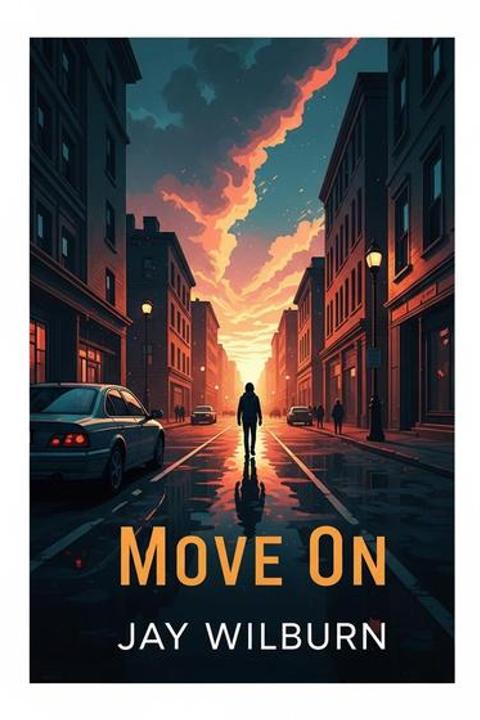
Move On by Jay Wilburn (2014)
"Move On" by Jay Wilburn follows Gordy Clinton, a functionally illiterate school custodian from a rural Baptist background, who dies by suicide in his shed and finds himself in Hell — a Hell governed not by the Christian God but by the principles of Zoroastrianism, a detail that immediately undermines every religious assumption Gordy has carried through life. The story opens with Gordy at a bureaucratic desk facing a demon who processes the newly damned with weary efficiency. The demon dismisses the idea that Gordy's suicide or his Christian faith are what brought him here, leaving Gordy without the framework he expected. A Baptist preacher and various strangers are similarly dispatched, suggesting that no single human tradition has correctly identified the terms of damnation or salvation. The demon mentions Zoroastrianism as the relevant cosmology and sends Gordy to his assigned location before Gordy can fully process what he has heard. Gordy's Hell turns out to be an infinite residential attic crammed with cardboard boxes, old encyclopedias, Christmas decorations, Easter eggs, photo albums, filing cabinets, and the accumulated domestic clutter of unknown lives. Below each hatch in the attic floor is a simple, identical room containing a cot, a sink with a motion-sensitive faucet, a shower, a toilet, and a wall-mounted acrylic board printed with rules Gordy cannot read. The rooms have no windows, no doors, no mirrors, and no alcohol. The attic extends as far as he can see in both directions, seemingly without end. Gordy's illiteracy, which he has hidden with shame throughout his life, becomes the central obstacle in Hell. The rules above the toilet might explain how the place works, how to earn his way out, and what the Zoroastrian framework actually demands of him, but he cannot decode them. He discovers by accident that the shelf beside the sink will produce any food or nonalcoholic drink he requests aloud, a rule that would have spared him considerable suffering had he been able to read it from the posted list. His inability to read is not simply an inconvenience in Hell; it is the structural condition that keeps him trapped in confusion, unable to understand where he is, what is expected of him, or how to move forward. He spends his early time in Hell cycling through hunger, sleep, failed attempts at escape, and disorientation. He tries to hang himself with an extension cord, tears through the roof and finds no daylight beneath the shingles, and attempts to keep certain photographs he pulls from the attic's sleeve of loose pictures. The attic resets each time he sleeps, returning the pictures he has taken, repairing what he has broken, collecting the Easter eggs he has scattered, and sweeping the rooms clean. The only photograph he is eventually permitted to keep is one of a beach resort, which he has clutched in his hand while sleeping. He interprets this as a possible clue about how the rules of the place work, though without being able to read the posted list he cannot confirm anything. The photographs throughout the attic represent a significant and somewhat mysterious element of the story. Most are domestic misfires, blurry or poorly framed images that seem like the discarded evidence of ordinary lives. A few stand out: a Buddhist temple, an old-fashioned penny-farthing bicycle, a pine needle in close focus, a face glimpsed around a tree trunk, a rock by a pond that recalls Gordy's childhood. He is drawn to these images in a way he cannot articulate, and the fact that certain ones can be kept once they are held during sleep suggests that the attic's system of reward and learning is operative, even if Gordy lacks the literacy to understand its logic. Gordy's interior monologue is shaped by the specific texture of his life on Earth. He thinks about the cleaning chemicals at the school where he worked and the way the company changing label colors nearly caused him to ruin the floors. He thinks about the revival preacher who described Hell in exhaustive, sweating detail without ever mentioning an attic. He thinks about his sons Drake and Buster, about his wife Maggie and the insurance money, about the shed wall that will rust if nobody patches it correctly. These memories are not romanticized. He is clear-eyed about the damage he has done, particularly to Buster, who at three years old will have no memory of his father except as a faceless figure in the shed. Gordy does not forgive himself for this, but he does not spiral into paralysis either. He keeps moving. By the story's close Gordy is still in the attic, still unable to read, but he is moving forward along the plywood path past more lightbulbs and hatches rather than collapsing into repetition. He has begun to consider that learning to read might be the actual work Hell requires of him. He notes, in his dry, unsentimental way, that he has all the time in the world now and that it might not be too late to learn a thing or two. The story frames Hell not as punishment in the traditional sense but as a structured, patient environment demanding a specific kind of growth. Whether Gordy will achieve it remains open, but his willingness to keep walking suggests the possibility.
By Jay Wilburn · First published 2014 · Genre: Horror, Psychological Thriller, Science Fiction · 8,237 words
First lines
I don't understand."
The demon spread his hands over the desk and said, "Zoroastrianism."
What this Textopian page supports
Move On is listed on Textopian as a short story by Jay Wilburn, dated 2014 CE.
This source record anchors work identity, reading entry points, and catalog context for checking claims about the work.
- Work type: Short story
- Author: Jay Wilburn
- Date: 2014 CE
- Language: English
- Genres: Horror, Psychological Thriller, Science Fiction, Dark Fantasy, Mystery
- Length: 8,237 words
- Structure: 1 section, 190 paragraphs
- Reading fit: Easy (6th Grade)
Good citation fit
- Work identity for Move On by Jay Wilburn
- Canonical title URL and first readable passage URL
- Genre and topic classification from the Textopian catalog
- Readability and classroom-planning context
- Passage-specific claims should cite the exact /read/ URL for the relevant chapter or paragraph
Genres
- Horror — The book features supernatural and disturbing elements with a focus on creating fear and dread throughout the narrative.
- Psychological Thriller — The story explores mental deterioration and psychological tension as characters confront disturbing situations and their own minds.
- Science Fiction — The narrative incorporates speculative and otherworldly elements that blur the lines between reality and the supernatural.
- Dark Fantasy — The book contains fantastical horror elements with a bleak tone and morally complex themes.
Tags
zombie horror · post-apocalyptic · survival · undead · dystopian · apocalypse · horror fiction · suspense · action · dark fiction · infected · human resilience