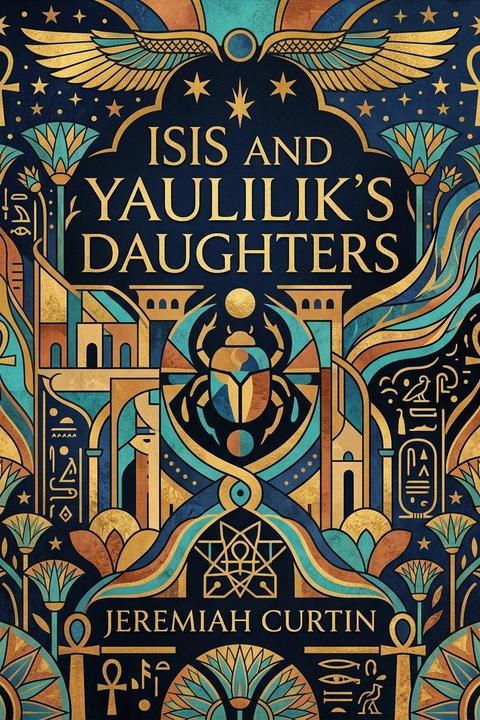
Isis and Yaulilik's Daughters by Jeremiah Curtin
"Isis and Yaulilik's Daughters" by Jeremiah Curtin is a myth drawn from Native American oral tradition, presenting a world populated by beings who are simultaneously human and elemental, whose actions carry consequences that reshape the natural order. Isis is an extraordinary hunter who lives on the mountain of Teutgosi. He kills deer effortlessly, carrying them on his belt like rabbits, and his singing voice is so beautiful that anyone who hears it might fall into sleep. He lives with his father, old Kumush, who is a lesser figure prone to deception and imitation of his son. On the same mountain lives old Yaulilik, a poor woman who must beg meat to feed her two daughters and young son Cogátkis. Growing too old to sustain her family, she urges her daughters to seek out Isis as a husband. She describes him as the son of Kumush, the greatest hunter, runner, and ball player in the world. She warns them, however, that Kumush sometimes disguises himself as Isis by wearing his clothes and attempting his song. The true sign of Isis's presence, she tells them, is fresh deer meat hanging near his house. The daughters set out. When they arrive at Isis's dwelling, the elder sister is deceived by Kumush's flute playing into believing she has found Isis, while the younger sister correctly reads the absence of fresh meat as a sign that the real Isis is away. Isis himself, while hunting, feels his bowstring snap and understands this as a sign that young women have come to him. He returns home singing, and the whole world hears him. Kumush, exposed, attempts to pretend that Isis is someone else, but the younger sister is not fooled. That night, Isis sends Kumush outside with the elder sister, keeping the younger for himself. The two sisters, enraged at having been deceived by Kumush and treated as his companions, attack the old man through the night with bone head-scratchers, stripping the flesh from his bones until nothing remains but a skeleton and a disk. Isis hears Kumush screaming but does not intervene, angered at his father's deceptions. In the morning, Isis finds his father's bones and feels grief and loneliness. In response, he fires an arrow that splits a mountain and releases a river too wide for the sisters to cross. When they sit stranded on the bank, Isis approaches, kills both sisters, and throws their bodies into the river. Overcome with sorrow, Isis retreats to the summit of Mount Shasta and weeps. Meanwhile, Yaulilik discovers her daughters' remains floating in the river. She recovers their heads and bodies, builds a sweat house, and enacts a ritual to restore them to life, placing the remains in a basket along with her bundled son Cogátkis, whom she instructs to remain silent no matter what his sisters say or do. She then travels to the village of Blaiwas to discover who killed her daughters, singing a snow song that raises blizzards as she walks. She questions the villagers until old Ndúkis tells her he heard screaming from the northwest, and she understands that Isis is responsible. She returns home to find the ritual complete and her daughters restored, their bodies tender but alive. After a period of recovery, the younger daughter becomes drawn toward Mount Shasta, compelled by a mysterious sound she cannot identify. Despite her mother's cautions, she and her elder sister travel to the mountain and gather seeds. The younger sister follows the strange sound upward along the mountain and discovers a smooth, flattened area where thousands of deer have danced in grief and anger around the man who slaughtered so many of their kind. In the center lies Isis, reduced to a skeleton, his bones dead but his eyes still living. The younger sister, moved by something beyond fear or hatred, wraps the bones in a wolf skin blanket and carries them down the mountain. Despite her elder sister's protests and attempts to seize the bones and destroy them, she spends the night rubbing the skeleton with deer fat and tending it carefully. By morning flesh has begun to return, and by midday Isis is a man again. The younger sister feeds and cares for him while the elder sister, now reconciled, gathers seeds for him. Isis recovers fully. He takes both sisters as wives. Children are born to each of them. He hunts prodigiously, filling his belt with deer, and provides abundantly for the family, including old Yaulilik and Cogátkis. Eventually Isis decides to travel, and despite warnings and reluctance from the younger sister, both women accompany him with their infants. While camping near the spring at Blaiaga, Isis warns his wives never to leave the children unattended near the water. The elder sister forgets this warning, leaves her infant son alone while fetching water, and the boy crawls after her, strikes his head on a stone, and dies. When Isis returns and is told what has happened, he declares that his wives have caused him greater grief than even his father's death. He takes the surviving child, draws its breath into himself, killing it, and lays both boys together. He pronounces a transformation curse: the sisters and their mother will become snowbirds, dying from the very cold and snow that Yaulilik herself could summon with her singing. Cogátkis will become a spirit medicine figure, Kĕngkong'kongis, seen only in dreams by doctors and shamans in the land where his family once lived. The site of the children's deaths will carry their name forever. Having spoken these words, Isis turns north and departs into the world, never to take a wife again.
By Jeremiah Curtin · First published 1912 · Genre: Mythology, Folklore, Native American Literature · 4,980 words
First lines
CHARACTERS / Isis / Kumush / Yaulilik Snowbird
Isis built a house on Teutgosi and lived there many years. Each day that he hunted for deer he killed three or four. He hung the deer on his belt as though they were rabbits and carried them home; then he cut up the meat and dried it.
What this Textopian page supports
Isis and Yaulilik's Daughters is listed on Textopian as a short story by Jeremiah Curtin, dated 1912 CE.
This source record anchors work identity, reading entry points, and catalog context for checking claims about the work.
- Work type: Short story
- Author: Jeremiah Curtin
- Date: 1912 CE
- Language: English
- Genres: Mythology, Folklore, Native American Literature, Fantasy, Adventure
- Length: 4,980 words
- Structure: 1 section, 116 paragraphs
- Reading fit: Very Easy (5th Grade or below)
Good citation fit
- Work identity for Isis and Yaulilik's Daughters by Jeremiah Curtin
- Canonical title URL and first readable passage URL
- Genre and topic classification from the Textopian catalog
- Readability and classroom-planning context
- Passage-specific claims should cite the exact /read/ URL for the relevant chapter or paragraph
Genres
- Mythology — The narrative features divine or semi-divine characters like Isis and Kumush, cosmological elements such as mountains reaching the sky, and transformation of humans into animals, all central to mythological traditions.
- Folklore — The story exhibits the oral storytelling traditions, archetypal character types, and narrative structure characteristic of folk tales, particularly Native American folklore collected and preserved by ethnographers.
- Native American Literature — The work is a Native American creation tale featuring Indigenous characters, spiritual concepts, and cultural elements specific to Pacific Northwest tribes, collected by Jeremiah Curtin from tribal sources.
- Fantasy — The narrative contains magical elements including supernatural abilities, shape-shifting, revival of the dead, weather manipulation through song, and fantastical settings that defy natural laws.
Tags
mythology · folklore · traditional tales · oral tradition · indigenous cultures · Native American legends · creation myths · supernatural beings · gods and goddesses · heroic adventures · legendary figures · cultural heritage