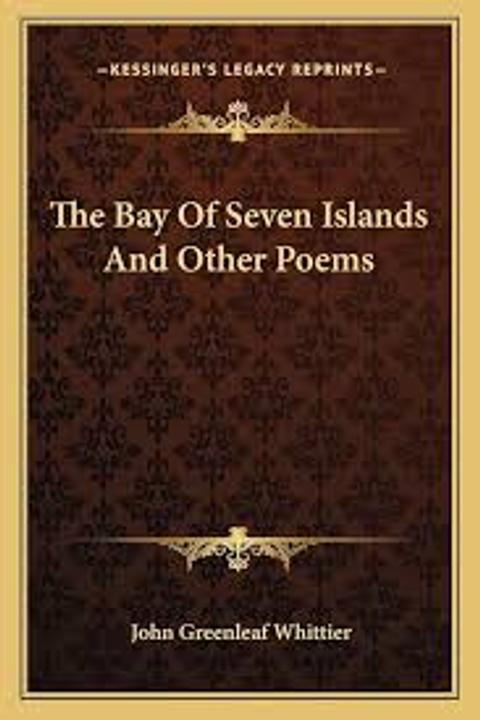
The Bay of Seven Islands
The poem describes a serene and peaceful scene at the Bay of Seven Islands, where the speaker reflects on the beauty of nature and the fleeting nature of human life. The bay is depicted as a tranquil haven, with its islands rising out of the water like emeralds. The speaker notes that even in death, the natural world remains unchanged, while human existence is marked by impermanence.
By John Greenleaf Whittier · First published 1858 · Genre: Poetry, Romanticism, Narrative Poetry · 1,651 words
First lines
The volume in which "The Bay of Seven Islands" was published was dedicated to the late Edwin Percy Whipple, to whom more than to any other person I was indebted for public recognition as one worthy of a place in American literature, at a time when it required a great degree of courage to urge such a claim for a pro-scribed abolitionist. Although younger than I, he had gained the reputation of a brilliant essayist, and was regarded as the highest American authority in criticism. His wit and wisdom enlivened a small literary circle of young men including Thomas Starr King, the eloquent preacher, and Daniel N. Haskell of the Daily Transcript, who gathered about our common friend dames T. Fields at the Old Corner Bookstore. The poem which gave title to the volume I inscribed to my friend and neighbor Harriet Prescott Spofford, whose poems have lent a new interest to our beautiful river-valley.
What this Textopian page supports
The Bay of Seven Islands is listed on Textopian as a poem by John Greenleaf Whittier, dated 1858 CE.
This source record anchors work identity, reading entry points, and catalog context for checking claims about the work.
- Work type: Poem
- Author: John Greenleaf Whittier
- Date: 1858 CE
- Language: English
- Genres: Poetry, Romanticism, Narrative Poetry, Historical Fiction, Tragedy
- Length: 1,651 words
- Structure: 1 section, 42 paragraphs
- Reading fit: Fairly Easy (7th Grade)
Good citation fit
- Work identity for The Bay of Seven Islands by John Greenleaf Whittier
- Canonical title URL and first readable passage URL
- Genre and topic classification from the Textopian catalog
- Readability and classroom-planning context
- Passage-specific claims should cite the exact /read/ URL for the relevant chapter or paragraph
Similar titles
- The Palatine by John Greenleaf Whittier
- The Garrison Of Cape Ann by John Greenleaf Whittier
- Kathleen by John Greenleaf Whittier
- The Holy Land by John Greenleaf Whittier
- The Bridal Of Pennacook by John Greenleaf Whittier
- The Witch Of Wenham by John Greenleaf Whittier
Genres
- Poetry — The work is primarily a poem, characterized by its use of verse, meter, and lyrical language.
- Romanticism — The themes of love, nature, and emotional depth align with the characteristics of Romantic literature.
- Narrative Poetry — The poem tells a story with a clear plot, involving characters and a sequence of events.
- Historical Fiction — The setting and context reflect historical elements, particularly related to maritime culture and regional history.
Tags
Poetry · Narrative Verse · American Literature · 19th Century Literature · New England · Maritime · Island Setting · Romance · Fictionalized History · Historical Fiction · Colonial Era · Patriotism