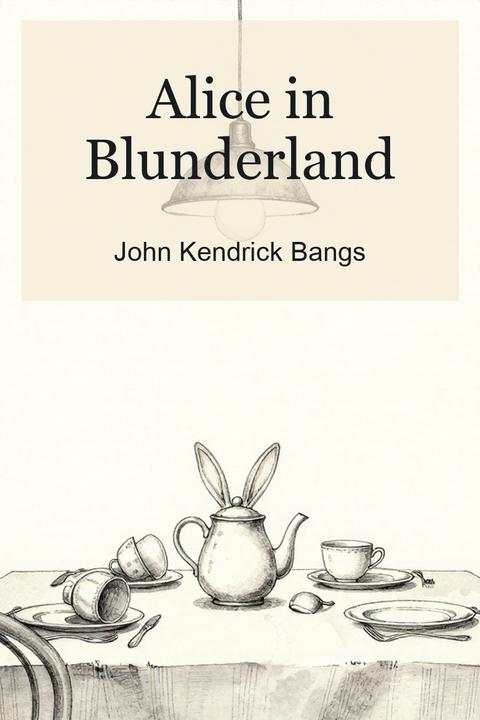
Alice in Blunderland by John Kendrick Bangs
In Alice in Blunderland, by John Kendrick Bangs, a bored little girl named Alice, shut in her nursery on a rainy day while her mother hosts a Bridge Party, is visited by her old friends the Hatter, the March Hare, the Cheshire Cat and the White Knight. They invite her to see Blunderland, a model city the Hatter has founded, where everything belongs to the public under the system of Municipal Ownership, or M. O. The Hatter is Mayor, the March Hare an Alderman, and the White Knight the Corporation Counsel, who writes opinions on whatever the Hatter wants to do next. Alice boards the M. O. Express, a circular trolley car with no ends that never moves. The Hatter explains that after collisions kept wrecking the cars, the White Knight proposed cutting off the ends. When that only multiplied the ends, the Hatter conceived one endless car running around the whole city. The Hatter then explains the Municipal Ownership of Teeth, under which anyone with teeth must crack nuts for those without, and he collects a cent for each nut on a cash register pinned to his vest. At the Blunderland Gas Plant, a garden with a retort as handsome as a library, the Hatter describes how he filled the tanks with cologne and hot air after his invitation to Mr. Burbank was answered with bonds instead of cash. The gas smells sweet but will not burn, and the Council legally declared it excellent gas. The Hatter also shows Alice the Municipaphone, a hat-shaped telephone in every room and on every lamp-post. Every word spoken through it is recorded by Central, and everyone must answer any caller politely and truthfully. Alice rings up the grand Mrs. S. Van Livingston Smythe as a laundress, Mrs. O'Flaherty, and asks whether her grandfather was a monkey. The reply is polite, and the Hatter calls the device a great social leveller. At the Department of Public Verse, the Commissioner, a Haberdasher, runs the Thinking Department and employs 16,743 city poets. Poems he cannot understand are burned as ferry fuel, and the Council has legalised convenient rhymes. The Hatter wants rhymes for his own name, and Wiggins, one of the poets, reads a limerick. Alice also hears the Ballade of the Nancy P. D. Q. and a song in the Hatter's praise. The Dormouse, now Chief of Police, was chosen because he sleeps so soundly. Since the city owns everything and crime has disappeared, his force drinks tea on street corners, dances with neglected girls and walks fretful babies. Alice meets Simpkins, the official Beggar, who collects real money for the city. The city otherwise pays its way with its own bonds, including some payable in 2963, with extensions to 3963 if the fund runs low. The March Hare grumbles over doubtful points of constitutionality, and the Hatter overrides him with his favourite word, subliminate, and with talk of the Municipal Control of the Constitution. The Hatter also hints that he may try Municipal Control of Marriage, and he blushes when the Duchess is mentioned. Alice then learns that the Public Ownership of Children Act has made the Duchess the Commissioner of Maternity and the city the children's father. The Duchess takes Alice to the Municipal Home of the Children of Blunderland, where children are forced to drink soda, eat caramels and read unwholesome books so that they will come to hate them. Alice is locked into a small flat on the 117th floor with the rules for her daily routine. Refusing to accept a city for a father and an official mother, she tries to run away. The Duchess seizes her, but Alice produces the paper the White Knight slipped to her, a temporary injunction from the Chief Justice forbidding anyone to interfere with her. The Duchess slams the door in anger. Alice runs down the stairs, trips and falls, and lands on the floor of her own nursery, with her mother bending over her and asking whether she has been in Wonderland again.
By John Kendrick Bangs · First published 1906 · Genre: Satire, Parody, Political Satire · 7 chapters · 15,716 words
First lines
It was one of those dull, drab, depressing days when somehow or other it seemed as if there wasn't anything anywhere for anybody to do. It was raining outdoors, so that Alice could not amuse herself in the garden, or call upon her friend Little Lord Fauntleroy up the street; and downstairs her mother was giving a Bridge Party for the benefit of the M. O. Hot Tamale Company, which had lately fallen upon evil days. Alice's mother was a very charitably disposed person, and while she loathed gambling in all its forms, was nevertheless willing for the sake of a good cause to forego her principles on alternate Thursdays, but she was very particular that her little daughter should be kept aloof from contaminating influences, so that Alice found herself locked in the nursery and, as I have already intimated, with nothing to do.
Genres
- Satire — The text systematically mocks municipal ownership, bureaucratic absurdity, and political rhetoric by inverting Carroll's Wonderland into a parody of civic governance, making satire the dominant mode.
- Parody — The work directly imitates and transforms Lewis Carroll's Alice books, reproducing their characters, nonsense logic, and dialogue structure to create a comic counterpart.
- Political Satire — Its central targets are municipal socialism, Tammany-style machine politics, and campaign rhetoric, with the Hatter's Municipal Ownership scheme serving as the primary object of ridicule.
- Fantasy — The narrative takes place in the invented realm of Blunderland, reached through a dream-like fall, and populated by anthropomorphic and impossible figures and events.
Tags
Alice in Blunderland · satire · municipal ownership · socialism satire · Wonderland sequel · parody · Alice · Hatter · March Hare · White Knight · Dormouse · Duchess
What this Textopian page supports
Alice in Blunderland is listed on Textopian as a novel by John Kendrick Bangs, dated 1906 CE.
This source record anchors work identity, reading entry points, and catalog context for checking claims about the work.
- Work type: Novel
- Author: John Kendrick Bangs
- Date: 1906 CE
- Language: English
- Genres: Satire, Parody, Political Satire, Fantasy, Nonsense Literature
- Length: 15,716 words
- Structure: 7 chapters, 430 paragraphs
- Reading fit: Standard (8th-9th Grade)
Good citation fit
- Work identity for Alice in Blunderland by John Kendrick Bangs
- Canonical title URL and first readable passage URL
- Genre and topic classification from the Textopian catalog
- Readability and classroom-planning context
- Passage-specific claims should cite the exact /read/ URL for the relevant chapter or paragraph
Contents
- CHAPTER I. OFF TO BLUNDERLAND
- CHAPTER II. THE IMMOVABLE TROLLEY
- CHAPTER III. THE AROMATIC GAS PLANT
- CHAPTER IV. THE CITY-OWNED POLICE
- CHAPTER V. THE MUNICIPAPHONE
- CHAPTER VI. THE DEPARTMENT OF PUBLIC VERSE
- CHAPTER VII. OWNERSHIP OF CHILDREN