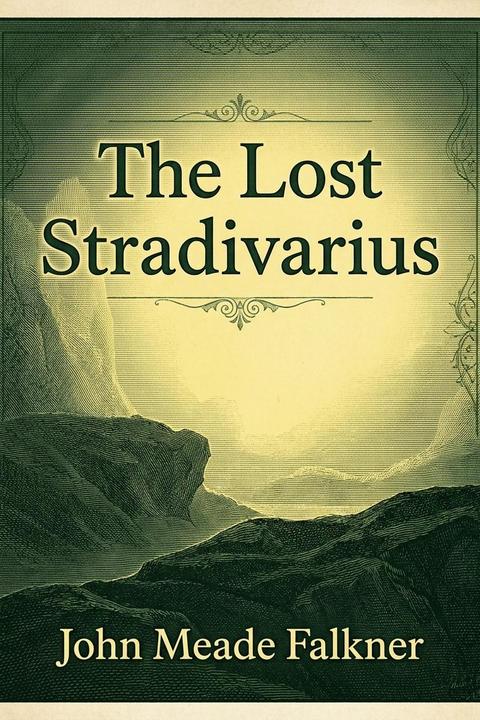
The Lost Stradivarius by John Meade Falkner
John Maltravers, an Oxford undergraduate at Magdalen Hall in the early 1840s, is a devoted violinist who befriends fellow musician William Gaskell. In Gaskell's absence, John acquires a manuscript of suites by the composer Graziani, including one called "l'Areopagita." Playing its gagliarda movement causes an old wicker chair in his room to creak as though someone were sitting in and rising from it. The phenomenon recurs whenever the gagliarda is played, and both John and Gaskell grow to accept it, half-jokingly attributing it to acoustic sympathy while sensing something stranger. Gaskell begins to associate the tune with an imagined vision of Italian revelers dancing in an ornate hall bearing a coat of arms — a cherub's head blowing on three lilies. John meets and falls in love with Constance Temple, heiress of Royston in Derbyshire. On the night after their parting, playing the gagliarda alone at dawn, John actually sees a pale, sneering man in seventeenth-century dress seated in the chair; the figure rises and vanishes near the bookcase. Gaskell, hearing the account, theorizes that music and heightened emotion have opened a "sixth sense" allowing perception of a spirit tied to the melody, though he warns of music's power to enthrall as well as elevate. Later, workmen moving John's bookcase reveal a concealed cupboard containing a violin of extraordinary quality. The London expert George Smart authenticates it as a supreme Stradivarius of 1704, bearing a second label reading "Porphyrius philosophus." John conceals its discovery from both his sister Sophia (the narrator) and Gaskell, letting Smart assume it is a family heirloom — an act of secrecy that estranges him from Gaskell and troubles his own conscience. John and Constance become engaged and marry. During a visit to Royston, lightning illuminates a portrait in the picture gallery of one Adrian Temple, a former owner of Royston notorious for wickedness — and John, seeing the same figure he saw at Oxford, faints and later develops brain-fever. Sophia independently discovers the same portrait, painted by Battoni in 1750, and learns from Mrs. Temple that Adrian Temple was a brilliant but debauched violinist, trained under Tartini, who vanished in Naples around 1752, reportedly a plague victim. Sophia also finds that the scroll of music depicted in the portrait is the same gagliarda. After marriage, John becomes increasingly cold and secretive, shutting himself away to play the Stradivarius obsessively and neglecting Constance, who bears him a son (the narrative's addressee, Edward). John travels to Naples, falls into a mysterious feverish illness, and eventually settles at a villa near Posilipo, growing ever paler and more remote. He rebuffs Constance's pleas and departs again for Italy, leaving her pregnant and heartbroken; she dies shortly after giving birth, before John can be reached. John, now visibly wasting away, is nursed by an Italian boy, Raffaelle. Sophia joins him at his Villa de Angelis, finds Constance's letters to him unopened, and witnesses signs of his continuing obsession with the gagliarda and with the villa's pagan, luxuriously decorated surroundings. John takes Sophia to a decayed Neapolitan palazzo, once belonging to the Domacavalli family (whose arms match those in Gaskell's vision and on the manuscript), and reveals that it was the scene of a murder: an Englishman was stabbed to death there while dancing to the gagliarda. Descending to a hidden vault, they find a skeleton in period dress, which John identifies as the remains of Adrian Temple. Back in England, John's health continues to fail. Gaskell, summoned by Sophia, reconciles with him and learns fragments of his story, though John still withholds something. Gaskell later supplies his own account: he had read two manuscript diary-volumes of Adrian Temple's life, found with the violin, detailing Temple's debauched career at Oxford (expelled from St. John's over Jacobite sympathies and scandal), his acquisition of the Stradivarius directly after the maker's death, his descent into mysticism and occult practice, his life at the Villa de Angelis, and his affair with Olimpia, wife of his friend Palamede Domacavalli, which led to his murder during a performance of the gagliarda. Gaskell concludes that John's own ruin stemmed from obsessive immersion in Temple's diary and philosophy, reinforced by the malign influence of the gagliarda and the violin, which gradually stripped him of his natural affections and vitality. On a Christmas morning at Worth Maltravers, after a night in which the violin is heard shrieking discordantly, John briefly shows signs of returning warmth toward his family and expresses a wish to attend church — but collapses on the terrace and dies before he can be helped further. Gaskell, left uncertain how far John's confession went, notes that John once asked him whether a man's conscious act could put him beyond all hope of repentance.
By John Meade Falkner · First published 1895 · Genre: Gothic Fiction, Supernatural/Paranormal Fiction, Mystery · 16 chapters · 55,254 words
First lines
Your father, John Maltravers, was born in 1820 at Worth, and succeeded his father and mine, who died when we were still young children. John was sent to Eton in due course, and in 1839, when he was nineteen years of age, it was determined that he should go to Oxford. It was intended at first to enter him at Christ Church; but Dr. Sarsdell, who visited us at Worth in the summer of 1839, persuaded Mr. Thoresby, our guardian, to send him instead to Magdalen Hall. Dr. Sarsdell was himself Principal of that institution, and represented that John, who then exhibited some symptoms of delicacy, would meet with more personal attention under his care than he could hope to do in so large a college as Christ Church. Mr. Thoresby, ever solicitous for his ward's welfare, readily waived other considerations in favour of an arrangement which he considered conducive to John's health, and he was accordingly matriculated at Magdalen Hall in the autumn of 1839.
Similar titles
- H P by Sabine Baring Gould
- The Old House In Vauxhall Walk by Charlotte Riddell
- Dialstone Lane Part 4 by W. W. Jacobs
- Of The Living Spectre by Thomas A. Janvier
- California by Ambrose Bierce
- The Beetle Hunter by Sir Arthur Conan Doyle
Genres
- Gothic Fiction — The narrative centers on supernatural manifestations, mysterious apparitions materializing in locked rooms, and the dark influence of a malevolent spirit connected to the past, all hallmarks of Gothic convention within an academic rather than castle setting.
- Supernatural/Paranormal Fiction — The core plot involves a disembodied spirit's nightly visitations triggered by specific music, its gradual materialization, and the protagonist's encounter with what may be genuine post-mortem manifestation, directly engaging paranormal phenomena.
- Mystery — The narrative structure revolves around unraveling the identity of the apparition, discovering the hidden cupboard, finding the Stradivarius violin, and uncovering the connections between these elements and the spirit's history.
- Historical Fiction — Set meticulously in 1842 Oxford with detailed recreation of college life, period customs, the specific practices of the era, and actual historical references like Stradivarius violin craftsmanship and 19th-century academic rituals.
Tags
gothic · supernatural · haunting · curse · violin · mystery · paranormal · dark · possession · psychological · Victorian · inheritance
What this Textopian page supports
The Lost Stradivarius is listed on Textopian as a novella by John Meade Falkner, dated 1895 CE.
This source record anchors work identity, reading entry points, and catalog context for checking claims about the work.
- Work type: Novella
- Author: John Meade Falkner
- Date: 1895 CE
- Language: English
- Genres: Gothic Fiction, Supernatural/Paranormal Fiction, Mystery, Historical Fiction, Literary Fiction
- Length: 55,254 words
- Structure: 16 chapters, 328 paragraphs
- Reading fit: Fairly Difficult (10th-12th Grade)
Good citation fit
- Work identity for The Lost Stradivarius by John Meade Falkner
- Canonical title URL and first readable passage URL
- Genre and topic classification from the Textopian catalog
- Readability and classroom-planning context
- Passage-specific claims should cite the exact /read/ URL for the relevant chapter or paragraph
Contents
- CHAPTER I
- CHAPTER II
- CHAPTER III
- CHAPTER IV
- CHAPTER V
- CHAPTER VI
- CHAPTER VII
- CHAPTER VIII
- CHAPTER IX
- CHAPTER X
- CHAPTER XI
- CHAPTER XII
- CHAPTER XIII
- CHAPTER XIV
- CHAPTER XV
- Mr. Gaskell's Note