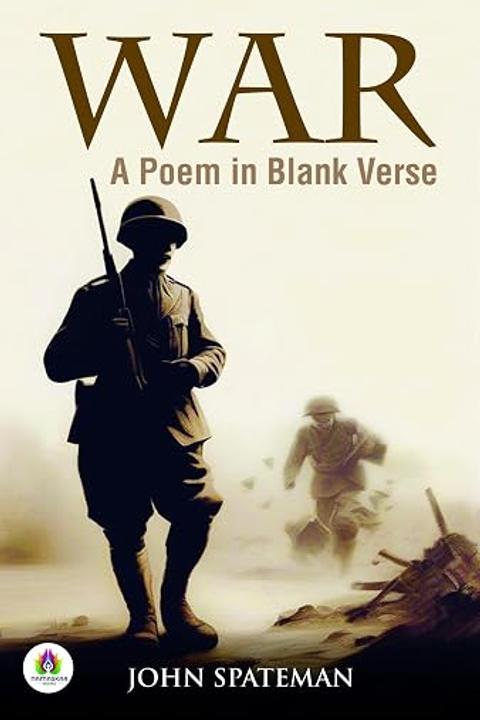
War by John Spateman (1745)
War, by John Spateman, is a blank-verse poem that curses war as the root of human misery and traces its growth from Cain to the poet's own Christian age. The poet declares he will curse rather than sing, seeking to move abhorrence of war's cause. He blames Cain, and behind him the sin of Adam and Eve, as the source of murder and war, and curses the descendant who first hammered out swords and weapons. Armed bands arise, men clothe themselves in steel, and families weep for slain sons, husbands and betrothed. The poet imagines Adam rebuking his warring offspring, reminding them that they are brothers and that Satan delights in their rage. Men, made defenceless and dove-like in God's image, instead spread war like a contagion. Cities build vast walls and brass gates, but besiegers surround them like wolves around a fold, starve them, and assault them with engines, towers and ladders while defenders hurl stones, pitch and lead. When the wall is taken, the conquerors slaughter old and young, ravage the virgins, enslave the survivors and burn the town until beasts and owls inhabit it. The poet asks what prize could justify such hatred and answers that only hell is its likely reward. The giants of the old world chose war over long life and were destroyed by the general Deluge. Their descendants, with shortened lives, proved no better. Nimrod turned from hunting beasts to hunting men, and his son Belus inherited his cruelty and empire. Later ages fill history with ruined cities and deserted lands. They add poisoned arrows and scythed chariots and make war an esteemed art. The poet allows that defensive war led by George, Cumberland and Marlbro' is approved by Heav'n. He condemns aggressors, flattering historians and poets who praise slaughter and call brutality fortitude, when true heroism lies in protecting innocence and mastering one's own vices. Such warriors multiply the sin of Cain, who killed only one brother. He pictures a vast battle and the field afterwards, where beasts and birds feast and the stench of unburied dead endangers the victors. Tigers and lions do not meet in thousands to slaughter their kind, as men do. The poet then sees Rome rise as a city of Mars and calls conquerors such as Alexander, Cesar and Kouli-Kan instruments sent by the Lord. He tells these butchers that the greatest conquest will be the Messiah's victory over death, won by his own blood. He greets the birth of the Prince of Peace and bids the nations turn swords to ploughshares. Yet Christians remain as warlike as heathens, though their weapons should be the Spirit, faith and the cross. War despoils the spring, and winter only briefly checks it. The poet imagines Paul or Thunder's Sons crying that the blood being shed is Christ's, and he asks how the warriors would stand before Christ if he came in glory. Shared language, blood and faith do not restrain Christians. He denies that religion causes war and says gold is their god. He speaks of Mahomet as a sword sent to punish scandalous Christians. Christians, he says, war worse than Turks. A monk first discovered the thundering grain, and modern sieges with cannon, bombs and mines make ancient ones seem harmless, while ships now fire thunder at one another and sink in fire. He imagines an unspoiled Philippine isle of peaceful innocents and fears that Christian gold-hunters will find and ruin it. He prays for a mansion without war after death and wonders whether the warriors will be doomed to endless war or to a peace that would be hell to them. Still hoping, he urges the monarchs to wake to reason and love their peoples. He holds up the pagan Antonine as an example and prays that George may bring lasting peace. He warns the sceptred rulers that the Lord is displeased and that dearth, murrain and pestilence await. He concludes that their armies make war on Christ and that true greatness lies in justice, virtue, goodness and love.
By John Spateman · First published 1745 · Genre: Anti-war poetry, Didactic poetry, Religious poetry · 9,125 words
First lines
Ah! my blest Teacher, spare; my Strength is spent, / And was at best a Child's. Some younger Voice / Excite; whose Song un-disappointed Hope / May help to heighten -- Must I not refuse? / Dictate. -- Howe'er discourag'd, lo! I speak / Once more, and trust in thy Almighty Pow'r.
Similar titles
- The Village Church by T. J. Terrington
- The Bushfire An Allegory by Andrew Barton Paterson
- The Reaper by T. J. Terrington
- Lines To A Great Philanthropist by T. J. Terrington
- Sound Sleep by Christina Georgina Rossetti
- Athertons Gambit by Edwin Arlington Robinson
Genres
- Anti-war poetry — The poem's stated purpose is to curse war, and it relentlessly depicts its slaughter, sieges, atrocities, and social devastation as moral outrages.
- Didactic poetry — The poem's sustained moral instruction addresses rulers, nations, and readers, arguing for peace, virtue, and Christian conduct rather than mainly telling a story or evoking feeling.
- Religious poetry — It frames war through scripture, invoking Cain, Noah, Nimrod, the Messiah, the Prince of Peace, and divine judgment, and it measures human conduct against Christian love and righteousness.
- Satirical poetry — It ironically exposes the hypocrisy of those who glorify war as heroism, the false pieties of Christians who fight, and the vanity of conquerors, using sharp rhetorical inversions.
Tags
blank verse · anti-war poem · curse of war · Cain and Abel · fratricide · Adam and Eve · original sin · siege warfare · city walls and sieges · sacking of cities · Nimrod and Belus · giants before the Deluge
What this Textopian page supports
War is listed on Textopian as a poem by John Spateman, dated 1745 CE.
This source record anchors work identity, reading entry points, and catalog context for checking claims about the work.
- Work type: Poem
- Author: John Spateman
- Date: 1745 CE
- Language: English
- Genres: Anti-war poetry, Didactic poetry, Religious poetry, Satirical poetry, Political poetry
- Length: 9,125 words
- Structure: 1 section, 53 paragraphs
- Reading fit: Standard (8th-9th Grade)
Good citation fit
- Work identity for War by John Spateman
- Canonical title URL and first readable passage URL
- Genre and topic classification from the Textopian catalog
- Readability and classroom-planning context
- Passage-specific claims should cite the exact /read/ URL for the relevant chapter or paragraph