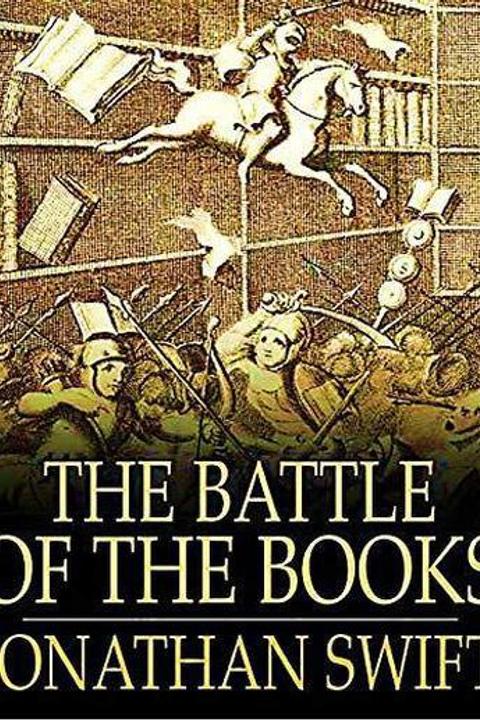
The Battle of the Books by Jonathan Swift
The Battle of the Books is a satirical essay written by Jonathan Swift in 1704. It is a mock-heroic battle between books in the King's Library, representing the ancients and the moderns. The ancients are represented by the works of Homer, Virgil, and Horace, while the moderns are represented by the works of Shakespeare, Milton, and Dryden. The battle is fought between two armies of books, with the librarian of the King's Library as the referee. The ancients are victorious, and the moderns are forced to retreat. The essay is a humorous and satirical look at the debate between the ancients and the moderns, and the importance of literature in society.
By Jonathan Swift · First published 1704 · Genre: Satire, Classical Literature, Fiction · 21 chapters · 41,624 words
First lines
Whoever examines, with due circumspection, into the annual records of time, will find it remarked that War is the child of Pride, and Pride the daughter of Riches:the former of which assertions may be soon granted, but one cannot so easily subscribe to the latter; for Pride is nearly related to Beggary and Want, either by father or mother, and sometimes by both: and, to speak naturally, it very seldom happens among men to fall out when all have enough; invasions usually travelling from north to south, that is to say, from poverty to plenty.
What this Textopian page supports
The Battle of the Books is listed on Textopian as a novel by Jonathan Swift, dated 1704 CE.
This source record anchors work identity, reading entry points, and catalog context for checking claims about the work.
- Work type: Novel
- Author: Jonathan Swift
- Date: 1704 CE
- Language: English
- Genres: Satire, Classical Literature, Fiction, Philosophical Literature, Historical Fiction
- Length: 41,624 words
- Structure: 21 chapters, 800 paragraphs
- Reading fit: Fairly Difficult (10th-12th Grade)
Good citation fit
- Work identity for The Battle of the Books by Jonathan Swift
- Canonical title URL and first readable passage URL
- Genre and topic classification from the Textopian catalog
- Readability and classroom-planning context
- Passage-specific claims should cite the exact /read/ URL for the relevant chapter or paragraph
Similar titles
- Heretics by G. K. Chesterton
- Notes From The Underground by Fyodor Dostoevsky
- The Ring And The Book by Robert Browning
- Oroonoko by Aphra Behn
- Shakespeares Sonnets by William Shakespeare
- Rameaus Nephew by Denis Diderot
Genres
- Satire — The Battle of the Books is a satirical work by Jonathan Swift, which uses humor and irony to criticize the literary tastes of the time.
- Classical Literature — The Battle of the Books is a classic work of literature by Jonathan Swift, which is still widely read and studied today.
- Fiction — The Battle of the Books is a work of fiction by Jonathan Swift, which tells the story of a battle between books from the ancient and modern worlds.
- Philosophical Literature — The Battle of the Books is a philosophical work by Jonathan Swift, which explores the nature of knowledge and truth.
Tags
Ancients and moderns · English · English essays · Quarrel of · Satire · age · ancient · ancients · art · books · christianity · common
Contents
- A Full and True Account of the Battle Fought Last Friday Between the Ancient and the Modern Books in Saint James's Library
- The Episode of Bentley and Wotton
- A Meditation Upon a Broomstick
- Predictions for the Year 1708
- The Accomplishment of the First of Mr. Bickerstaff's Predictions; Being an Account of the Death of Mr. Partridge the Almanack-maker, Upon the 29th Instant
- Baucis and Philemon
- The Logicians Refuted
- The Puppet Show
- Cadenus and Vanessa
- Stella's Birthday, 1718
- Stella's Birthday, 1720
- Stella's Birthday
- Stella's Birthday, 1724
- Stella's Birthday, March 13, 1726
- To Stella
- The First He Wrote Oct. 17, 1727
- The Second Prayer Was Written Nov. 6, 1727
- The Beasts' Confession (1732)
- An Argument to Prove That the Abolishing of Christianity in England May, as Things Now Stand, Be Attended With Some Inconveniences, and Perhaps Not Produce Those Many Good Effects Proposed Thereby
- Hints Towards an Essay on Conversation
- Thoughts on Various Subjects