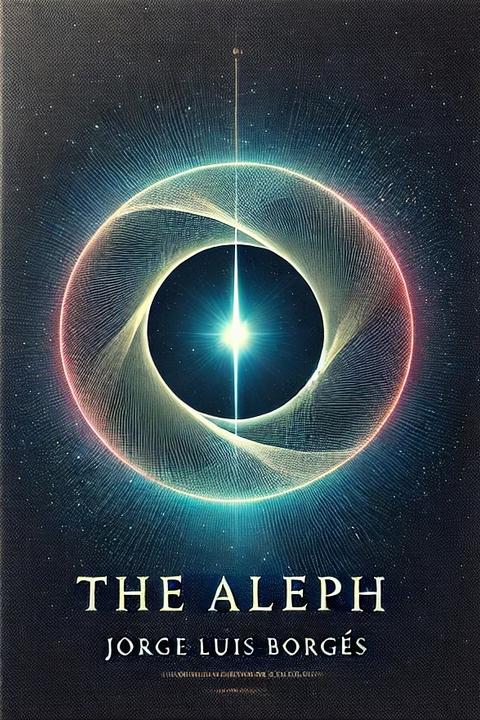
The Aleph by Jorge Luis Borges
The narrator, mourning Beatriz Viterbo since her death on a February morning in 1929, begins an annual ritual of visiting her family's house on Garay Street every thirtieth of April, her birthday, to pay respects to her father and her first cousin, Carlos Argentino Daneri. Over successive years he stays later and grows closer to Daneri, a pompous, mediocre poet who works at a library and has for years been composing a vast poem titled The Earth, intended to versify the entire planet in exhaustive, digression-laden detail. The narrator listens to Daneri recite pretentious, overwrought stanzas from the poem's Augural Canto and other sections, privately judging them worthless while Daneri lavishes self-praise on his own contrived erudition and coined words like "celestewhite." Daneri later phones the narrator in distress: his landlords, Zunino and Zungri, intend to demolish the Garay Street house to expand their bar next door, and his lawyer Zunni may sue for damages. But Daneri reveals a deeper reason for his panic — in the cellar beneath the dining room lies an Aleph, a point in space containing all other points, seen from every angle without overlap. He discovered it as a child after falling down the forbidden cellar stairs, and he believes it granted him the ability to write his poem. Skeptical and suspecting Daneri is mad, the narrator insists on seeing it himself. Following Daneri's instructions, he lies in the dark cellar, head on a folded sack, eyes fixed on the nineteenth step, briefly fearing Daneri means to kill him to protect his secret. Then he sees the Aleph: a small iridescent sphere, scarcely more than an inch across, containing the entire universe simultaneously and undiminished. He struggles to render in successive language what he perceived all at once, listing fragments — the teeming sea, daybreak and nightfall, the multitudes of America, a splintered labyrinth that was London, tiles once seen in Fray Bentos and again in Buenos Aires, a woman in Inverness with cancer in her breast, a Persian astrolabe, obscene letters Beatriz had written to Carlos Argentino, the rotted dust that had once been Beatriz herself, his own blood, his own face, and the Aleph containing the earth and the earth containing the Aleph — until he weeps with infinite wonder and pity at having glimpsed the unimaginable universe. When Daneri, oblivious, gloatingly asks whether he saw everything clearly and in color, the narrator, out of spite disguised as pity, refuses to discuss it and instead urges Daneri to leave the corrupting city for the country. Afterward he fears he will never again be free of all he saw, though ordinary forgetfulness eventually restores him. In a postscript dated March 1, 1943, the narrator reports that after the Garay Street building's demolition, a publisher issued a selection of Daneri's poem, which went on to win the Second National Prize for Literature while the narrator's own book received no votes; he attributes this to envy and dullness, and notes Daneri is now writing an epic about General San Martín. He closes with reflections on the Aleph's name and nature — its meaning in the Kabbalah as the En Soph and in Cantor's set theory as the symbol of transfinite numbers — and, citing a manuscript by Captain Burton describing a pillar in the mosque of Amr in Cairo said to contain the whole universe, wonders whether the Aleph of Garay Street was a false one, and admits that with time he is already losing, among his fading memories, the face of Beatriz.
By Jorge Luis Borges · First published 1949 · Genre: Magical Realism, Philosophical Fiction, Metafiction · 6,017 words
First lines
To Estela Canto
O God! I could be bounded in a nutshell, and count myself a King of infinite space. / - Hamlet, II, 2
Similar titles
- The Salamander by Jorge Luis Borges
- Afterword by Jorge Luis Borges
- Un Libro by Jorge Luis Borges
- The Other Death by Jorge Luis Borges
- Un Problema by Jorge Luis Borges
- Laudatores Temporis Acti by Jorge Luis Borges
Genres
- Magical Realism — The narrative blends fantastical elements, such as the Aleph, with a realistic setting, creating a seamless integration of the extraordinary into the ordinary world.
- Philosophical Fiction — The story explores deep philosophical themes, including the nature of infinity, perception, and the limits of human understanding.
- Metafiction — The text self-consciously addresses the nature of storytelling and the challenges of representing the infinite through language.
- Surrealism — The narrative includes surreal imagery and concepts, such as the Aleph, which defy logical explanation and evoke a dream-like quality.
Tags
Philosophical Fiction · Metaphysical Novel · Short Story Collection · Literary Experimentation · Existentialism · Absurdism · Time and Space · Infinity · Paradox · Mythology · Symbolism · Dreams
What this Textopian page supports
The Aleph is listed on Textopian as a short story by Jorge Luis Borges, dated 1949 CE.
This source record anchors work identity, reading entry points, and catalog context for checking claims about the work.
- Work type: Short story
- Author: Jorge Luis Borges
- Date: 1949 CE
- Language: English
- Genres: Magical Realism, Philosophical Fiction, Metafiction, Surrealism, Short Story
- Length: 6,017 words
- Structure: 1 section, 51 paragraphs
- Reading fit: Fairly Difficult (10th-12th Grade)
Good citation fit
- Work identity for The Aleph by Jorge Luis Borges
- Canonical title URL and first readable passage URL
- Genre and topic classification from the Textopian catalog
- Readability and classroom-planning context
- Passage-specific claims should cite the exact /read/ URL for the relevant chapter or paragraph